
Ah, the great visa stream showdown! If you're wondering which subclass 482 visa path to take, you're not alone. Yes, both Core Skills and Specialist Skills visa streams get you to the same sunny destination – legally working in Australia with a potential path to permanent residency. But they're like choosing between two different airlines to get to the same destination with slightly different experiences along the way.
When Australia introduced the Skills in Demand visa (subclass 482), they promised to simplify things.1 And they did… kind of. It's like when your friend says they “tidied up” but really just organized their mess into neater piles. You've still got decisions to make between Core Skills and Specialist Skills streams, and let me tell you, choosing the wrong one can mean wasted time, money, and quite possibly, sanity.
Let me break down these options and hopefully, by the time you finish reading, you'll actually understand the difference. For a broader overview of the entire visa program, check out my complete Skills in Demand visa guide.
⏱️ Article Summary
The Core Skills stream requires your occupation on the CSOL list and $76,515 minimum salary (from July 2025), with 68-day average processing. The Specialist Skills stream needs $135,000+ salary with 39-day processing but no occupation list restriction. Both lead to permanent residency after 2 years via employer sponsorship.
Disclaimer: This information is current as of May 2025 but immigration policies may change. Always check the Department of Home Affairs website for the most up-to-date information and consult with a registered migration agent for personalized advice.
Core Skills Stream: The Mainstream SID Visa Pathway
Think of the Core Skills Stream, also known as the Core Skills Occupation List (CSOL) Stream, as the sensible sedan of visa options. It's reliable, gets the job done, and works for a wide range of professionals. This stream is designed for people whose occupations appear on Australia's shopping list of needed skills – formally called the Core Skills Occupation List (CSOL) (currently listing 456 occupations).2
Does the CSOL Include Your Occupation?
The Core Skills visa stream is all about what you do, not how much you get paid for doing it. Australia essentially says, “We need nurses, teachers, engineers, and IT folks – if that's you, come on over!”
The government regularly updates this list based on which professions are experiencing shortages. Right now, it includes a bunch of occupations across different sectors:
- Healthcare (nurses, medical techs, therapists)
- Education (teachers who don't mind wrangling Australian kids)
- Construction (project managers, civil engineers)
- Technology (software engineers who aren't allergic to sunshine)
- Trades (electricians, plumbers, and others who know which end of a tool is which)
Check the current list on the Department of Home Affairs website rather than take my word for it. These lists change often.
Core Skills Stream Eligibility Requirements
Ready for the nitty-gritty? Here's what you need to qualify:
The Occupation List Game
- Occupation requirement: Your job needs to be on the CSOL (I know, shocking revelation)
- Qualification check: You actually need to be qualified for that job (no faking it till you make it here)
- Skills verification: For many occupations, an Australian authority needs to verify your skills – kind of like having your professional life peer-reviewed
Employer Sponsorship Stuff
- Sponsor approval: An Australian employer needs to put their hand up and say, “Yes, I'll take this one!
- Role matching: The role should match what you're qualified to do (no sponsoring rocket scientists to flip burgers)
- Labor market testing: Your employer needs to prove they tried to find a local but, alas, had to resort to importing talent like yourself
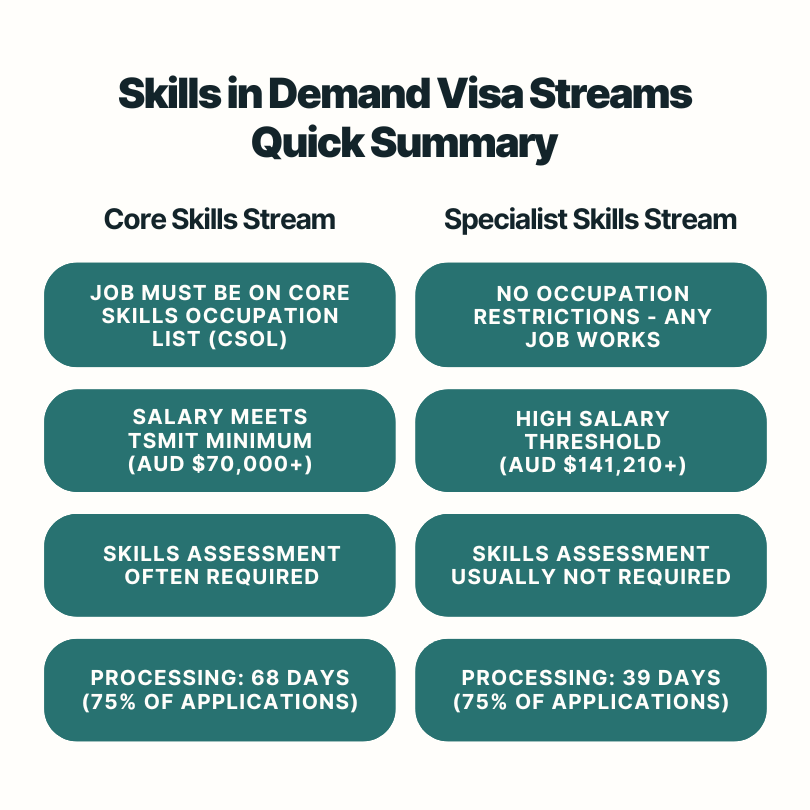
- Salary threshold: Your salary must meet the Temporary Skilled Migration Income Threshold (TSMIT) of at least AUD $70,0003 – this is the absolute minimum regardless of occupation, with the Core Skills Income Threshold (CSIT) set to increase to AUD $76,515 from July 1, 2025.4
Understanding what employers must do to sponsor you helps you better approach potential sponsors. Check the Department of Home Affairs employer information for official requirements.
English Skills
- Test requirement: You'll need an IELTS score of 5.0 overall (at least 4.5 in each band)5 or equivalent scores in other tests like TOEFL, PTE, or Cambridge
- Exemptions: Americans, Brits, Irish, Canadians, and Kiwis get to skip this6 – one of the few perks of being from an English-speaking country
Age Factor
- Age limit: They don't explicitly say it everywhere, but being under 45 is generally expected
- Exceptions: Exceptions exist, but they're about as common as a cool day in Darwin during summer
Health and Character
- Medical check: Pass a medical exam (don't worry, it's not as invasive as the TSA)
- Background check: Provide police clearances proving you haven't been an international person of mystery (the bad kind)
You'll need to gather extensive documentation including proof of identity, qualifications, and work experience. I have a post all about SID visa documentation requirements.
Core Skills Stream Pros and Cons
✅ The Good Stuff
- Occupation variety: Lots of eligible occupations, from architects to zoologists
- PR pathway: Clear path to permanent residency after 2 years7
- Affordability: Salary requirements aren't as eye-watering as the Specialist Stream
- Healthcare: Access to Medicare so you don't need to sell a kidney to see a doctor
❌ The Less Good Stuff
- Limited scope: Limited to occupations on The List™️
- Assessment hassle: Skills assessment can be time-consuming and about as fun as a root canal
- Slower timeline: Processing times can be longer than the Specialist Stream
- Job constraints: Less flexibility with your job terms
Core Skills to Permanent Residency Pathways
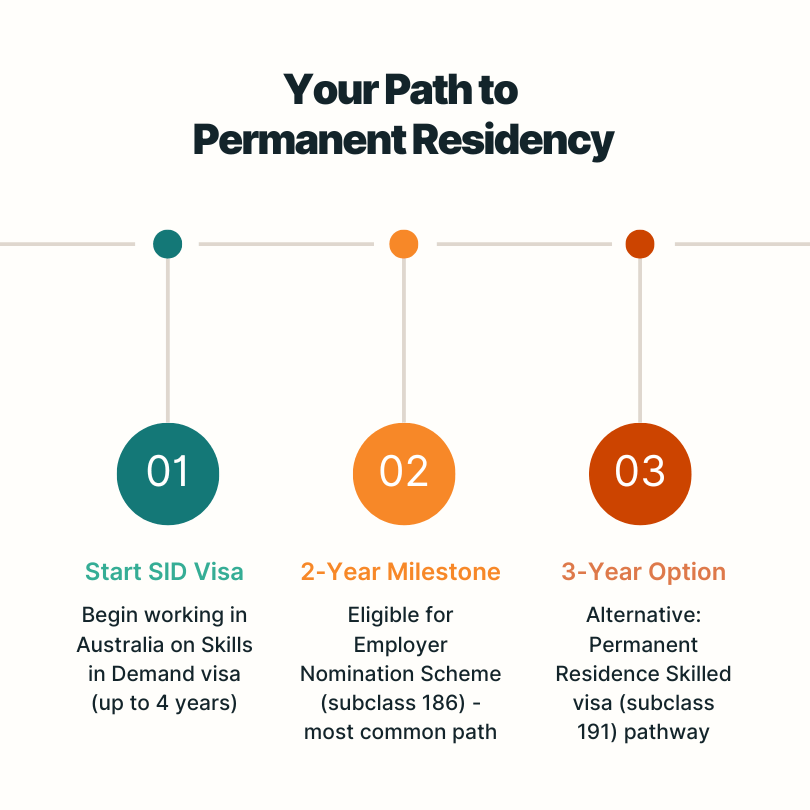
After you've spent enough time being a model temporary resident (and developed a taste for Vegemite), you can apply for a permanent residency visa (detailed permanent residency pathways from SID visa):
- Work for your sponsor for 2 years and you can apply for the Employer Nomination Scheme (subclass 186) visa8
- Or hang in there for 3 years and try for the Permanent Residence (Skilled) visa (subclass 191)9
- There's also the Skilled Independent visa (subclass 189) if you rack up enough points
I know, the visa numbers make about as much sense as Australian slang did to me when I first arrived. Just remember that the 186 is the one most people aim for after 2 years.
Is the Core Skills Stream Right for You?
The Core Skills Stream is perfect for:
- People with traditional careers that have clear qualifications
- Healthcare workers, teachers, and trades who are in demand
- Mid-career professionals who aren't commanding mega salaries (yet)
- Anyone who looks at the specialist salary threshold and thinks “Ha! In my dreams!”
- People planning to settle in Australia long-term
Specialist Skills Stream: High Salary Requirements
If the Core Skills Stream is a sensible sedan, the Specialist Skills Stream (also called the High-Earning Stream) is more like a luxury sports car – faster, fewer restrictions, but with a hefty price tag attached. This stream focuses on how much someone is willing to pay you rather than what specific job you do.
Specialist Skills Stream Definition and Requirements
Unlike the Core Skills Stream, this path doesn't care if your job is on any list.10 Australia's logic here is brilliantly simple: “If someone's willing to pay you a small fortune, you must be pretty good at what you do!”
This approach recognizes that:
- Market forces are pretty good at identifying valuable skills (money talks)
- Some specialized roles don't fit neatly into traditional job categories
- New and emerging fields need pathways too (Australia hasn't yet created a job category for “TikTok Algorithm Specialist”)
While there are no occupation restrictions, this stream typically attracts:
- Corporate big shots (people who use words like “synergy” unironically)
- Tech specialists (the folks who make the internet actually work)
- Financial wizards (people who understand what cryptocurrency actually is)
- Senior engineers and scientists (rocket science is actually applicable here)
- Consultants (those mysterious people who make PowerPoints and charge a fortune)
Specialist Skills Salary Threshold Requirements
The defining feature of the Specialist Skills visa stream is the salary threshold of AUD $141,21011 (as of May 2025):
- You need to be earning at least AUD $141,210 annually (that's about USD $93,800 depending on what the exchange rate is)
- This magic number changes every July when the government reassesses
- It has to be genuine salary, not “We'll pay you $50K but wink-wink there's another $85K in gift cards”
- Only base salary counts – not superannuation (Australia's retirement system) or other benefits
This threshold serves several purposes:
- It ensures Australia is getting the cream of the crop
- It simplifies the process by using salary as a proxy for value
- It lets the government skip some of the more tedious verification steps
⚠️ Important note: This threshold changes annually. Always check the Department of Home Affairs website for the current figure, or you might be in for a rude awakening.
Specialist Skills Stream Pros and Cons
✅ The Good Stuff
- Occupation freedom: Not restricted by occupation lists, perfect for those in niche or emerging fields, if well-paid
- Faster processing: Generally faster processing12 (express lane privileges)
- No age limit: No specific age limitations (midlife career change? No problem!)
- Less paperwork: May not need skills assessment (saving you time, money, and sanity)
- PR pathway: Clear path to permanent residency after 2 years
❌ The Less Good Stuff
- High cost barrier: That salary threshold is no joke (AUD $141,210+)
- Salary maintenance: You need to maintain that salary level (no post-arrival pay cuts)
- Sponsor requirement: Still needs employer sponsorship (you can't sponsor yourself, unfortunately)
- Profession exceptions: Certain regulated professions still need skills assessment (sorry, doctors)
Specialist Skills to Permanent Residency Pathways
Just like its Core Skills counterpart, this stream leads to permanent residency.
- After 2 years with your sponsor, you can apply for the Employer Nomination Scheme (subclass 186) visa
- Or wait 3 years for the Permanent Residence (Skilled) visa (subclass 191)
The big advantage here is that applications through this stream often get priority processing – kind of like having TSA PreCheck while everyone else is still taking off their shoes.
Is the Specialist Skills Stream Your Best Option?
The Specialist Skills Stream is perfect for:
- Mid to senior-career professionals who command top dollar
- People with niche skills that don't fit traditional categories
- Anyone seeking faster processing and fewer hurdles
- Workers in high-demand sectors like tech and finance
- People who are comfortable negotiating a higher salary
482 Visa Comparison: Core Skills vs Specialist Skills
Financial Note: All costs listed are in Australian Dollars (AUD) and are current as of May 2025. Currency conversions to USD are approximate. Always check the Department of Home Affairs fee schedule for the most current fees.
Let's compare Core Skills vs Specialist Skills streams in a way that makes sense. Think of this as your cheat sheet for when your brain starts to melt from information overload:
| Feature | Core Skills Stream | Specialist Skills Stream |
| The Big Requirement | Job on the Core Skills List | Big salary (AUD $141,210+) |
| Who It's For | People in jobs Australia needs | Specialists who earn the big bucks |
| How Long It Lasts | Up to 4 years | Up to 4 years |
| Path to Permanent | After 2 years (186) or 3 years (191) | After 2 years (186) or 3 years (191) |
| English Skills Needed | IELTS 5.0 overall (min 4.5 each band) | IELTS 5.0 overall (min 4.5 each band) |
| Age Factor | Usually under 45 years | No specific age limit |
| Skills Assessment | Required for many occupations | Only for regulated professions |
| Processing Speed | 68 days (75% of applications)13 | 39 days (75% of applications)14 |
| Application Cost | Base fee: AUD $1,33015 | Base fee: AUD $1,330 |
| Sponsorship | Yes, you need an employer | Yes, you need an employer |
| Job Flexibility | Stuck in your nominated role | Stuck in your nominated role |
| Best Suited For | Traditional careers with clear qualifications | Specialized roles with fat paychecks |
| If You Lose Your Job | 180 days to find new sponsor16 | 180 days to find new sponsor |
⏰ Processing Time Note: Processing times fluctuate based on application volumes and policy changes. The times listed were accurate as of May 2025 according to the Global Visa Processing Times page. Always check current processing times on the Department of Home Affairs website.
⚠️ Important note: Application costs are as accurate as my memory of where I parked at the shopping center (pretty good, but you should still double check). Always check the Department of Home Affairs fee schedule for up-to-date information before you start counting your pennies.
Labour Agreement Stream: Alternative 482 Visa Pathway
There's actually a third stream that doesn't get as much attention as the popular kids. The Labour Agreement SID Visa Stream is like that quirky alternative route that only locals know about.
This path works through custom deals between employers and the Australian government.17 It's designed for unique situations that don't fit the standard molds, like:
- Industry-wide shortages (when an entire sector is desperate)
- Regional areas (where the population sign says “Welcome to [Town Name], Population: Not Enough”)
- Jobs needing specific cultural or language skills
- Innovative businesses with peculiar needs
These agreements are individually negotiated and can include special terms like:
- Custom occupation lists
- Different English requirements
- Modified salary thresholds
- Special training commitments
For the full scoop on Labour Agreements, check out the official Department of Home Affairs Labour Agreement page.
Which Stream Is Right For You? A Decision Framework
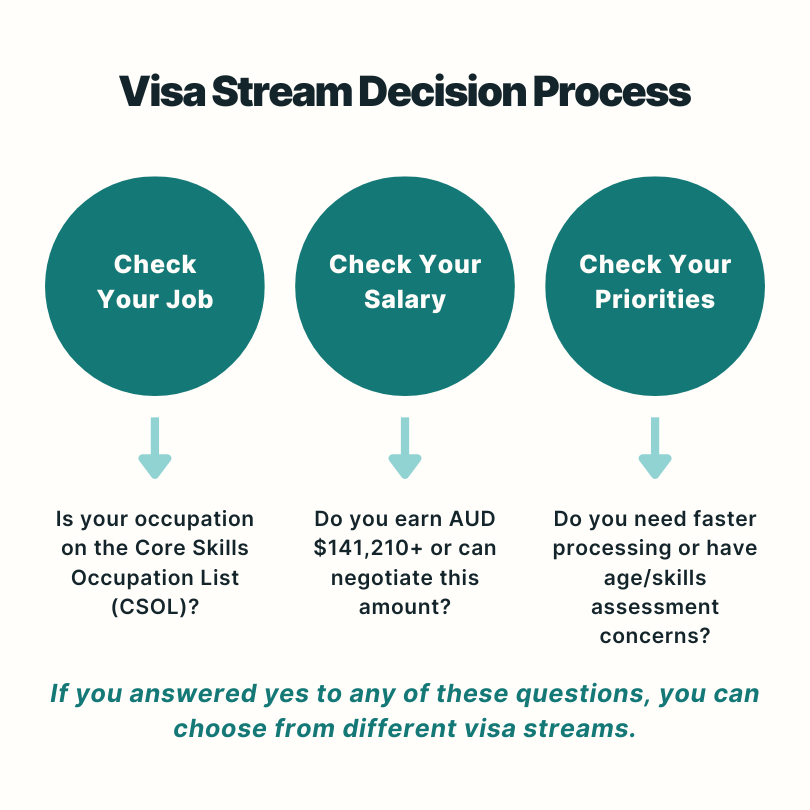
Choosing between Core Skills and Specialist Skills streams is a bit like those choose-your-own-adventure books we read as kids, except with more paperwork and higher stakes. Let's walk through the decision process:
Questions for Choosing Your Stream
- Is your job on the Magic List (CSOL)?
- Yes: Core Skills Stream is on the table
- No: Specialist Skills Stream is your main option (unless you fancy a career change)
- Is your salary in the six-figure club (AUD $141,210+)?
- Yes: Specialist Skills Stream is available to you
- No: Core Skills Stream it is (or time to negotiate that raise)
- Are you over 45?
- Yes: Specialist Skills Stream might be more accommodating
- No: Both paths welcome your youthful energy
- Are you in a rush?
- Yes: Specialist Skills Stream typically moves faster
- No: Either stream works if you're not counting days
- Does your profession need formal assessment?
- Yes: Factor in the time and cost for either path
- No: One less thing to worry about!
- Is your job highly specialized or unusual?
- Yes: Specialist Skills Stream better recognizes unique talents
- No: Core Skills Stream has a well-trodden path for traditional roles
Strategic Considerations for Your 482 Visa Choice
Beyond the basic questions, here are some chess moves to consider:
- Salary Negotiations: If you're close to the Specialist threshold, that extra few thousand might be worth more than just the money – it could mean a faster visa path.
- Career Trajectory: Which stream positions you better for your Australian career? A role that aligns perfectly with the Core Skills list might offer more local recognition.
- Family Planning: Both streams allow family members to join you with similar benefits, so no difference there.
- Application Timing: Immigration priorities shift like sand dunes. Check current processing times before committing.
- Regional Considerations: In some cases, working in regional Australia provides additional advantages.
Example Scenario: Raj Software Developer 482 Visa Choice
Nothing beats an example to help better understand something complicated. This example is complete fiction. Its only purpose is to help explain the difference between the two SID visa streams.
Raj is a Software Developer from San Francisco with 10 years experience.
Raj received offers from two Australian tech companies:
- Company A: Offered AUD $130,000 for a Senior Developer position
- Company B: Offered AUD $150,000 for a similar role
Raj's 482 Visa Stream Options
Raj found himself at a decision point that many skilled professionals face. Both offers were solid, but they pointed to different visa streams:
- The AUD $130,000 offer qualified for the Core Skills Stream (Software Developer was on the CSOL)
- The AUD $150,000 offer qualified for the Specialist Skills Stream
Raj's Pros and Cons List
Raj, being the analytical developer he is, created a spreadsheet of factors:
- Processing Speed: His research showed Specialist Skills applications were getting priority, with processing about 2-3 weeks faster than Core Skills applications.
- Skills Assessment: As a tech professional, he'd need an Australian Computer Society assessment for the Core Skills Stream – about AUD $850 and 8-12 weeks of waiting while someone decided if his Stanford degree and Silicon Valley experience were “adequate.”
- Company Comparison: Both were solid companies with good reputations. Company B was slightly larger with more international employees (meaning they probably had more experience with visa processes).
- Future Growth: Both roles offered similar career advancement and both companies had successfully sponsored employees for permanent residency.
- Show Me The Money: The AUD $20,000 difference was nothing to sneeze at – about 15% more compensation.
Raj's Decision
After weighing his options (and several sleepless nights), Raj went with Company B's offer for several reasons:
- The higher salary qualified him for the Specialist Skills Stream
- This stream typically had faster processing
- His new employer was an Accredited Sponsor, further speeding things up
- The higher salary would help with Sydney's not-insignificant cost of living
- The role still provided a clear path to permanent residency after 2 years
Raj's Outcome: Specialist Skills Stream Results
Raj's application was processed in just 6 weeks – significantly faster than the average for Core Skills applications at that time. The quicker timeline meant he could:
- Give notice to his current employer with actual confidence
- Make definite (not tentative) plans for his move
- Start his new job without delays
The higher salary also helped offset the shock of Sydney rental prices and funded weekend trips exploring Australia.
The Lesson from Raj's Experience
While money matters, Raj's decision wasn't just about the extra dollars. The faster processing through the Specialist Skills Stream significantly reduced his stress and uncertainty, allowing for better planning and a smoother transition.
His case shows that the stream selection impacts not just your eligibility, but your entire migration experience and timeline. Sometimes, the path with fewer administrative headaches is worth its weight in gold (or Australian dollars).
482 Visa FAQs: Core Skills vs Specialist Skills
Making Your Final Decision
Choosing between the Core Skills Stream and Specialist Skills Stream for your Australian work visa isn't just checking boxes on a form – it's about finding the path that best fits your situation, career, and life plans.
Your Next Steps: Core or Specialist Skills
If the Core Skills Stream is calling your name:
- Check eligibility: Double-check the current CSOL (it changes more often than you'd think)
- Research requirements: Figure out if you need a skills assessment for your occupation
- Start early: Start the skills assessment process early if required (seriously, these take forever)
- Prepare language proof: Make sure your English test scores meet requirements (even if English is your first language, test formats can be tricky)
If you're headed for the Specialist Skills Stream:
- Confirm salary: Verify your salary offer meets the current threshold
- Check exceptions: Check if your occupation requires skills assessment despite the salary level
- Document details: Ensure your employment contract clearly documents your salary arrangement
- Demonstrate value: Gather evidence showing why your role deserves the big bucks
Remember that both streams:
- Allow you to bring your family along for the adventure
- Offer paths to permanent residency
- Include the 180-day safety net if you need to change employers
Official Government Information
- Department of Home Affairs – Skills in Demand Visa (Subclass 482) – Official visa information including eligibility, requirements, and application processes
- Core Skills Occupation List (CSOL) – Current Skills List – The official, up-to-date list of 456 eligible occupations for the Core Skills Stream
- Fee Schedule – Current Visa Pricing – All visa costs including primary applicant, additional applicants, and sponsorship fees
- Processing Times – Global Visa Processing Times – Current processing statistics for all visa types including Core Skills (68 days) and Specialist Skills (39 days)
- Labour Agreements – Labour Agreement Information – Details on custom agreements between employers and the government
- Regional Migration – Regional Migration – Information about regional visa advantages and area definitions
Skills Assessment Authorities
- Australian Computer Society (ACS) – Skills Assessment – For IT professionals and software developers
- Engineers Australia – Skills Assessment – For all engineering disciplines
- Trades Recognition Australia (TRA) – Skills Assessment – For trades and technical occupations
- Australian Institute of Management (AIM) – Skills Assessment – For management positions
Community Resources & Forums
- Reddit Australia Immigration – r/AusImmi – Discussions and first-hand experiences from visa applicants and holders
- LinkedIn Groups – Australia Immigration Network – Professional networking for skilled migrants
Professional Services
- Migration Institute of Australia – Find a Migration Agent – Directory of registered migration agents
- Law Council of Australia – Find a Migration Lawyer – Database of specialized migration attorneys
- Your Investment Property – Regional Property Guide – Information on regional housing markets for those considering regional visas
- Department of Home Affairs. (2024, December 7). Skills in Demand visa (subclass 482). Retrieved from https://immi.homeaffairs.gov.au/visas/getting-a-visa/visa-listing/skills-in-demand-visa-subclass-482 ↩︎
- “This is Australia,” Skills in Demand (SID) Visa (Subclass 482), December 13, 2024, https://www.thisisaustralia.com/work-visas/skills-in-demand-visa-subclass-482/ ↩︎
- Visa Envoy, “TSMIT Temporary Skilled Migration Income Threshold,” February 27, 2025, https://visaenvoy.com/tsmit-70k/ ↩︎
- One Planet Migration Law, “New Skills in Demand Visa Salary Thresholds from 1 July 2025: What Employers Need to Know,” March 27, 2025, https://www.oneplanetmigrationlaw.com.au/immigration-blog/new-skills-in-demand-visa-salary-thresholds-from-1-july-2025-what-employers-need-to-know ↩︎
- IELTS Australia, “Skills in Demand visa (subclass 482) and IELTS requirements,” December 17, 2024, https://ielts.com.au/australia/about/news-and-articles/article-skills-in-demand-visa ↩︎
- Study English in Australia, “Australian Visa English Language Requirements Guide 2024,” accessed May 11, 2025, https://studyenglishinaustralia.com/en/post/3677-Navigating-the-English-Language-Requirements-for-Australian-Visas-in-2024 ↩︎
- KPMG, “Australia – Further Information on Introduction of Skills in Demand Visa,” December 9, 2024, https://kpmg.com/xx/en/our-insights/gms-flash-alert/flash-alert-2024-243.html ↩︎
- Immagine Immigration, “482 Visa | Skills in Demand Visa (2025),” accessed May 11, 2025, https://immagine-immigration.com/articles/skills-in-demand-visa/ ↩︎
- Terratern, “Australia Skills in Demand Visa for Indians: Latest Guide 2025,” March 3, 2025, https://terratern.com/blog/australia-skills-in-demand-visa/ ↩︎
- MinterEllison, “New Skills in Demand visa and Core Skills Occupation List,” December 8, 2024, https://www.minterellison.com/articles/delays-to-governments-new-skills-in-demand-visa ↩︎
- Absolute Immigration, “Increase in Income Thresholds under Sponsored Visas,” March 26, 2025, https://absoluteimmigration.com/news/increase-in-income-thresholds-under-sponsored-visas ↩︎
- Visa Envoy, “Skills in Demand Visa,” January 20, 2025, https://visaenvoy.com/skills-in-demand-visa/core-skills-pathway/ ↩︎
- Travelobiz, “Australia Raises Work Visa Income Thresholds: What Changes from July 2025?,” April 10, 2025, https://travelobiz.com/australia-work-visa-income-thresholds-july-2025-changes/ ↩︎
- Corporate Immigration Partners, “Australia: Skilled Visa Salary Thresholds to Rise July 2025,” April 8, 2025, https://corporateimmigrationpartners.com/australia-skilled-visa-salary-thresholds-to-rise-july-2025/ ↩︎
- Department of Home Affairs, “Fee Schedule,” Australian Government, accessed May 11, 2025, https://immi.homeaffairs.gov.au/visas/getting-a-visa/fees-and-charges/current-visa-pricing ↩︎
- The Sector, “Australia's new visa for in demand skills,” February 24, 2025, https://thesector.com.au/2025/02/24/what-ecec-centres-need-to-know-about-australias-new-skills-in-demand-visa/ ↩︎
- Department of Home Affairs, “Labour Agreements,” Australian Government, accessed May 11, 2025, https://immi.homeaffairs.gov.au/visas/employing-and-sponsoring-someone/sponsoring-workers/nominating-a-position/labour-agreements ↩︎