
Creating compelling application materials is a critical step between finding potential sponsors and securing your visa. You've identified potential sponsors and understand what they need to do to sponsor you.
Now comes the crucial part: convincing them that you're worth the investment.
Standing out when sponsorship is required means creating an application compelling enough to overcome the additional costs and paperwork involved.
As employers review your application, they're weighing your qualifications against the legal requirements and costs for visa sponsorship.
When my husband and I moved to Australia in 2008 on a subclass 457 work sponsored visa (which the Skills in Demand visa has now replaced)1, I learned firsthand how different the Australian employment process can be.
As the secondary applicant on his visa, I had to adapt to Australian job application standards to secure my own position. Based on this experience and my years helping others plan their moves to Australia, here are some strategies that can help your application stand out.
⏱️ Quick Article Summary
Australian sponsorship applications differ significantly from US standards. Resumes should be 2-4 pages (not one), address sponsorship directly in your first cover letter paragraph, and include a business case showing ROI that offsets the $3,000-5,000 sponsorship cost. Prepare for sponsorship-specific interview questions about commitment and value. Complete visa process takes 3-6 months from sponsorship approval to visa grant.
⚠️ Application Advice Disclaimer: This article provides general information only. Application strategies and employer preferences may vary. Always tailor your approach to specific positions and companies, and consider consulting with a career specialist familiar with Australian recruitment practices.
💵 Quick note about currency: All costs listed are in Australian dollars (AUD). When you see “$” it means Australian dollars, not US dollars.
Australian Resume for Visa Sponsorship
When I was looking for work in Sydney, I discovered how different Australian resumes can be compared to American ones2.
Even though I wasn't seeking sponsorship (since I was on my husband's visa), I had to rethink my application approach.
Your standard American resume will fall flat with Australian employers. Australian resumes (or CVs, as employers call them) differ from American ones, and adapting your resume is your first critical step.
Australian CV vs American Resume: Critical Differences Employers Notice Instantly
| American Resume | Australian CV |
| Usually 1 page | Often 2-4 pages |
| “Resume” is standard term | “CV” and “resume” used interchangeably |
| Objective statement common | Professional summary/profile preferred |
| Focus on responsibilities | Focus on achievements with metrics |
| References listed | “References available upon request” or none |
| Often includes personal details | No photos, marital status, or age |
| Chronological format dominant | Combination formats more accepted |
| Education often comes first | Work experience often comes first |
When applying for sponsorship, follow Australian conventions. An American-style resume signals unfamiliarity with local workplace norms – not a great first impression when you're asking them to invest thousands in your visa!
🔗 For more details on what Australian employers look for in sponsored candidates, see my article about understanding employer sponsorship requirements.
Australian Resume Structure: 7 Required Sections
Your Australian resume should follow this clear structure:
- Contact information – Name, phone, email, LinkedIn (no street address)
- Professional summary – 3-4 sentences highlighting key skills and experience
- Key skills – Bulleted list of relevant technical and soft skills
- Professional experience – Detailed work history with achievements
- Education – Qualifications with dates and institutions
- Professional development – Relevant certifications and training
- Additional information – Languages, work eligibility (mention visa sponsorship here)
Unlike in the US, Australian resumes can be 2-4 pages long. Don't cram everything onto one page. I have no idea how anyone with multiple years experience could fit it all in one page anyway. It makes you look less experienced to Australian employers.
Australian government and some corporate jobs may require addressing “Selection Criteria” – formal requirements listed in job descriptions (like KSAs – Knowledge, Skills, and Abilities – in US federal government applications).
When included, you must respond to each criterion with concrete examples demonstrating your qualifications. You submit this as a separate document alongside your resume and cover letter.
Resume Achievement Statements for Sponsorship Applications
The most critical shift is moving from responsibility-focused content to achievement-focused content. Transform every bullet point to emphasize results, not duties.
How to Write Achievement Statements: Action Verb + Specific Task + Measurable Result
Before (Responsibility-focused): “Responsible for managing a team of five developers”
After (Achievement-focused): “Led a team of five developers to deliver three major product releases, reducing development time by 20% through improved processes”
When applying for sponsorship, your achievements should address skills shortages and capabilities that local candidates may not possess. Highlight any niche expertise in areas where Australia lacks talent.
Cover Letter for Australian Visa Sponsorship: What to Include
The best sponsorship cover letters address the visa question while emphasizing your unique value. This strategy prevents employers from viewing sponsorship as a deal-breaker.
Your cover letter should:
- Acknowledge the sponsorship requirement upfront
- Highlight skills that appear on Australia's shortage lists
- Emphasize commitment to ongoing contribution
- Explain why you're worth the additional effort of sponsorship
- Demonstrate knowledge of the sponsorship process
Keep your cover letter to one page, 350-400 words. Australian employers appreciate concise, well-structured letters that get straight to the point.
How to Address Visa Sponsorship in Your Cover Letter
Mention sponsorship in the first or second paragraph. This gets it out in the open and allows you to focus the rest of your letter on why it's worth it for them.
Hiding this information until later wastes everyone's time.
Effective Sponsorship Request Phrases:
| Do | Don't |
| “As an experienced mobile developer with expertise in AR applications, skills currently in shortage in Australia, I'm seeking sponsorship opportunities with forward-thinking companies like yours.” | “I need visa sponsorship to work in Australia.” |
| “While I understand the additional considerations involved in sponsoring an international employee, my niche experience in [skill] addresses your current needs.” | “I hope you will sponsor my visa despite the extra work involved.” |
| “I am authorized to work in the US and would require Skills in Demand visa (SID visa) sponsorship to join your team in Australia, which I'm confident would be a worthwhile investment given my proven track record in [relevant achievement].” | “I cannot work in Australia without sponsorship but hope you'll consider me anyway.” |
🔗 Looking for strategies to identify companies more likely to sponsor? Check out my resource on how to identify companies likely to sponsor your visa.
Making the Business Case for Sponsorship in Your Cover Letter
Your cover letter should begin building a clear business case for your sponsorship by addressing how your skills offset the cost and effort involved.
Sample Business Case Paragraph:
“My six years of experience working with [specific technology] would allow [Company] to launch its planned expansion into [area] without the 3-6 month local training period, accelerating revenue generation by about 90 days. With Australian companies reporting difficulty finding local talent in this niche area, sponsorship represents an efficient path to securing these critical skills.”
Let's be honest. Your cover letter is just the introduction to your value proposition. The goal is to get them interested enough to interview you, where you can make your full case in person.
Convince Australian Employers to Sponsor Your Visa: Overcoming Objections
Understanding and proactively addressing employer concerns about sponsorship can make or break your application. These concerns typically focus on costs, complexity, and perceived risks.
| Employer Concern | How to Address It |
| “Sponsorship is too expensive” | Highlight skills that offset costs through productivity or revenue generation |
| “The process is too complicated” | Offer research on streamlined processes and resources available |
| “You might leave after we invest in sponsorship” | Emphasize commitment to Australia and multi-year career goals |
| “We've never sponsored before” | Provide information about the process and suggest migration agent referrals |
| “What if you don't work out?” | Discuss trial periods or contract-to-permanent arrangements |
| “We can find these skills locally” | Highlight niche expertise or experience that's rare in the Australian market |
| “We can't justify the additional cost” | Quantify your value with concrete examples of past achievements |
Employers must complete Labour Market Testing (LMT) before sponsoring a foreign worker. This testing requires advertising the position locally for at least 28 days within 4 months before nominating you3.
You can help by acknowledging this requirement and providing evidence that local employers find your skills genuinely difficult to source.
🔗 To understand employer costs and obligations in detail, read my breakdown of what Australian employers need to do to sponsor foreign workers.
Australian Sponsorship Interview: Questions & Answers
Preparing for sponsorship-specific questions is crucial for interview success. You'll need to anticipate and practice responses to common sponsorship concerns.
These questions trip up many qualified candidates because they didn't prepare for them.
Common Australian Sponsorship Interview Questions
Q: Why do you want to work in Australia?
A: Australia is leading innovation in [your industry], with excellent work in [area relevant to your skills]. I've followed [company name]'s work in [specific project], and see an opportunity to contribute my experience in [area of expertise]. Australia's emphasis on work-life balance and collaborative work culture also aligns with my professional values.
Q: Why should we sponsor you instead of hiring locally?
A: I can hit the ground running from day one with [niche skill/technology].You won't need to spend months training someone or waiting for them to get up to speed. I know you're looking at sponsorship costs, and I get that it's a significant investment. I've done my homework on this process. I'm confident that what I bring to the table will pay for itself pretty quickly through [specific contribution you can make].
Q: How long do you plan to stay in Australia?
A: I'm looking to build an ongoing career in Australia.I see this position as an opportunity to grow with [company] over the coming years and potentially pursue permanent residency options in the future. I've thoroughly researched living in Australia and am committed to establishing myself professionally there.
⚠️ Important: Be prepared to discuss your salary expectations. Research current salaries for your role in Australia using resources like PayScale Australia or the Australian Government's Job Outlook.
Remember that Australian employers often quote salaries as annual packages including superannuation (retirement savings, similar to a 401(k) in the US).
Sponsorship Interview Preparation Checklist
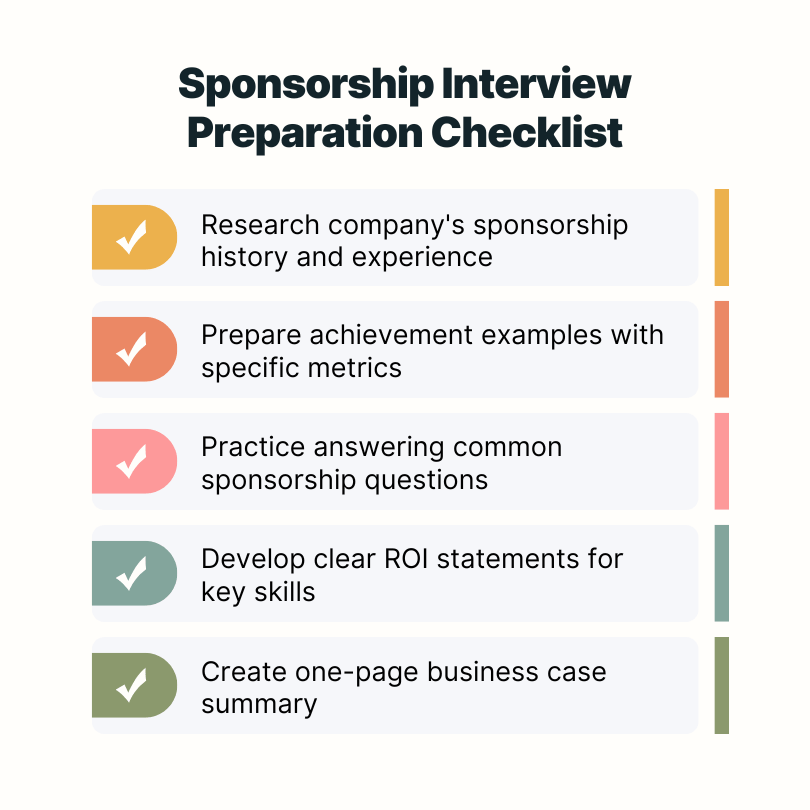
Before your interview, prepare these critical elements:
- Research the company's history with sponsorship (if available)
- Prepare concise examples of your achievements with metrics
- Develop clear ROI statements for key skills you bring
- Research current Australian salary ranges for your position
- Practice answering common sponsorship questions
- Prepare questions about their sponsorship experience
- Have a one-page “leave behind” business case summary
- Understand the timeline from interview to potential visa approval
Business Case for Australian Visa Sponsorship: ROI Template
The key to successful sponsorship applications is a strong business case that shows your value exceeds the costs. This helps employers see sponsorship as an investment rather than an expense.
5 Required Elements for Your Sponsorship Business Case
For senior positions or niche roles, consider creating a standalone one-page business case document to supplement your resume and cover letter. This document should:
- Quantify your potential contribution with specific metrics from past achievements
- Highlight skills shortages relevant to your expertise
- Address cost concerns by demonstrating ROI on sponsorship investment
- Position international experience as a distinct asset
- Outline integration timeline showing quick onboarding
One-Page Business Case Template
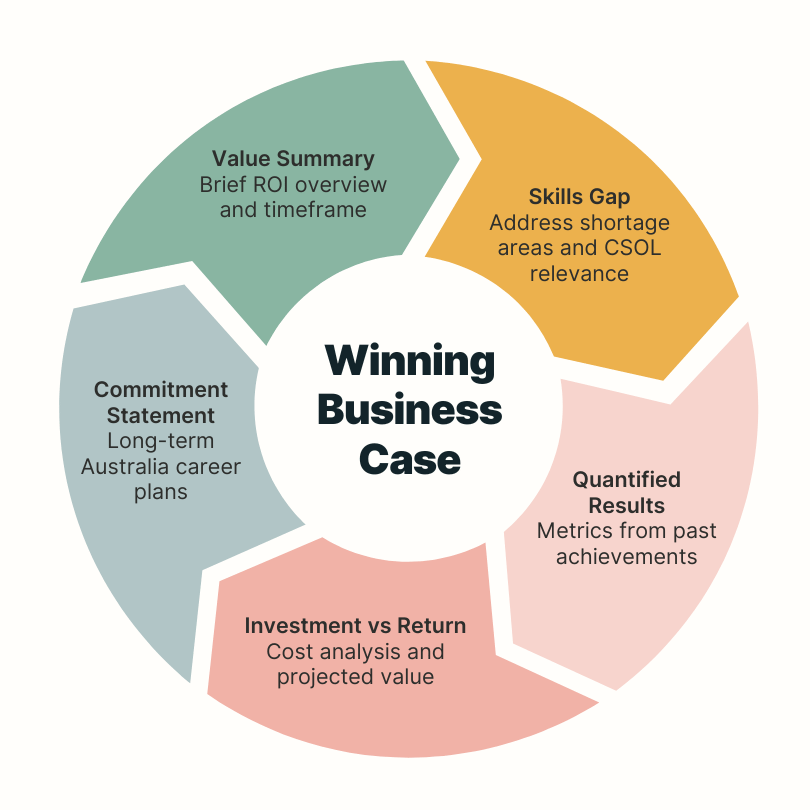
1. Value Summary (2-3 sentences) – Brief overview highlighting your unique value proposition and ROI timeframe.
2. Skills Gap Addressed
- [Specific skill] addresses [specific company need]
- [Industry data point] showing difficulty sourcing this locally
- [Relevant Core Skills Occupation List reference]
3. Quantified Contributions
- [Previous achievement with metrics]
- [Projected revenue/savings for new employer]
- [Implementation timeline]
4. Sponsorship Investment vs. Return
- Total sponsorship cost: [$X]
- Projected value delivered: [$Y] within [Z timeframe]
- Additional benefits: [Training capacity, international connections, etc.]
5. Commitment Statement – Brief statement addressing commitment to Australia and long-term career plans.
When developing this business case, be aware of the specific visa stream you're targeting. For the Core Skills Stream, emphasize how your skills match the Core Skills Occupation List (CSOL) (Skills Priority List) and meet the minimum salary threshold of $79,423.4.
For the Specialist Skills Stream, with the minimum salary threshold of $146,5765, focus more on your high-level expertise and earning potential.
ROI of Hiring You: Calculations That Make Sponsorship a Financial Win
Business Case ROI Calculation Example:
Investment:
- Sponsorship costs: $3,000-5,0006
- Administrative time: 10-15 hours
Return:
- Immediate expertise without 3-6 month local search: $120,000
- Revenue from implemented systems/skills: $200,000 annually
- Training capabilities for local team members
- International market insights and connections
ROI Timeline: 2-3 months
Salary Comparisons for Australian Sponsorship Positions
When developing your business case, include a salary comparison that shows your expectations align with Australian market rates while highlighting your additional value.
| Position Level | Australian Market Rate | Your Expected Salary | Your Added Value |
| Senior Data Scientist | $130,000 – $150,000 | $140,000 | • Advanced ML expertise • Experience with finance APIs • International project leadership |
🔗 To learn more about finding employers receptive to business cases, check out my walkthrough on research techniques for finding potential sponsors.
Email Templates for Australian Sponsorship Applications
Well-crafted email templates can improve your sponsorship communication effectiveness. You can customize these templates for your specific situation.
Follow-Up Email Template for Sponsorship Applications
Subject Line: Following Up: [Your Profession] Sponsorship Application – [Key Skill/Value Proposition]
Dear [Name],
Thank you for considering my application for the [Position] role at [Company Name]. I wanted to follow up regarding my application and my interest in joining your team.
I understand the considerations involved in sponsoring an international employee and would welcome the opportunity to discuss:
1. How my experience with [niche skill/technology] directly addresses your current needs
2. The specific value I can bring to [Company] based on my work with [relevant experience]
3. My familiarity with the sponsorship process and how we can navigate it efficiently
Would you be available for a brief 15-minute call next week? I'm flexible and can work with your schedule.
Thank you for your consideration.
Best regards,
[Your Name]
[Your Contact Information]
LinkedIn Message Templates for Australian Sponsorship
Connection Request Note (300 character limit):
Hi [Name], I noticed [Company] is leading in [specific industry area]. As a [Your Profession] with experience in [relevant skill], I'd be interested in connecting to discuss potential opportunities. I'm exploring roles in Australia that might align with my expertise.
Follow-Up Message (After Connection):
Hi [Name],
Thank you for connecting. I've been following [Company]'s work on [recent project/development], and [specific achievement or innovation] impressed me.
I have [X] years of experience specializing in [niche skill/expertise] and am exploring sponsorship opportunities in Australia. My background includes [brief achievement with metrics] that directly relates to the [specific area] your team is focusing on.
Would you be open to a brief conversation about your team's needs and whether my skills might be valuable? I understand the considerations involved with sponsorship and would appreciate any insights you might share.
Looking forward to potentially speaking with you.
Best regards,
[Your Name]
🔗 For additional communication strategies when connecting with potential sponsors, see my article on connecting with Australian employers for sponsorship.
Example Scenario: Putting Strategies into Practice
This example scenario illustrates how applicants might apply these strategies in a real-world situation.
Consider this example of a digital marketing manager from New York who initially struggled to find sponsorship despite applying to numerous positions. His standard American resume and generic cover letters weren't getting results, so he decided to change his approach based on the strategies in this article.
Problem: Employers were hesitant about sponsorship costs and the perceived risk of bringing in an international employee.
Approach:
- He rewrote his resume in Australian format, expanding to 3 pages with detailed achievement metrics
- He created a cover letter that directly addressed sponsorship and highlighted his niche expertise
- He developed a one-page business case showing how his experience could accelerate their expansion
- When interviewing, he proactively addressed concerns about commitment and knowledge transfer
This example demonstrates how showing you understand the employer's perspective can make the sponsorship decision much easier for them.
Now that you've put together a compelling application and secured a sponsor, let's look at what comes next in your sponsorship roadmap to Australia.
After Securing Sponsorship: Australian Visa Timeline & Process
Once you've secured sponsorship, a multi-stage visa process begins.
- Sponsorship approval – Your employer completes Standard Business Sponsor application (if the government hasn't approved them)
- Position nomination – Employer nominates your specific position
- Visa application – You apply for the Skills in Demand visa with the nomination details your employer provides

Current Processing Timeframes
| Visa Stage | Core Stream Processing Time | Specialist Stream Processing Time |
| Sponsorship approval | 2-4 weeks | 2-4 weeks |
| Position nomination | 4-8 weeks | 2-6 weeks |
| Visa application | 6-12 weeks | 3-8 weeks |
| Total average time | 3-6 months | 2-4 months |
Core Skills processing time is approximately 47 days, while Specialist Skills applications take around 39 days7.
For the Core Skills Stream, you must meet English language requirements of IELTS 5.0 overall with minimum 5.0 in each component (or equivalent)8. This ensures you can communicate effectively in an Australian workplace.
🔗 For detailed information about the visa application process, complete overview of Australia's Skills in Demand visa requirements.
If you're thinking ahead, you may want to explore pathways from sponsorship to permanent residency after arriving in Australia. Generally, applicants must be under the age of 45 at the time of application for permanent residency through the Employer Nomination Scheme (ENS)9.
Beyond the Visa: Turning Your International Status into an Advantage
Standing out in the competitive landscape of visa sponsorship requires more than qualifications. It demands strategic presentation and a solid business case. By adapting your application materials to Australian expectations and addressing sponsorship concerns, you increase your chances of success.
Remember that employers are making both a financial and administrative investment when they sponsor a foreign worker. Your job is to make that decision as easy as possible by demonstrating clear value that exceeds these costs. The difference between successful and unsuccessful sponsorship applications often comes down to preparation, presentation, and persistence.
These strategies can work for applicants who initially struggle to find sponsorship. With the right approach, your international experience and unique skills can become assets rather than obstacles in your Australian career journey. Good luck with your application.
Official Government Resources
- Department of Home Affairs – Employer Sponsored Visas – Official sponsorship requirements
- Skills Priority List – Current skills shortages in Australia
- Fair Work Ombudsman – Visa Holder Rights – Workplace rights information
Salary Research Tools
- PayScale Australia – Salary comparison tool
- Hays Salary Guide – Annual salary survey across industries
- Indeed Salary Tool – Salary information by job title and location
Application Resources
- Resume Writing Services Australia – Professional CV assistance
- Seek's Interview & Resume Advice – Australia-specific job application tips
- Australian Resume Templates – Examples of Australian format resumes
- Resume Writing Australia – Specializes in Australian-format resumes with visa sponsorship focus
- Seek's Selection Criteria Guide – How to address formal selection criteria in Australian applications
Business Case Development
- Hudson ROI Calculator – Tools for calculating employee value and ROI for sponsorship cases
- Australian Business Case Institute – Templates and frameworks for business case creation
- AIHR Value Metrics Guide – Metrics for demonstrating employee value in business cases
Cover Letter Resources
Michael Page Sponsorship Cover Letters – Guidance on addressing sponsorship in cover letters
Career One Cover Letter Examples – Australian-specific cover letter examples
- “Skills in Demand Visa, replacing the Temporary Skill Shortage (Subclass 482) Visa in 2024” (TechVisa, 2024), https://techvisa.com.au/new-skills-in-demand-visa-to-replace-482-visa-and-create-pathways-to-pr-for-all-applicants/ ↩︎
- “Australian resumes are longer than U.S. resumes, often reaching two to five pages depending on experience level.” (MyPerfectResume, 2024), https://www.myperfectresume.com/career-center/resumes/how-to/australian ↩︎
- “You must advertise the position in Australia, in English, within the four months immediately before you submit the TSS 482 or SERS 494 nomination application.” (LegalVision, 2024), https://legalvision.com.au/demonstrate-labour-market-testing/ ↩︎
- “The Core Skills Income Threshold for the Core Skills stream is currently set at $73,150.00… The income thresholds will be indexed yearly on 1 July.” (Lavan, 2024), https://www.lavan.com.au/advice/migration/Unlocking_Australias_New_Skills_in_Demand_Visa ↩︎
- “The SSIT will increase to $141,210 from 1 July 2025.” (VisaEnvoy, 2025), https://visaenvoy.com/skills-in-demand-visa/specialist-skills-pathway/ ↩︎
- “Sponsors must pay a Skilling Australians Fund (SAF) levy as part of the nomination application fee.” (AustMSS, 2024), https://www.austmss.com.au/skills-in-demand-visa/ ↩︎
- “Escalation requests will only be actioned for applications exceeding these new processing timelines (39 days for Specialist Skills and 47 days for Core Skills).” (Agape Henry Crux, 2025), https://www.ahclawyers.com/news-articles/25/02/28/updated-processing-times-for-skills-in-demand-sid-visas-subclass-482 ↩︎
- “For the Core Skills Stream, the following English language test scores are required: IELTS – An overall band score of at least 5.0 with a score of at least 5 in the test components.” (Bambrick Legal, 2025), https://bambricklegal.com.au/english-requirements-for-the-skills-in-demand-subclass-482-visa/ ↩︎
- “Applicants must generally be under the age of 45 at the time of application.” (PRPathway, 2024), https://prpathway.com.au/understanding-the-186-visa-your-key-to-permanent-residency-in-australia/ ↩︎