
Only two Australian banks let Americans open accounts before arrival: Commonwealth Bank and Westpac.
If you've been searching for banking information online, you've probably hit the same wall I did. Conflicting advice everywhere. Some guides say NAB works, others mention ANZ, and half the articles still reference Citibank like it's 2015.
Even when you “open” an account online, it's basically a glorified piggy bank until you show up in person. You can throw money in. You can't touch a single cent until you drag yourself to a branch. It's like having a lockbox where you can see your money but can't actually use it.
📝 Article Summary
Only Commonwealth Bank (CBA) and Westpac accept pre-arrival applications in 2025. Both create deposit-only accounts until in-person verification. Apply within 14 days of arrival, not months ahead. CBA accepts foreign addresses—solves the problem for 90% of migrants without Australian housing secured. Westpac requires an Australian address upfront. Critical deadline: Verify within 20 days or start over from scratch.
⚠️ Important: This covers transaction accounts for daily banking, not investment accounts. Information current as of January 2026, but banking policies change frequently. This is general guidance, not personalized financial advice. Verify directly with your bank and consult professionals for your specific situation.”
Can You Open an Australian Bank Account Before Moving?
You can open an Australian bank account from overseas if you're moving on a valid visa longer than three months.
Eligible visa holders:
- Work visa holders (Skills in Demand, 189, 190, 482, etc.)
- Student visa holders
- Partner visa holders
- Permanent residency visa holders
Not eligible for online opening:
- Tourist visa holders (subclass 600, 601, 651)
- Business visitors on short-term visas
- People visiting family without migration intent
If you're on a tourist visa, you cannot use pre-arrival online banking services. You would need to visit a branch in person after arriving in Australia, though banks may have additional restrictions for tourist visa holders.
Don't get confused by the term “non-resident.” For banking purposes, you're considered a migrant if you're moving to Australia with a valid visa, even if you haven't established tax residency yet.
How Pre-Arrival Banking Actually Works
This isn't some banking conspiracy to annoy you. It's Australian law under the Anti-Money Laundering and Counter-Terrorism Financing Act 2006. The law requires all Australian banks to verify customer identity in person before allowing withdrawals or payments. This “Know Your Customer” protocol prevents the use of Australia's financial system for illicit activities. It's non-negotiable under Australian law.
When you “open” an account online, you're not getting a real bank account. You're getting what's basically a glorified piggy bank you can look at but not touch.
You've got money sitting in Australia. You can see it on your online banking app, but you can't buy so much as a coffee with it. The account opens in this weird limbo state where you can throw money in. You can't withdraw cash. You can't transfer anything out. You can't pay bills. You can't make purchases. Nothing. You're staring at your own money through bulletproof glass.
What you CAN do with a deposit-only account:
- Transfer money into the account
- Check your balance online
- Tell yourself you're “getting organized” for your move
What you CANNOT do:
- Withdraw cash from ATMs
- Transfer money out
- Pay bills
- Make purchases
- Use a debit card (you won't have one yet)
Trust me, I tried withdrawing cash and the ATM basically laughed at me.
Once you complete verification at an Australian branch, your account changes from a fancy savings jar into a real, working bank account.
Critical Timing Requirements
Both Commonwealth Bank (CBA) and Westpac have a 14-day application window. I call it the “procrastinator's nightmare.” That's it. Fourteen days before you're supposed to land in Australia, and not a day earlier.
You can't apply months in advance like some outdated guides suggest. The system won't let you. The 14-day window is as firm as a brick wall.
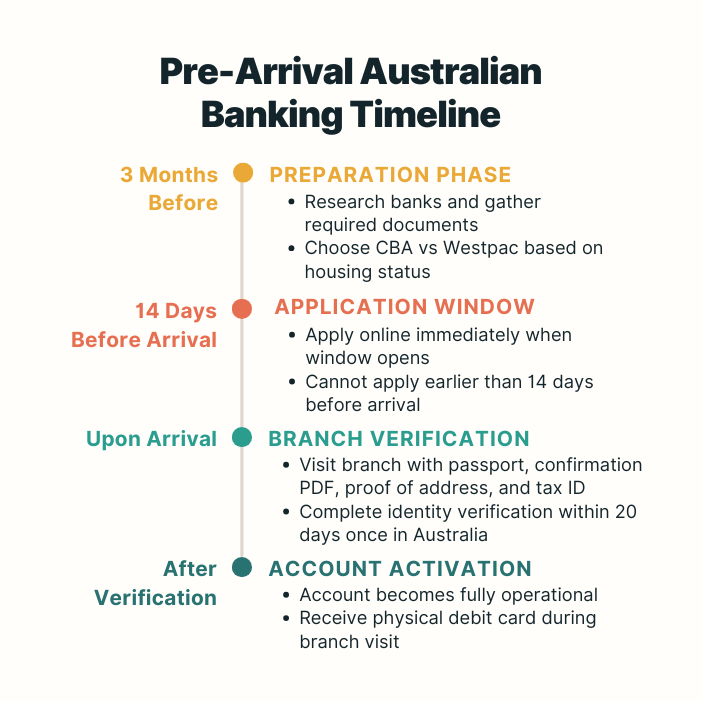
The timeline:
- 3 months before: Research banks, gather documents, choose CBA vs Westpac, but keep your hands off that application button
- 14 days before: Apply online immediately
- Upon arrival: Visit a branch within 20 days (CBA requirement)
- After verification: Your account becomes fully operational
⏳ CRITICAL DEADLINE WARNING
Missing the 20-day verification deadline closes your account permanently. You're back to square one, starting over with in-person applications after arrival. Book your branch appointment for your first week in Australia while you're still functioning on adrenaline, caffeine, and the sheer determination to get things done before reality and jet lag hit you like a freight train.
Don't be the person who waits until day 19 thinking “I'll get to it tomorrow.”
⚠️ Regulatory Notice: Australian banking regulations, including AML/CTF requirements and verification procedures, can change without notice. The 14-day and 20-day timeframes mentioned are current bank policies, not legal requirements, and banks may modify these at any time.
Your Two Banking Options: CBA vs Westpac
Commonwealth Bank (CBA) and Westpac are the only two Australian banks offering pre-arrival account opening services.
| Bank | Online Opening From Overseas | Timeline Before Arrival | Initial Address Requirement |
| Commonwealth Bank (CBA) | PARTIAL (Deposit-only account) | Up to 14 days | Foreign address acceptable |
| Westpac | PARTIAL (Deposit-only account) | Up to 14 days | Australian residential address required |
| National Australia Bank (NAB) | NO (In-person application required) | Not Applicable | Australian address required at opening |
| ANZ | NO (Except for NZ residents via phone) | Not Applicable | Australian address required at opening |
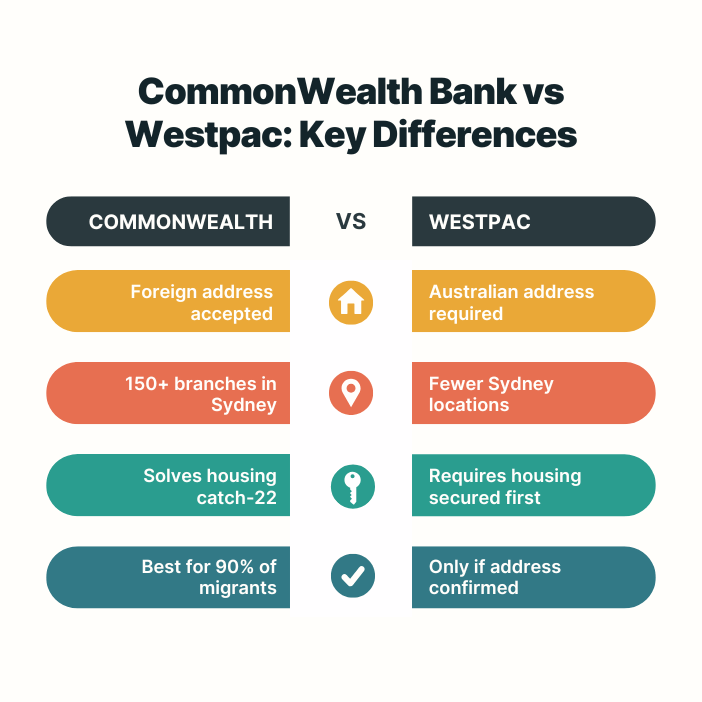
CBA works for 90% of migrants who don't have Australian housing secured before the 14-day application window. Westpac only works if you have confirmed Australian housing with an address upfront. Both create deposit-only accounts until in-person verification within 20 days of opening.
Commonwealth Bank: Best for Most Migrants
CBA allows the use of a foreign residential address for the initial application, which helps migrants who haven't secured housing before departure.
You must visit any CBA branch in person within 20 days of the online account opening. This prevents automatic closure. With over 150 branches in Sydney, CBA has the largest network for convenient verification.
CBA's foreign address policy solves the address catch-22 problem that frustrates most new arrivals.
Best for: Most migrants (90% scenario) who don't have Australian housing secured before the 14-day application window.
Westpac: Requires Australian Address
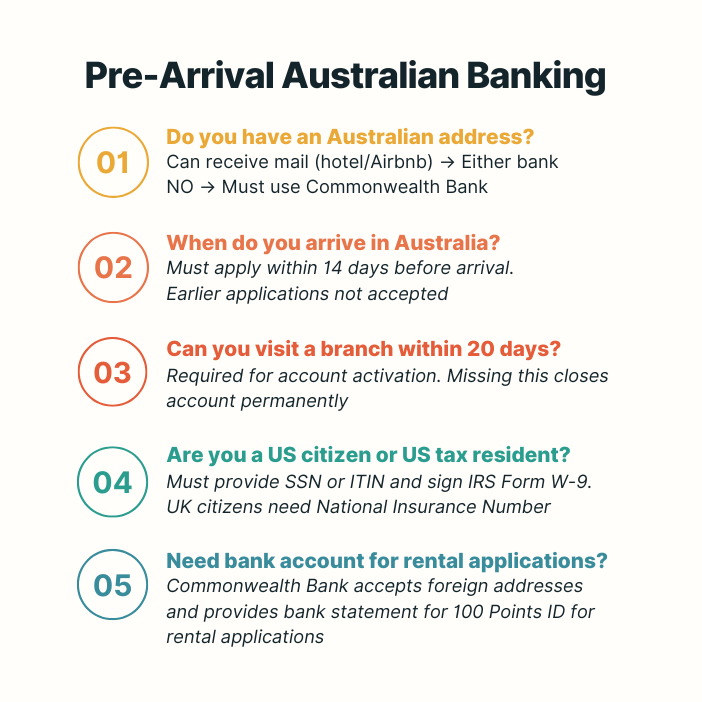
A critical difference in Westpac's process is the requirement for an Australian residential address at the time of online application.
CBA's policy helps break the common migrant catch-22 of needing an account for a lease and a lease for an account. Westpac's policy reinforces it. For any migrant who hasn't secured housing before departure, Westpac's pre-arrival service can't be used.
Best for: Migrants who have already secured Australian housing with a confirmed address before the 14-day application window.
But what if you don't have Australian housing lined up yet? That's the situation for about 90% of people moving to Australia. You're probably thinking about neighborhoods, scrolling through rental listings, but you haven't signed a lease yet. That's exactly why CBA's no-address-required policy is such a game-changer.
Post-Arrival Alternatives: NAB, ANZ, and HSBC
National Australia Bank (NAB) requires new migrants to open bank accounts in person at a branch after arrival. This represents a major policy shift from as recently as 2014, when NAB heavily advertised the ability to open an account up to a year in advance. The market contracted as banks reduced complexity in their migrant banking services. This explains why you'll find conflicting information online—much of the advice about opening accounts with NAB or ANZ is outdated.
ANZ requires in-person applications for most countries. The only exception is a specialized process available only to individuals located in New Zealand.
HSBC's pre-arrival service is primarily for existing global customers and requires an assisted service through the customer's home country branch.
All three require in-person applications after arrival but offer immediate full functionality without deposit-only limitations.
The Address Catch-22: How CBA Solves the Chicken-and-Egg Problem
You need a bank account to get a lease. You need an address to get a bank account. It's like some cosmic joke designed by bureaucrats who've clearly never moved anywhere in their lives.
When I moved to Sydney in 2008, this catch-22 drove me bonkers. Picture this: landlords and rental agents want to see local banking sorted before they'll consider you. Makes sense. They want their rent paid reliably. But then you call the banks. Half of them want a confirmed Australian address before they'll talk to you about opening an account.
It's the classic chicken-and-egg problem. More paperwork. Higher stress levels. The nagging feeling that the universe is personally conspiring against your sanity.
CBA's foreign address policy solves this problem. You can start the banking process using your current address back home. You're not stuck in the “can't get A without B, can't get B without A” spiral.
Westpac's address requirement basically reinforces the catch-22. If you haven't secured accommodation before departure, their pre-arrival service might as well not exist.
Your Australian bank statement becomes useful ammunition for the 100 Points of Identification system. It's used for rental applications, mobile phone contracts, and other services. It's like having a local reference before you even arrive. Understanding rental markets and strategies for securing rental accommodation quickly becomes much easier when you already have local banking established.
Why Open Your Bank Account Before Moving
Pre-arrival banking provides 25-40 points toward 100 Points ID verification for rentals and services. Australian bank statements signal commitment to landlords and establish local financial presence before apartment hunting while managing jet lag and work start dates.
Migrant banking eligibility expires within your first month or six weeks after arrival. Banking setup consistently ranks as one of the top 5 questions Americans ask when planning their move, and for good reason.
You could wait until you arrive. You'd be making things harder on yourself. Picture this: you're jet-lagged, living out of a suitcase in some random hotel, trying to figure out which side of the road cars drive on, and suddenly you need to open a bank account just to get your phone connected. Not exactly the smooth welcome to Australia you were dreaming about on the plane.
Plus, you lose out on the strategic advantages that come with having local banking already sorted. It's like showing up to a job interview in your pajamas. Technically possible, but you're not setting yourself up for success.
The 100 Points ID Advantage
Having an Australian bank account helps you pass the 100 Points of Identification check required for rental applications and other services.
To pass the 100 Points ID check, you need one primary photo ID (your passport, worth 50-70 points) plus secondary identification worth the remaining 30-50 points.
Your Australian bank statement becomes useful supporting documentation for your first rental application, especially when you don't yet have local utility bills or other Australian documentation. From community feedback, landlords consistently view local banking as a positive signal of commitment to staying in Australia.
Credit History Doesn't Transfer
Your credit history from any country (US, UK, Canada, anywhere) doesn't transfer to Australia. You'll start building Australian credit at zero regardless of your previous credit score.
💳 Your Credit Score Starts at Zero
Perfect 850 FICO score in the US? Australia doesn't care. You start at zero. Your Australian bank account becomes the foundation for building credit through future car loans, mortgages, or credit cards. This makes establishing local banking early in your move more important than most people realize.
Australian Bank Accounts for Non-Residents: Banking vs Tax Definitions
Here's where things get confusing – the term “non-resident” means different things depending on whether you're talking to a bank or the tax office.
For Banking Purposes: You're a “Migrant,” Not a Non-Resident
If you're moving to Australia on any work, study, or resident visa, banks don't consider you a non-resident. You're classified as a “migrant,” which means you can access the pre-arrival banking services we've been talking about.
For Tax Purposes: Different Story
Tax-wise, you might be considered a “non-resident” until you establish Australian tax residency, but that doesn't affect your banking eligibility at all. The ATO and the banks operate on completely different definitions.
True Non-Residents (Who CAN'T Open Online)
These are the people who actually can't use pre-arrival banking services:
- Tourists on visitor visas (subclass 600, 601, 651)
- Business travelers on short-term visas
- People visiting family without any intention to migrate
If you're on a tourist visa, you cannot access online pre-arrival banking services. You would need to visit a branch in person after arriving, show your passport and visa, though banks may have additional restrictions for tourist visa holders.
The bottom line: if you're moving to Australia to live and work, you're a migrant for banking purposes. The tax residency stuff gets sorted out later with the Australian Taxation Office.
What Documents You Need to Open an Australian Bank Account
Required documents for online application:
- Passport (name must match exactly as it appears)
- Australian visa approval documentation (see the Department of Home Affairs for details on what you'll receive)
- Approximate arrival date in Australia
- Home address (CBA accepts foreign address; Westpac requires Australian address)
Tax identification numbers required:
- US Citizens: Social Security Number (SSN) for FATCA compliance
- UK Citizens: National Insurance Number for CRS reporting
- Other countries: Home country Tax Identification Number
You don't need your Australian Tax File Number initially. Add it to your account after receiving it to avoid non-resident tax rates on interest earned.
Get your paperwork ready before the 14-day window opens. You can't apply until 14 days before arrival, and you don't want to scramble for documents at the last minute.
Complete Step-by-Step Guide: Opening Australian Bank Accounts From USA and UK
Step 1: Before You Leave (3 months before)
Research banks using the comparison table above and decide which fits your situation.
Choose Commonwealth Bank (CBA) if you don't have Australian housing secured yet (90% of migrants). Choose Westpac only if you have confirmed Australian housing with an address before the 14-day application window.
Gather required documents:
- Passport (must match visa application exactly)
- Australian visa approval documentation
- Planned arrival dates
- Tax identification number (SSN for Americans, National Insurance Number for UK citizens)
You can't apply until within 14 days of your arrival date. Use these three months to get everything ready.
Step 2: Opening Online (14 days before arrival)
Apply immediately once you're within 14 days of arrival. The online process takes about five minutes once you have all the information ready.
- Enter your name exactly as it appears on your passport
- Select your visa type from the dropdown
- Provide your arrival date (Australian date format is day/month/year, which trips up Americans)
- Use your current home address (for CBA) or confirmed Australian address (for Westpac)
- Select a branch for verification. I recommend Martin Place for its central location and fast migrant processing. It's in Sydney's CBD and easy to get to by train. They're used to dealing with new arrivals who need verification appointments. From helping dozens of American families move through this process, Martin Place consistently processes applications fastest.
Your account number is generated immediately when you submit your application. Save your confirmation PDF and account details.
Step 3: Upon Arrival in Australia (first week)
Visit your selected branch with required documents within 20 days to prevent automatic account closure.
Bring to verification appointment:
- Original passport (same one used for visa application)
- Printed confirmation PDF from online application
- Proof of Australian address (rental agreement, hotel confirmation, or temporary accommodation letter)
- Tax identification from all countries of tax residency
Country-specific requirements:
- US Citizens: Provide Social Security Number, declare US tax residency, sign IRS Form W-9 for FATCA
- UK Citizens: Provide National Insurance Number for CRS reporting
- All applicants: Provide Tax ID from each country where you file returns
Verification takes 15-30 minutes with all documents ready. The account becomes fully operational with all transaction capabilities immediately after successful verification. You'll receive your physical debit card during this same visit.
Tax Reporting Requirements You Should Know
All Australian banks must report US citizen accounts to the IRS through the Australian Taxation Office (ATO) under FATCA requirements. You'll provide your Social Security Number at verification and sign IRS Form W-9 declaring US tax residency. Yeah, I know. Nobody likes handing over their Social Security number, but banks will decline to open accounts if you refuse.
Combined balances over $10,000 USD require FBAR filing by April 15th. UK and other citizens provide Tax Identification Numbers under Common Reporting Standard (CRS).
🚨 Critical Tax Notice: Tax reporting requirements for international accounts are complex and penalties for non-compliance can be severe. US citizens face significant FBAR and FATCA penalties for unreported foreign accounts. This information is for general guidance only. Consult a qualified international tax professional before opening any Australian bank account to understand your specific obligations in both countries.
FATCA Requirements: US Citizens Opening Australian Bank Accounts
All Australian financial institutions must identify US citizens and report account information to the IRS through the Australian Taxation Office. This reporting is automatic and non-negotiable.
If your combined Australian account balances exceed $10,000 USD at any point during the year, you must file an FBAR (Foreign Bank Account Report) with the US Treasury by April 15th.
Common Reporting Standard (CRS) for All Nationalities
Banks will ask for your Tax Identification Number for every country where you hold tax residency:
- UK Citizens: National Insurance Number
- Canadian Citizens: Social Insurance Number
- EU Citizens: Country-specific TIN
- All nationalities: Your home country's tax identifier
CRS doesn't automatically report to your home tax authority, but you must declare foreign accounts on your home country tax returns if you remain a tax resident there.
Which Bank Should You Choose?
Best for Most Migrants: Commonwealth Bank
Commonwealth Bank (CBA) works best for most migrants. The bank's key advantage lies in its policy of accepting foreign residential addresses. This solves the catch-22 of needing a bank account to secure a lease and a lease to open an account.
With over 150 branches in Sydney, CBA has the largest network for convenient verification. You must visit any CBA branch in person within 20 days of the online account opening to prevent automatic closure.
Choose CBA if: You don't have Australian housing secured yet (90% of migrants)
Alternative: Westpac
Westpac works as an alternative, but only for migrants who have already secured an Australian residential address. A critical difference in Westpac's process is the requirement for an Australian residential address at the time of online application.
CBA's policy helps break the common migrant catch-22 of needing an account for a lease and a lease for an account. Westpac's policy reinforces it. For any migrant who hasn't secured housing before departure, Westpac's pre-arrival service can't be used.
Choose Westpac if: You have confirmed Australian housing with an address before the 14-day application window
Fees to Know About
| Fee Type | Amount (AUD) | Amount (USD) | When It Applies |
| Monthly Account-Keeping Fee | $4-5 | $2.50-3.25 | Every month (waived with $2,000 monthly deposits or under 25 enrolled full-time) |
| International Transfer Fee (Incoming) | $18-22 | $12-14 | Each transfer from overseas bank |
| ATM Withdrawal (Other Banks) | $2-3 | $1.30-2 | Using another Australian bank's ATM |
| Foreign Transaction Fee | 2-3% | 2-3% | Purchases in non-AUD currency |
The transfer fees are where banks really get you. Don't transfer money to Australia using traditional bank-to-bank transfers due to poor exchange rates and high fees on both ends. Use Wise or OFX instead to save on fees and get better exchange rates.
Banking fees represent just one component of your overall cost of living in Sydney—budget for housing, transportation, and daily expenses as well.
Transferring Money to Australian Banks
Avoid bank-to-bank international transfers due to poor exchange rates and fees on both sides.
Wise (formerly TransferWise): Mid-market exchange rates with transparent fees, 1-2 day transfers from US or UK to Australia. Works well for regular transfers under $10,000 AUD.
OFX: Competitive rates with no transfer fees, better for larger transfers over $10,000 AUD. Works well for one-time large transfers.
Both services offer better exchange rates than traditional banks and complete transfers faster than bank-to-bank options.
Set up your preferred transfer service before moving so you can move money immediately after account verification.
Australian Banking for Expats FAQ
Can I open an Australian bank account from the USA?
Yes, but only with Commonwealth Bank (CBA) or Westpac within 14 days of arrival. You'll need your passport, Australian visa, arrival date, and Social Security Number for FATCA compliance. The account will be deposit-only until you verify in person after arrival.
Do I need an Australian address to open a bank account?
Depends on which bank. Commonwealth Bank (CBA) accepts your foreign address during online application. Westpac requires a confirmed Australian residential address before you can apply online. This is why CBA is recommended for most migrants who don't have housing secured before departure.
Can I use my account immediately after opening online?
No. The online process creates a deposit-only account. You can transfer money INTO the account but can't withdraw, transfer out, or make payments until you complete in-person identity verification at a branch after arrival. This typically takes 15-30 minutes at a branch during your first week in Australia.
What happens if I miss the 20-day verification deadline?
Your account closes permanently and you start over with in-person applications after arrival. CBA doesn't offer extensions or second chances. Book your branch appointment for your first week in Australia to avoid this problem.
Ready to Open Your Australian Bank Account?
Only Commonwealth Bank (CBA) and Westpac offer pre-arrival banking within 14 days of arrival. CBA accepts foreign addresses, solving the housing catch-22 for most migrants. Westpac requires Australian addresses upfront.
Both create deposit-only accounts until you verify in person within 20 days. After verification, you'll have full account access.
Choose your bank, gather documents (passport, visa, tax ID), and apply during the 14-day window before arrival.
⚠️ Professional Guidance: For complex financial situations involving significant assets, business accounts, or unusual circumstances, consider consulting a registered migration agent, international tax advisor, or Australian financial planner before proceeding. Banking policies change frequently. Check directly with Commonwealth Bank or Westpac for current requirements before applying.
Official Government Resources
- Australian Prudential Regulation Authority (APRA) – Banking regulatory oversight and consumer protection guidelines for the Australian financial system
- Services Australia – 100 Points of Identification verification system and requirements for opening bank accounts and accessing government services
- Australian Taxation Office (ATO) – Tax File Number applications, international tax reporting requirements, and guidance on tax residency for new migrants
- AUSTRAC – Anti-Money Laundering compliance information and regulations governing Australian financial institutions
Australian Banks with Pre-Arrival Services
- Commonwealth Bank Migrant Banking – Foreign address accepted, 20-day verification requirement, largest branch network in Sydney for convenient verification
- Westpac Migrant Banking – Australian address required, strong international services, alternative option for migrants with confirmed housing
Post-Arrival Banking Options
- National Australia Bank (NAB) – In-person applications only after arrival, immediate full account functionality without deposit-only restrictions
- ANZ – In-person applications required for most countries, full banking services available immediately after opening
International Money Transfer Services
- Wise (formerly TransferWise) – Mid-market exchange rates with transparent fees, ideal for regular transfers under $10K AUD, 1-2 day processing times
- OFX – Competitive rates with no transfer fees, better for larger one-time transfers over $10K AUD, superior to traditional bank transfers
US Tax Compliance Resources
- US Treasury FBAR Requirements – Foreign Bank Account Reporting for combined balances over $10K USD, filing deadline April 15th
- IRS FATCA Information – Foreign Account Tax Compliance Act requirements for US citizens opening Australian bank accounts