

You've been in Australia for a few years on a temporary work visa. Now you're wondering whether the Employer Nomination Scheme (subclass 186) pathway makes sense for your permanent residency goals.
You're not alone in feeling unsure about this decision. Many temporary visa holders with steady work relationships find themselves at this crossroads.
Your current visa works. You've built a life here. You're facing timeline pressure and want the security of knowing you can stay in Australia permanently.
The 186 offers a direct route that skips points competition. But the 186 Employer Nomination route isn't just about meeting eligibility requirements. It's about whether you're ready for the employer relationship this visa creates.
My goal with this guide is to help you understand the 186 PR pathway better and how it compares to your other choices, plus the realities of employer-sponsored permanent residency that many people don't fully consider.
⏱️ Quick Summary
The Employer Nomination Scheme (subclass 186) offers permanent residency through employer sponsorship. Success rate: 98.9% as reported in the 2024-25 Migration Program Report. Processing takes 12-18 months1 with AUD $6,140 (USD $4,300) application fee2 as of the 2026-27 fee schedule. Requires age under 453, strong employer relationship willing to commit to permanent sponsorship, and occupation on approved lists. Best suited for people with stable employer relationships who value security over immediate job flexibility.
⚠️ Important: Immigration policies change regularly. Check the Department of Home Affairs website for current information and consult with a registered migration agent for personalized advice about your specific circumstances.
186 Pathway Suitability Checklist
Before going any further, use this list to see if you qualify for a 186 visa.
- Age under 45 years4 (hard requirement with limited exceptions)
- Hold temporary skilled work visa (subclass 482/Skills in Demand/TSS)
- At least 2 years relevant work experience5 in nominated occupation
- Occupation appears on approved skills lists6 (MLTSSL or STSOL)
- Strong relationship with current employer willing to sponsor permanent residency
- Comfortable with initial employment commitment obligations
- English proficiency meets requirements (competent level)7
- Clean health and character background
186 Visa Eligibility Assessment: Is This Right for Your Situation?
You need to know whether you're a good fit for the 186 route before talking to your employer. This isn't just about meeting basic requirements.
It's about whether this option makes sense for your situation.
Your age, job, and current visa status all affect whether you qualify for the 186 pathway. More importantly, whether your employer is positioned to support permanent sponsorship affects your pathway viability.
The 186 visa has three streams. Most people working in Australia will look at the Direct Entry stream. This requires skills assessment, English proficiency, and being under 45 years old.
If you're getting close to that age limit, timing becomes critical for your decision timeline.
Your Current Visa Status and 186 Eligibility
You're probably on what used to be called a TSS 482 visa. Or you're on a Skills in Demand visa and looking into your options for permanent residency.
This doesn't change your 186 visa eligibility.
The requirement is having at least two years of related work experience. This must be in your nominated occupation. This doesn't have to be with your current employer, good news if you've switched companies but stayed in the same field.
Your current employer does need to nominate you for a role that matches your experience.
Under 45 Requirement: Timeline Pressures You Can't Ignore
Let me be direct about this. If you're over 40, the age requirement should drive your timeline decisions.
The 186 has a hard cutoff at 45 years old. There are limited exceptions but don't count on them.
Unlike skilled independent visas that use a points test, this age limit is non-negotiable. The Australian government doesn't bend on this one. Trust me, they're about as flexible as C-3PO in a yoga class when it comes to age cutoffs.
This creates genuine urgency for your decision-making timeline. You're looking at 13-21 months from start to finish8 when you factor in skills assessment processing (3-6 months), employer nomination (6-9 months), and visa application processing (4-6 months).

It's like the clock tower scene in Back to the Future. You have a specific window to make it work, and missing it means starting over with different options. So make sure your flux capacitor is working.
📆 Timeline Check
If you're approaching 45, start planning at least 2 years before your 45th birthday. The total timeline of 13-21 months doesn't include preparation time or potential delays.
Understanding Your Employer's Role and Commitment
Your employer isn't just signing a form. They're taking on significant legal and financial obligations that go well beyond temporary work visa sponsorship.
The 186 visa requires substantially more from employers than temporary work visas. Your employer successfully sponsored you temporarily, but permanent sponsorship involves additional business case requirements, ongoing compliance obligations, and higher stakes if things go wrong.
Understanding what permanent sponsorship actually entails helps you evaluate whether your employer is likely to commit to this level of involvement.
What Makes Permanent Sponsorship Different
You've been through temporary sponsorship, but permanent sponsorship has additional complexity layers. Your employer must demonstrate stronger business justification, commit to longer-term obligations, and accept greater compliance responsibilities.
The labour market testing requirements are more rigorous for permanent sponsorship. Your employer must prove they've genuinely tried to find Australian workers for the permanent role, not just the temporary position they initially sponsored you for.
They need to show genuine business need for the role that extends beyond temporary project work. They must demonstrate they have the financial capacity to meet ongoing sponsorship obligations for permanent residents.
What Your Employer Must Demonstrate
Your employer faces several requirements before they can nominate you. They must complete labour market testing (proving they tried to hire Australian workers first). They need to show genuine business need for the permanent role.
The business case requirements include:
- Evidence of genuine business need for the permanent role
- Proof of labour market testing (advertising to Australian workers first)
- Financial capacity to pay the nominated salary consistently
- Commitment to provide working conditions equal to Australian workers
- Clean track record with previous sponsorships (if any)
The role must also be on the right eligible occupations for 186 visa lists.
👀 At a Glance
Your 186 pathway fit depends on: age under 45 (hard requirement), employer willing to commit to permanent sponsorship obligations beyond temporary sponsorship, job on eligible skills lists, and at least 2 years related experience. Permanent sponsorship requires additional business case proof, labour market testing, and long-term compliance obligations.
186 Visa Benefits vs Trade-offs: What You're Really Getting
The 186 visa offers direct permanent residency. This is its biggest selling point. You're not waiting for invitation rounds or competing on points. If your employer nominates you and your application is approved, you have permanent residency.
This security comes with trade-offs that aren't immediately obvious.
The direct benefits are significant. You get full work rights after any initial employment restrictions. You get direct access to Medicare and social services. You get a pathway to citizenship. Your family gets the same rights. You have the freedom to travel without visa restrictions.
What many people don't fully consider is you're trading job flexibility for the security of knowing you can stay in Australia permanently. There are work obligations tied to your sponsoring employer. These aren't permanent, but they do limit your options initially.
Immediate Advantages of 186 Visa Approval
Once your 186 visa is granted, you're a permanent resident from day one. This means direct access to Medicare. You can sponsor family members for permanent residency. You can apply for Australian citizenship after meeting the residence requirements.
For families, this security is often worth the trade-offs. Your children can access local tuition rates for university. You don't have to worry about visa renewals. You have the stability of knowing you can stay permanently.
Understanding the Employment Commitment Reality
You can't just quit your job immediately after getting permanent residency. There's an expectation that you'll work for your sponsoring employer for approximately two years9, though this isn't a strict legal requirement.
More importantly, if you leave your sponsoring employer within the first two years without reasonable grounds, it can affect future sponsorship applications if you ever need them. In extreme cases, it can lead to visa cancellation.
This is rare for genuine cases.
This means you need to be confident in your employer relationship and your role before starting this process. If you're already planning to change jobs or start your own business, the 186 isn't the right choice.
🎯 Bottom Line
The 186 visa provides immediate permanent residency with high approval rates and full access to Australian benefits. It requires an initial work commitment to the sponsoring employer. Trade-offs include reduced job flexibility initially versus knowing you can stay permanently. Best for employees with stable employer relationships who value security over immediate job mobility.
How 186 Compares to Your Other Permanent Residency Options
You're wondering how the 186 stacks up against the skilled independent (189) and state nominated (190) pathways. Each has advantages depending on your situation.
These differences matter for making the right choice.
The biggest difference is the pathway to permanent residency. With the 186, if your employer nominates you and your application meets requirements, you're essentially guaranteed permanent residency. The approval rates are excellent. With the 189 and 190, you're competing against other applicants based on points and invitation rounds.
So which pathway actually fits your priorities?
186 vs Independent Skilled Migration: Security vs Flexibility
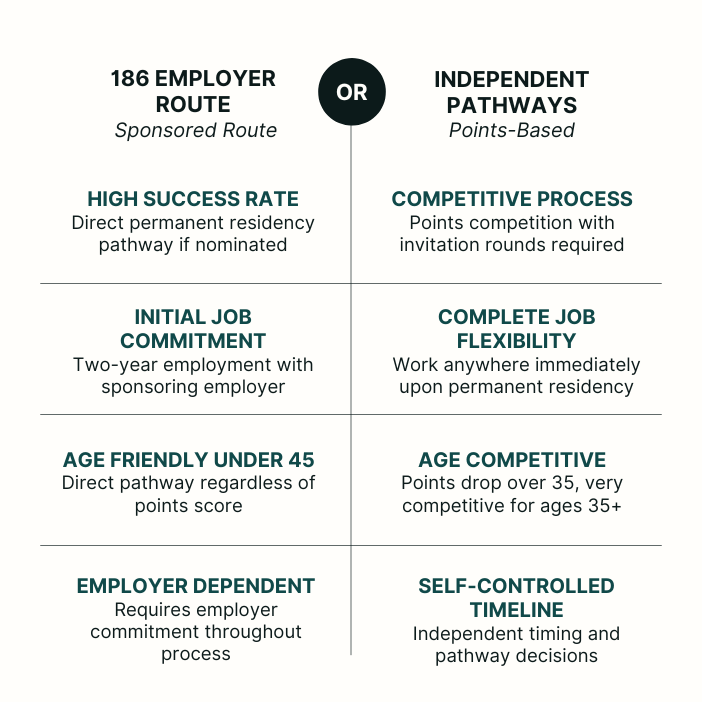
The independent skilled migration Australia pathway offers ultimate flexibility. No employer ties. No geographic restrictions. Complete freedom to work wherever and for whoever you want from day one.
Getting a 189 invitation is increasingly competitive, especially if you're over 35.
Here's where the age factor becomes crucial. If you're 42 with solid qualifications but not exceptional points, the 189 visa will be nearly impossible. The 186 gives you a way to get permanent residency that doesn't depend on who has the most points.
The flexibility trade-off is real. With the 189, you can immediately pursue any career opportunity. With the 186, you have initial employment obligations that limit your immediate options.
State Nomination vs Employer Sponsorship: Which Commitment Works Better?
The 190 visa state sponsorship pathway offers an interesting middle ground. You get additional points through state nomination, making permanent residency more achievable than the 189. But you commit to living in that state for two years rather than working for a specific employer.
For some people, geographic flexibility is more valuable than job flexibility. If you're happy with your location but want job options, the 190 might be better. If you love your job but want to move cities, the 186 would be preferable.
Permanent Residency Pathway Comparison
| Factor | 186 (Employer Nomination) | 189 (Independent) | 190 (State Nominated) |
| Age Limit | Under 45 (hard cutoff) | Under 45 (points based) | Under 45 (points based) |
| Commitment | 2 years work commitment | None | 2 years state residency |
| Points Required | Not applicable | 85-90+ competitive | 65-75+ competitive |
| Processing Time | 12-18 months reliable | Variable (invitation dependent)10 | 7-10 months average11 |
| Success Rate | 98.9% (if nominated) | 96.9% (if invited)12 | 98.7% (if nominated)13 |
| Application Control | High (with employer support) | Low (invitation dependent) | Medium (nomination dependent) |
186 Visa Processing Time, Costs, and Success Expectations
Let's talk numbers. Knowing the realistic timeline and costs helps with your planning.
The 186 route involves two stages: employer nomination and your visa application. Both take time and money.
Processing averages 12-18 months for the complete process. Employer nominations take 6-9 months. Visa applications take 4-6 months afterward.
The success rate is encouraging. 98.9% of 186 visa applications were approved in 2024-25, according to the Department of Home Affairs Migration Program Report.
This high success rate tells you that once you clear the nomination hurdle, you're in strong shape. The real challenge is getting that employer nomination approved in the first place.

186 Visa Cost Summary
Your Costs
- Visa application fee: AUD $6,140 (USD $4,300)
- Spouse/partner: AUD $3,070 (USD $2,150) additional14
- Child under 18: AUD $1,535 (USD $1,075) per child15
- Skills assessment: AUD $300-1,200 (USD $210-840)16
- English test: AUD $490 (USD $345)17
- Health examinations: AUD $300-500 (USD $210-350) per person18
- Police clearances: AUD $100-300 (USD $70-210)19
💰 Budget Planning: Total costs range from AUD $7,300-8,600 (USD $5,100-6,000) for single applicants or AUD $14,500-16,600 (USD $10,200-11,600) for family of 4. That range covers everything listed above, including the skills assessment and English test, and it leaves out employer costs, which are set out separately below.
USD amounts are approximate and for budgeting. Check the current rate when you pay.
Employer Costs
- Nomination fee: AUD $540 (USD $380)20
- Migration agent/lawyer: AUD $5,000-15,000 (USD $3,500-10,500)21
- Labour market testing: AUD $1,000-3,000 (USD $700-2,100)
Employer Total: AUD $6,500-19,000 (USD $4,600-13,300)
Making Your Decision: What to Do Now
After looking at all this information, you should have a clearer picture of whether the 186 route makes sense for you.
The decision comes down to your priorities. Security versus flexibility, your employer relationship strength, and your timeline pressures.
But what's your next move?
If you're leaning toward this pathway, your next steps involve getting a professional qualification assessment, evaluating your employer's willingness to commit to permanent sponsorship, and gathering documentation.
If you've decided it's not right for you, it's time to focus your energy on other permanent residency options.
For those that decide the 186 isn't a good fit, don't see this as a setback. You might find the 189 visa route or 190 state nomination route better suits your priorities.
Weighing Your 186 Visa Options
The 186 visa route offers security and predictability that's appealing to many who've established themselves in Australia. The high success rate and clear timeline make it attractive, especially for temporary visa holders approaching age limits for other PR visa routes.
The employment commitment aspect isn't a disadvantage if you're satisfied with your current role and employer. For many people, the trade-off of initial job restrictions for knowing you can stay in Sydney permanently is worthwhile.
What matters most is honest assessment of your priorities and situation. If job flexibility is crucial to your immediate plans, independent migration might be better despite the competition. If knowing you can stay permanently and family stability take priority, the 186 route deserves serious consideration.
Those who are happiest pursuing the 186 route are those who genuinely like their jobs and see themselves staying with their employers anyway. The visa just formalizes what they were already planning to do.
If that sounds like you, then go for it!
Official Government Resources
- Department of Home Affairs 186 Visa Information – Complete requirements, application process, and current processing times for the Employer Nomination Scheme. Essential reading for understanding eligibility criteria and application procedures.
- Migration Program Report 2024-25 – Official statistics on visa grants and success rates including the 98.9% success rate figure. This report provides authoritative data on program outcomes and processing performance.
- Current Visa Application Fees – Up-to-date fee schedule for all applications including the AUD $6,140 main applicant fee and family member costs.
- Global Processing Times – Current processing time estimates updated monthly for 186 visa applications and employer nominations.
- Labour Market Testing Requirements – Detailed requirements for employers including advertising obligations and exemptions for permanent sponsorship.
Professional Services
- Migration Institute of Australia – Directory of registered migration agents specializing in employer-sponsored visas. Use their “Find a Migration Agent” tool to locate qualified professionals in your area.
- Migration Agent Registration Authority (MARA) – Verify credentials and check registration status of migration agents. Essential for confirming professional qualifications before engaging services.
- Law Institute of Victoria Immigration Lawyers – Qualified legal practitioners for complex sponsorship cases requiring legal expertise beyond standard migration agent services.
- Skills Assessing Authorities – Official list of authorities for professional qualification assessment by occupation. Required first step for most 186 applications.
- Department of Home Affairs, “Global Visa Processing Times,” https://immi.homeaffairs.gov.au/visas/getting-a-visa/visa-processing-times/global-visa-processing-times ↩︎
- Department of Home Affairs, “Current Visa Application Fees,” https://immi.homeaffairs.gov.au/visas/getting-a-visa/fees-and-charges/current-visa-pricing ↩︎
- Department of Home Affairs, “Employer Nomination Scheme (subclass 186),” https://immi.homeaffairs.gov.au/visas/getting-a-visa/visa-listing/employer-nomination-scheme-186 ↩︎
- Department of Home Affairs, “Employer Nomination Scheme (subclass 186),” https://immi.homeaffairs.gov.au/visas/getting-a-visa/visa-listing/employer-nomination-scheme-186 ↩︎
- Department of Home Affairs, “Employer Nomination Scheme (subclass 186),” https://immi.homeaffairs.gov.au/visas/getting-a-visa/visa-listing/employer-nomination-scheme-186 ↩︎
- Department of Home Affairs, “Skilled Occupation Lists,” https://immi.homeaffairs.gov.au/visas/working-in-australia/skill-occupation-list ↩︎
- Department of Home Affairs, “English Language Requirements,” https://immi.homeaffairs.gov.au/help-support/meeting-our-requirements/english-language ↩︎
- Department of Home Affairs, “Global Visa Processing Times,” https://immi.homeaffairs.gov.au/visas/getting-a-visa/visa-processing-times/global-visa-processing-times ↩︎
- Department of Home Affairs, “Employer Nomination Scheme (subclass 186),” https://immi.homeaffairs.gov.au/visas/getting-a-visa/visa-listing/employer-nomination-scheme-186 ↩︎
- Department of Home Affairs, “Global Visa Processing Times,” https://immi.homeaffairs.gov.au/visas/getting-a-visa/visa-processing-times/global-visa-processing-times ↩︎
- Department of Home Affairs, “Global Visa Processing Times,” https://immi.homeaffairs.gov.au/visas/getting-a-visa/visa-processing-times/global-visa-processing-times ↩︎
- Department of Home Affairs, “Migration Program Report 2024-25,” section 2.14, p.49. Skilled Independent grant rate 96.9% in 2024-25. https://www.homeaffairs.gov.au/research-and-stats/files/report-migration-program-2024-25.pdf ↩︎
- Department of Home Affairs, “Migration Program Report 2024-25,” section 2.16, p.53. State/Territory Nominated grant rate 98.7% in 2024-25. https://www.homeaffairs.gov.au/research-and-stats/files/report-migration-program-2024-25.pdf ↩︎
- Department of Home Affairs, “Current Visa Application Fees,” https://immi.homeaffairs.gov.au/visas/getting-a-visa/fees-and-charges/current-visa-pricing ↩︎
- Department of Home Affairs, “Current Visa Application Fees,” https://immi.homeaffairs.gov.au/visas/getting-a-visa/fees-and-charges/current-visa-pricing ↩︎
- Skills Assessing Authorities, “Assessment Fees,” https://immi.homeaffairs.gov.au/visas/working-in-australia/skills-assessment-and-assessing-authorities ↩︎
- IELTS Australia, “Test Fees,” https://www.ielts.org/book-a-test/test-fees ↩︎
- Department of Home Affairs, “Health Examination Requirements,” https://immi.homeaffairs.gov.au/help-support/meeting-our-requirements/health ↩︎
- Australian Federal Police, “Police Check Fees,” https://www.afp.gov.au/what-we-do/services/police-checks ↩︎
- Department of Home Affairs, “Current Visa Application Fees,” https://immi.homeaffairs.gov.au/visas/getting-a-visa/fees-and-charges/current-visa-pricing ↩︎
- Migration Institute of Australia, “Migration Agent Fees,” https://www.mia.org.au/ ↩︎