
Yes, you can apply for a 189 visa while on a 482 visa. Your 482 doesn’t restrict independent skilled migration applications, and your Australian work experience actually strengthens your points score. Beyond the 189, you have two other direct pathways to permanent residency: employer-sponsored ENS 186 or state-nominated 190.
This post started with an email from a frustrated newsletter subscriber. She was four months into her 482 visa: “Things are not going so well at work and I’m thinking of quitting my job.”
She wanted independence from employer sponsorship. She wanted control over her Australian future. It was just a question of how. She chose the 189 route and got approval in three months.
Four things decide which one fits you. Your employer, and whether they’ll nominate you. Your occupation and points. Your age, since most routes close at 45. And whether you’re happy to commit to one state. Here’s how each option compares.
⏱️ Quick Summary
Compare three PR routes for 482 visa holders: ENS 186 via employer (98.9% success*), 189 independent (96.9% success*, points-tested, minimum invited score set per occupation in each round), or 190 state-nominated (98.7% success*, points-tested, each state and territory sets its own nomination priorities). Choice depends on employer relationship, occupation, points score, and age (under 45 required). Regional backup available. Most pathways process in 8 to 22 months for 90% of applications. Start planning 12-18 months ahead.
*Source: Department of Home Affairs 2024-25 Migration Program Report
⚠️ Important: Immigration policies change regularly. Check the Department of Home Affairs website for current information and consult with a registered migration agent for personalized advice.
Why Most 482 Visa Holders Miss Their PR Opportunity
After three years in Sydney on a work visa, my husband and I hit barriers. Skills assessment complications. Age threshold issues. These blocked permanent residency for us.
The lesson: planning ahead matters more than you think. Coming from America, I expected Australian immigration to be straightforward. Fill out forms, meet requirements, get approved. The reality involves layers of planning that most people don’t anticipate.
Success depends on three things.
- Route selection that fits your situation
- Timeline planning that maximizes your chances
- Having backup plans for when things change
Think marathon training. You wouldn’t show up on race day without preparation. This guide lays out each PR pathway side by side, so you can see which ones fit your situation.
482 to PR: Three Direct Pathways Compared
All three take you straight to permanent residency. The wait is one of the biggest differences. Ninety percent of 189 applications are decided within 8 months, 190 applications within 17, and 186s within 21 to 22.
Quick Comparison: What Each Visa Requires
Here are the rules for each visa side by side, so you can figure out which pathway fits your situation best.
| What applies | ENS visa (186) | Skilled Independent visa (189) | State Nominated visa (190) |
| Employer sponsorship | Required. Your employer nominates you | Not required | Not required |
| State nomination | Not required | Not required | Required |
| Points test | No | Yes, 65 minimum | Yes, 65 minimum |
| Occupation | No list. The occupation your 482 was granted for | On the Medium and Long-term Strategic Skills List (MLTSSL) | On the MLTSSL or the Short-term Skilled Occupation List (STSOL) |
| Sponsored work before applying | 2 of the last 3 years, full-time | None required | None required |
| Age | Under 45 when you apply, with some exemptions | Under 45 when invited | Under 45 when invited |
| 90% of applications decided within | 21 to 22 months | 8 months | 17 months |
| Application charge | AUD $6,140 (USD $4,300) | AUD $6,135 (USD $4,300) | AUD $6,140 (USD $4,300) |
⚖️ How Each Route Works
Employer-led: ENS process. Employer nominates you. No points test.
Independent: 189 visa. Points-tested, minimum score set per occupation.
State-led: state nomination (190). Points-tested, plus a state nominates you.
Four things set each route apart.
- Age threshold closeness – Nearing 45? For the 189 and 190, you need an invitation before you turn 45, and there’s no telling when one will come. For the ENS 186 it’s under 45 when you apply, with some exemptions.
- Employer relationship strength – A supportive employer makes the ENS work, since they’re the one nominating you. If your job feels shaky, the 189 and 190 don’t depend on your employer at all.
- Occupation and points – There’s no magic number for the Skilled Independent track. The minimum score depends on your occupation, so check yours before assuming you’re out. The 190 is points-tested too, plus a state has to nominate you.
- Geographic commitment – For the 190, a state has to nominate you, and each state sets its own rules for who it picks. The 189 doesn’t tie you to a state at all.
Which PR pathway is best for you? That’s the million dollar question.
What Determines Your Best PR Pathway From 482?
Age and Timing Leverage
Your age, your occupation and points score, and your relationship with your employer all shape which 482-to-PR pathways are open to you. Most PR pathways need you to be under 45 years of age. For the 189 and 190 that’s when you’re invited. For the ENS it’s when you apply, and a few exemptions exist.
Points-tested pathway age brackets1:
- Age 18-24: 25 points
- Age 25-32: 30 points
- Age 33-39: 25 points
- Age 40-44: 15 points
Two ages to watch:
- Age 40: Points drop by 10 points (from 25 to 15)
- Age 45: Most pathways become unavailable
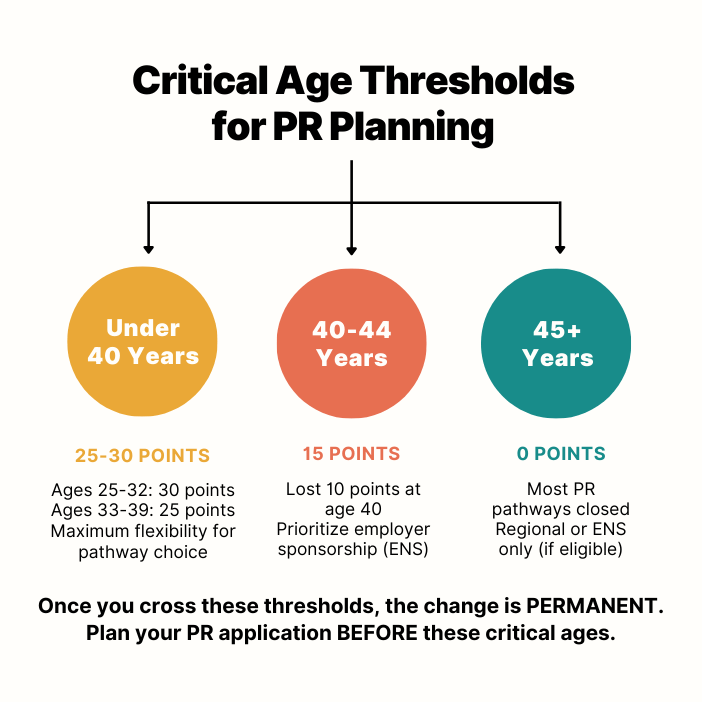
Over 40? That drop only hits the 189 and 190. The ENS has no points test, so age points don’t come into it.
The 2-Year Employment Rule for ENS Process
The 2-year mark is the milestone to plan around for the ENS2. Those 2 years of full-time sponsored work have to fall within the 3 years before you apply, so a gap of up to a year, like time between jobs, still fits.
Changing employers doesn’t reset the clock. Sponsored time with each employer counts toward the 2 years. If you started with a new employer before their nomination for you was approved, your time with them counts from the day the nomination was lodged.3
Think of it like a checkpoint in a video game. Switching employers doesn’t wipe your progress. It does change who can nominate you. Only the last employer who sponsored you on your 482 can.
📋 Documentation Planning
Start collecting evidence now, not later. Keep detailed employment records, note any change to your role, find out how leave affects your 2 years, and save performance reviews that show your value. This documentation becomes your insurance policy for any pathway you choose.
Getting your employer on board:
- Write down what you’ve contributed, with numbers where you can
- Start sponsorship discussions after 12-18 months of employment
- Know the costs and requirements on your employer’s side before you ask
- Expect questions about cost and commitment, and have your answers ready
📌 Bottom Line: Your 482-to-PR pathway depends on your age (under 45 for most options), your occupation and points score, and your employer relationship. The ENS needs your employer to nominate you. The 189 needs an invitation, with the minimum score set per occupation. The 190 needs a state to nominate you. Begin planning 12-18 months before your target application date.
Can You Apply for a 189 Visa While on a 482 Visa?
Yes. Your 482 doesn’t stop you, and you don’t have to tell your employer. The 189 is independent skilled migration, so there’s no employer nomination or sponsorship involved. Your 482 visa remains your legal status throughout the 189 processing period.
It’s like applying for a credit card. The bank doesn’t call your current bank to let them know you’re shopping around.
While you wait, keep meeting your 482 conditions. That means working for your sponsor, or for a new employer once their nomination is approved. Changing sponsors on a 482 isn’t easy, so don’t plan on quitting and waiting out the 189.
482 to 189 Visa: Independent Skilled Migration Track
Here’s what the 189 offers, and the reasons are all good ones.
- Complete independence from employer relationships
- No 2-year waiting period unlike ENS pathway
- Much faster processing than employer sponsorship. Home Affairs decides 90% of 189 applications in 8 months4, against 21 to 22 months for the 186.
The main thing you need is a competitive points score for your occupation. The minimum invited score is set per occupation in each round5, so there’s no single number to aim for. Your occupation also has to be on the Medium and Long-term Strategic Skills List (MLTSSL). That’s a different list from the Core Skills Occupation List (CSOL) used for the 482.
Occupation check: Being on the MLTSSL makes your occupation eligible, but it doesn’t mean it’s being invited. Home Affairs publishes the minimum score for each occupation after every 189 round, so look yours up before you count points. Some occupations have been invited at 65, the lowest possible score. Others, including Accountant (General) and Software Engineer, are still eligible but haven’t appeared in any of the three 189 rounds published since November 2024.
Applying while you’re on a 482:
- Submit your Expression of Interest without employer knowledge
- Continue meeting all conditions of your current 482 visa
- Plan for bridging visa if 482 expires during 189 processing
- Get comprehensive documentation ready independently
Regional 491/494 Visa: 4-5+ Year PR Pathway
The regional pathway (491/494→191) takes 4-5+ years minimum, against roughly 1 to 4 years on the direct routes, but has no age limit once you qualify for the 191.
Look, I’m going to be straight with you. The regional pathway isn’t the scenic route to PR. It’s more like taking the back roads through three different states when the highway was blocked.
You’ll get there eventually, but it’s going to take a while and you might question your life choices along the way.
Direct PR vs Regional Provisional Comparison
| Aspect | Direct PR (189/190/ENS) | Regional Provisional (491/494→191) |
| Timeline to PR | Roughly 1 to 4 years | 4-5+ years minimum |
| Location Requirements | Stay where you are | Must relocate to regional area |
| Visa Steps | One application to PR | Two visas (provisional then PR) |
| Work Flexibility | Varies by visa type | Restricted to regional areas for 3+ years |
| Age Limit for Initial Visa | Must be under 45 | 491: Under 45 at invitation; 494: Under 45 at application |
| Age Limit for PR (191) | N/A – direct to PR | No age limit once eligible |
| Total Cost | AUD $6,135-6,140+ (USD $4,300+) once | AUD $6,140+ (USD $4,300+) then AUD $630+ (USD $440+) later |
When This Becomes Your Best Bad Option
The regional provisional visa pathway starts making sense when…
- Your points are playing hard to get – Your occupation’s recent 189 scores are out of reach, and no state has picked you up for the 190
- Father Time is breathing down your neck – Almost 45? Grab that provisional visa before the age door slams shut. The beautiful part? Once you’re in, the 191 doesn’t care if you’re 48 or 88
- Your employer won’t put a ring on it – No ENS sponsorship and your points aren’t cutting it for independence
- You’re genuinely okay with regional life – And I mean genuinely. Not “I’ll tolerate it for PR” but actually okay with it
- Your family’s on board – Because dragging reluctant teenagers to regional Australia is about as fun as it sounds
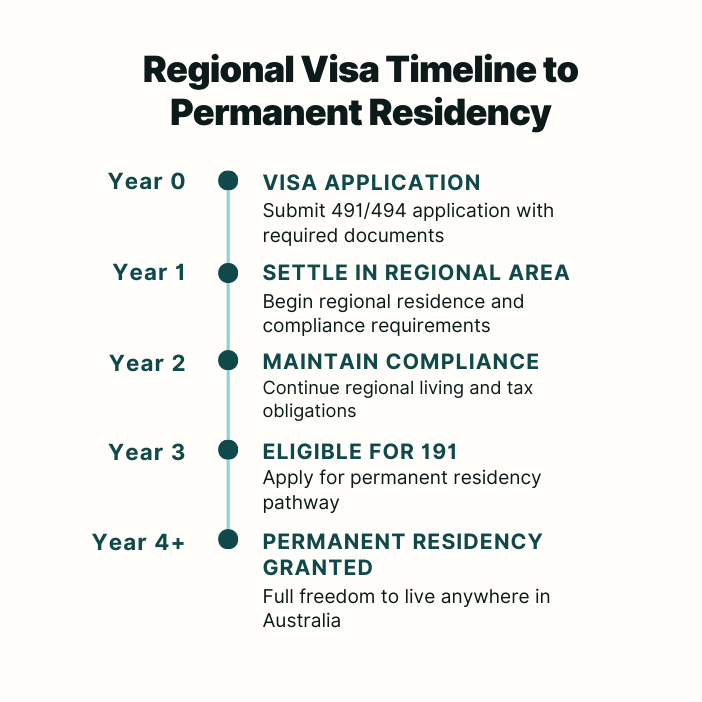
Calling this a “last resort” sounds harsh. Let’s call it what it is. Your safety net when Plan A through C didn’t pan out.
The good news? “Regional” includes places like Perth, the Gold Coast, and Adelaide. Perth has 2.45 million people. Adelaide’s got world-class restaurants and wine regions. Calling these places “regional” is like calling Target a boutique shop, but Australian immigration has its own dictionary.
Want the full scoop on which areas qualify, how the whole thing actually works, and whether you’ll lose your mind in the process? Check out my complete regional provisional visa guide.
Backup PR Plans If Your 482 Situation Changes
Pick your main route, then pick a backup. Immigration rules change and so do jobs, and a Plan B means one bad turn doesn’t end your PR plans.
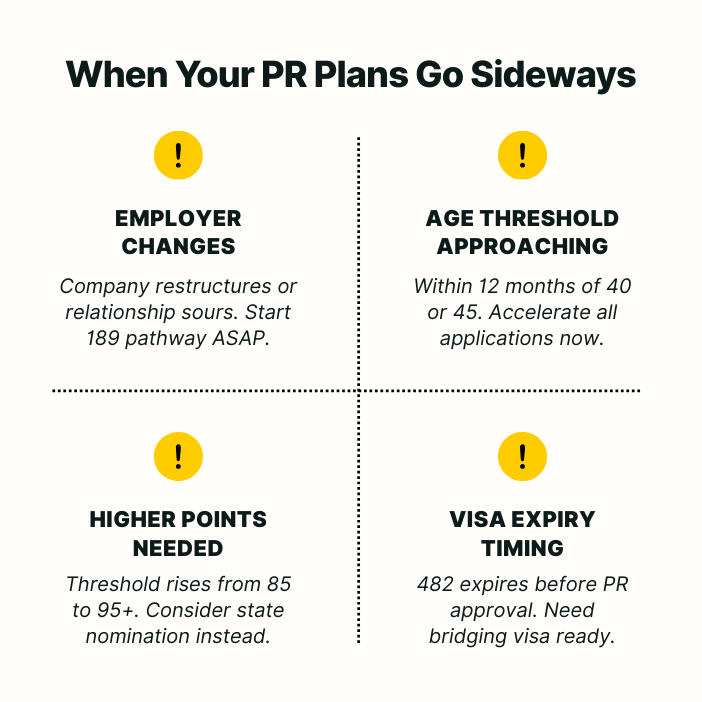
What happens if your employer relationship changes unexpectedly? This reality hits more 482 visa holders than you’d expect. Having backup options means you’re prepared instead of panicked.
🛡️ Backup Planning
Don’t just plan for success. Plan for the curveballs. Too many people put all their eggs in the employer sponsorship basket only to have their job situation change, leaving them to find a new job and a new sponsor for their visa. Multiple option preparation isn’t paranoia. It’s smart planning.
Things That Can Go Wrong
- Age threshold closeness needing timeline acceleration
- Employer relationship changes affecting ENS eligibility
- Points threshold increases hurting competitiveness
- Policy changes affecting visa availability
- Processing delays needing visa status management
When to Switch to Plan B
- Switch to backup option at 6-month checkpoints
- Bridging visa needs for processing extensions
- Consider regional pathway only if you’re genuinely okay with the 4-5 year commitment and lifestyle change
- Skills assessment complications needing professional support
482 to PR Timeline: When Should You Start Your Application?
Start planning 12-18 months ahead for your preferred PR route. The full journey from 482 to PR runs roughly 1 to 4 years on the direct pathways, depending mostly on whether you need two years with your employer first, and 4-5+ years if you go regional.
12-Month Timeline for Direct PR Pathways
- 12+ months ahead: Research pathways and calculate points
- 9 months ahead: Pick target pathway and plan approach
- 6 months ahead: Update/gather any missing documentation
- 3-6 months ahead: Submit Expression of Interest (points-tested) OR confirm your employer will nominate you (ENS)
- At eligibility: Submit complete application
Permanent Residency Visa Processing Costs and Times
Direct PR Visa Options
- ENS (186): AUD $6,140 (USD $4,300) application fee, 21 months processing for 90% of Direct Entry applications and 22 months for Transition6
- Skilled Independent (189): AUD $6,135 (USD $4,300) application fee7, 8 months processing for 90% of applications
- State Nominated (190): AUD $6,140 (USD $4,300) application fee8, 17 months processing for 90% of applications9
Regional Provisional Visa Option (if you’re really committed)
- Regional Provisional (491/494): AUD $6,140 (USD $4,300) initial + AUD $630 (USD $440) for 191 after 3 years10, 4-5+ years total timeline
The USD costs listed above are currency exchange estimates, not a sale price, and they go up with each dependent you add. But that’s not the whole picture. You’ll also pay for a skills assessment, health checks, and a migration agent, if you use one. Processing times are from the Department of Home Affairs processing times guide, captured September 2026.
Here’s What You Can Do Today
- Calculate points using official calculator
- Check occupation on relevant skilled occupation lists
- Research skills assessment needs for your occupation
- Pick main PR route using comparison table above
- Find backup options
- If going for ENS: Schedule informal employer sponsorship discussion
- If going for points-tested: Start preparing your Expression of Interest
- Begin formal skills assessment process if needed
- If considering regional: Make sure you actually want to live regionally (not just tolerate it for PR)
Bridging Visas and When You Need One
Apply for your PR before your 482 expires. When you lodge your PR application onshore, you’ll automatically receive a Bridging Visa A (BVA) that maintains your lawful status in Australia while your PR is being processed. If your 482 expires before lodging your PR application, you become unlawful and may need to leave Australia.
Bridging Visa Facts
- Automatic grant: BVA is granted automatically when you apply for PR while in Australia
- Work rights: Usually continues your existing work rights from your 482 visa
- Travel restrictions: BVA doesn’t allow re-entry if you leave Australia
- Bridging Visa B: Apply for BVB if you need to travel overseas, AUD $575 (USD $405)11
- When to apply: No more than 3 months, and not less than 2 weeks, before you want to travel12
💡 Main Points: Apply for PR before your 482 expires to automatically receive a Bridging Visa A (BVA). The BVA maintains your work rights and lawful status during processing. If you need to travel overseas, apply for a Bridging Visa B.
How Your 482 Visa Helps You Get PR
The Australian immigration system creates clear connections between temporary visas and permanent outcomes. Your 482 visa performance affects PR options and success probability.
In 2024-25, 29,349 people moved from Temporary Resident (Skilled Employment) visas to permanent residency. These transitions made up 29.1% of all temporary-to-permanent transitions in Australia. This makes the 482-to-PR route the most common transition track.
Overall, 54.6% of permanent places went to people already in Australia on temporary visas. This shows that moving from temporary to permanent status is well-established in Australia’s immigration system.
What Are the Success Rates for 482 to PR Pathways?
Department of Home Affairs 2024-25 data shows high success rates across all PR options.
- Employer Sponsored (186): 98.9% grant rate
- State/Territory Nominated (190): 98.7% grant rate
- Skilled Work Regional (491): 97.8% grant rate
- Skilled Independent (189): 96.9% grant rate
These high success rates reflect Australia’s organized skilled migration system. By application decision stage, most applicants have met tough eligibility requirements.
The main challenge isn’t application approval. It’s qualifying for and getting an invitation to apply. This matters for points-tested tracks where competition for invitations can be tough.
📌 Important Point
Success rates show the importance of route selection and preparation rather than application execution. Focus energy on choosing the right option and meeting eligibility requirements. Don’t worry about application rejection.
From Frustrated 482 Holder to PR in 3 Months
Remember the email subscriber I mentioned who was struggling with her job situation? She had everything going for her on paper. PhD from a US university, profession on the skills list, excellent English scores. The only problem was an unsupportive employer making her life miserable.
Rather than stick it out for two years to qualify for employer sponsorship, she decided to go independent. Applied for the 189 visa without saying a word to her boss.
Three months later, she sent me this: “I got my permanent residency in less than three months! I was SO lucky and got my invitation within a day.”
Now, getting invited within 24 hours is incredibly rare. Most people wait months for invitation rounds. But her story shows something important. If you’ve got strong qualifications and high points, the 189 route can free you from employer drama completely.
What I Wish I’d Known
When I look back at our missed permanent residency opportunity, the biggest regret isn’t just the outcome. It’s knowing we could have succeeded with better planning.
Those skills assessment hurdles and that dreaded age cutoff blocked our path. Being four years older than my husband didn’t help! This changed our entire life trajectory.
If I were to do it all over again, I’d start by creating a detailed PR timeline on day one of arriving in Australia. I’d work backward from those critical age thresholds. Age 40 means losing 10 valuable points. Age 45 is the cutoff for most pathways! I’d map out exactly when to begin each step.
And I wouldn’t wait to start collecting evidence. Employment records matter. Qualifications matter. Performance reviews matter. You’ll need documentation regardless of which pathway you choose.
Your path to PR begins now. Not when you’re “eligible” to apply. With the framework I’ve outlined in this guide and timely action, permanent residency becomes achievable. What once seemed like wandering through a maze blindfolded becomes an achievable milestone in your Australian story.
For detailed guidance on next steps, including document preparation and pathway-specific planning, check out my permanent residency resources or consult with a registered migration agent.
Common Questions: Applying for PR on a 482 Visa
Which PR options are available from my 482 visa?
Three direct PR options exist: Employer Nomination Scheme (186), Skilled Independent (189), and State Nominated (190). These lead directly to permanent residency. Ninety percent of applications are decided within 8 to 22 months.
For those who can’t qualify for direct pathways, a regional provisional pathway (491/494→191) serves as a backup plan – though it requires relocating to regional areas and takes 4-5+ years total. See my regional provisional visa guide for details.
Can I apply for a 189 visa while on my 482 visa without telling my employer?
Yes. You can apply for the 189 visa while on a 482 without informing your employer. The 189 is independent skilled migration. It doesn’t require employer involvement or sponsorship. Your employer won’t be notified by immigration.
Keep meeting your 482 conditions while your application is processed.
I’m 38 with 75 points – should I apply for 189 visa or focus on employer sponsorship?
At 38, you have roughly 2 years before losing 10 points at age 40. Whether 75 points is enough for the 189 depends on your occupation. Home Affairs publishes a minimum score for each occupation after every 189 round. Carpenter and Electrician (General) have been invited at 65 in every round since June 2024, while some occupations needed 100 or more.
The 190 doesn’t come with a lower bar. Half of invited EOIs for the 190 scored 80 or more between September 2024 and August 2026, and the same is true for the 189. The ENS has no points test, but your employer has to nominate you, and you need 2 of the last 3 years in full-time sponsored work while holding a 457, 482 or eligible bridging visa.
Running both: SkillSelect lets you hold more than one EOI, so the 189 and the 190 don’t have to be an either-or.
Which PR route is best if I’m on a Skills in Demand visa?
There isn’t one best route. Four things set them apart: whether your employer will nominate you, how your occupation and points score line up, how close you are to 45, and whether you’re happy to commit to one state. On processing time, the Skilled Independent track (189) is the quickest of the three, with 90% of applications decided within 8 months, against 17 months for the 190 and 21 to 22 months for the ENS. Use the comparison table above to see what each visa requires side by side.
Should I consider the regional pathway if I can’t get enough points?
The regional pathway requires relocating to designated regional areas (outside Sydney, Melbourne, Brisbane) and committing to minimum 3 years there before permanent residency eligibility. It’s a 4-5+ year total journey, not a quick alternative.
Only consider this if you’re genuinely interested in regional living and can’t qualify for direct PR pathways. Remember though – “regional” includes Perth, Gold Coast, and Adelaide, so it’s not all small towns and tumbleweeds. See my complete regional visa guide to understand the full commitment.
What happens if I change employers on my 482 visa?
Changing employers doesn’t reset the 2-year qualifying period for the ENS. Sponsored time with each employer counts toward it. If you started with a new employer before their nomination for you was approved, your time with them counts from the day the nomination was lodged. The employer who nominates you for the ENS has to be the last one who sponsored you on your 482. For points-tested tracks, changing employers has less impact. Any new role should still qualify for your target visa category.
Can I apply for multiple PR options at the same time?
Yes. You can submit multiple Expressions of Interest for different tracks. You can even lodge applications for different visa subclasses simultaneously. This increases costs and complexity. Having backup options is often wise given processing uncertainties.
My 482 visa is expiring. What should I do about my PR application?
You must maintain valid visa status in Australia throughout the PR application process. If your 482 visa is expiring, you’ll need to apply for a bridging visa or another substantive visa. This maintains lawful status while your PR application is processed.
What if my 482 expires during PR processing?
If you lodge your PR application before your 482 expires, you’ll automatically receive a Bridging Visa A (BVA). This maintains your lawful status and usually continues your work rights. The BVA activates when your 482 expires and remains valid until a decision on your PR application.
If you need to travel overseas while on a BVA, apply for a Bridging Visa B (BVB) no more than 3 months, and not less than 2 weeks, before you want to travel. The BVB costs AUD $575 (USD $405) and allows re-entry to Australia.
My employer wants to sponsor me but they’re a small business. Is this a problem?
Small employers can sponsor ENS applications. They may have less experience with the process and concerns about costs: AUD $6,140+ (USD $4,300+) in fees plus administrative time.
Prepare a comprehensive business case demonstrating your value. Consider offering to manage the administrative aspects. Small businesses often value employee retention more highly. This can work in your favor.
Can I include my de facto partner in my application?
Yes. De facto partners can be included as secondary applicants in your PR application. You’ll need to prove your relationship has existed for at least 12 months immediately before applying. Evidence includes joint bank accounts, shared lease agreements, bills in both names, and statutory declarations from friends and family.
Your partner will need to meet health and character requirements. If applying for points-tested visas, your partner’s skills and English ability can contribute valuable points. Partner skills assessment adds up to 10 points if they’re under 45, have competent English, and have a positive skills assessment in an occupation on the same list as yours.
How do family members affect my PR application?
Family members can significantly impact both your points calculation and total costs.
Points impact: Partner skills can contribute up to 10 points on points-tested visas (189/190) if your partner is under 45, has competent English, and has a positive skills assessment in a relevant occupation.
Age requirements: Dependent children must be under 23 years old and financially dependent on you. Children 23 or older can only be included if they can’t earn a living because of physical or cognitive limitations.
Cost considerations: Each family member adds to your visa costs. Adult dependents (partner or children 18+) add approximately AUD $3,070 (USD $2,150) each. Children under 18 add approximately AUD $1,535 (USD $1,075) each, or AUD $1,540 on the 189. These amounts apply to each visa application, so budget accordingly.
Processing impact: Including family members doesn’t typically slow processing, but ensure all their documents (health checks, police certificates) are ready to avoid delays.
Official Government Resources
- Department of Home Affairs: Official immigration and visa information center. Your primary source for current visa requirements, processing updates, and policy changes.
- SkillSelect System: Expression of Interest submission portal and invitation tracking system for points-tested visas.
- Visa Processing Times Guide: Current processing timeframes by visa type and location.
- Official Points Calculator: Calculate your points score for skilled migration visas with scenario modeling.
- Skilled Occupation List: Every eligible occupation and the visas it qualifies for. The Core Skills Occupation List (CSOL), with 458 occupations, covers the 482 and the ENS. The 189 runs on the MLTSSL, and the 190 on the MLTSSL and STSOL.
- ENS 186 Visa Information: Official requirements and fees for employer sponsored permanent residency.
- Australian Bureau of Statistics: Official migration statistics and demographic data.
Professional Services
- Migration Institute of Australia (MARA): Find registered migration agents specializing in permanent residency pathways.
- Migration Agents Registration Authority: Verify migration agent credentials and check registration status.
- Skills Assessment Authorities: Directory of assessment bodies by occupation for professional qualification evaluation.
- Engineers Australia: Skills assessment for engineering occupations.
- CPA Australia: Skills assessment for accounting professionals.
- VETASSESS: Assessment for general professional occupations.
Tools and Calculators
- ImmiAccount: Online portal for visa applications and status tracking.
- VEVO: Visa Entitlement Verification Online – check your current visa status and conditions.
- Invitation Round Results: Latest invitation cutoff scores and processing data for points-tested visas.
- Regional Australia Postcodes: Official classification of regional areas for migration purposes.
- Department of Home Affairs, “Points table for Skilled Independent visa (subclass 189),” https://immi.homeaffairs.gov.au/visas/getting-a-visa/visa-listing/skilled-independent-189/points-table ↩︎
- Department of Home Affairs, “Temporary Residence Transition stream,” https://immi.homeaffairs.gov.au/visas/getting-a-visa/visa-listing/employer-nomination-scheme-186/temporary-residence-transition-stream ↩︎
- Department of Home Affairs, “Temporary Residence Transition stream,” https://immi.homeaffairs.gov.au/visas/getting-a-visa/visa-listing/employer-nomination-scheme-186/temporary-residence-transition-stream ↩︎
- Department of Home Affairs, “Global visa processing times,” https://immi.homeaffairs.gov.au/visas/getting-a-visa/visa-processing-times/global-visa-processing-times ↩︎
- Department of Home Affairs, “Invitation rounds,” https://immi.homeaffairs.gov.au/visas/working-in-australia/skillselect/invitation-rounds ↩︎
- Department of Home Affairs, “Global visa processing times,” https://immi.homeaffairs.gov.au/visas/getting-a-visa/visa-processing-times/global-visa-processing-times ↩︎
- Department of Home Affairs, “Visa fees and charges,” https://immi.homeaffairs.gov.au/visas/getting-a-visa/fees-and-charges/current-visa-pricing ↩︎
- Department of Home Affairs, “Visa fees and charges,” https://immi.homeaffairs.gov.au/visas/getting-a-visa/fees-and-charges/current-visa-pricing ↩︎
- Department of Home Affairs, “Global visa processing times,” https://immi.homeaffairs.gov.au/visas/getting-a-visa/visa-processing-times/global-visa-processing-times ↩︎
- Department of Home Affairs, “Permanent Residence (Skilled Regional) visa (subclass 191),” https://immi.homeaffairs.gov.au/visas/getting-a-visa/visa-listing/skilled-regional-191/regional-provisional ↩︎
- Department of Home Affairs, “Bridging visa B (BVB),” https://immi.homeaffairs.gov.au/visas/getting-a-visa/visa-listing/bridging-visa-b-020 ↩︎
- Department of Home Affairs, “Bridging visa B (BVB), Step by step,” https://immi.homeaffairs.gov.au/visas/getting-a-visa/visa-listing/bridging-visa-b-020#HowTo ↩︎