
If you're reading this because your sponsored employment just ended, take a deep breath.
Losing your job while on a Skills in Demand visa doesn't mean you have to move back home. You have more options and flexibility than you might think and you have 180 days to find a new sponsor.1
But, big but here, you need to have a crystal clear understanding of your 482 visa job loss rights and exactly what you can and cannot do during these six months. This will be the difference between successfully transitioning to a new sponsor or having to pack up your family for an unexpected return home.
The 180-day transition period gives you time to find new sponsorship without losing your visa status. Believe it or not, this is a huge improvement from the old work sponsorship visa we moved to Australia on. Back then you only had 60 days to find a new sponsor which made it impossible.2
What's more, your family's visa rights continue during this period, and you can work for other employers while you search for a new sponsor.3
Let me walk you through everything you need to know.
⏱️ Quick Article Summary
Lost your 482 visa job? You have 180 days to find new sponsorship while maintaining work rights. Your family stays, health insurance must continue, and you can work for anyone except potential sponsors (until their nomination approves). Start by documenting your end date and verifying visa status in ImmiAccount. Most nominations process in 4-8 weeks, so begin searching immediately.
⚠️ Important: Immigration policies change without notice. For advice specific to your situation, consult a registered migration agent through the Migration Institute of Australia.
How Does the 180-Day Transition Period Work?
Your 180-day countdown starts the day your employment ends. Not your last working day, but the actual end date – resignation, termination, redundancy, whatever it is.
Document this date. It determines everything.
When you find a new sponsor, they take over your existing visa with whatever time remains. You don't get a fresh 4-year visa.
During these 180 days, you can work for anyone – freelancing, contract work, whatever. But you still need to find a new sponsor within 180 days, and they must nominate you before you can work for them.
How Visa Condition 8607 Works
Normally, you must work only in your nominated occupation for your approved sponsor. When your employment ends, visa condition 8607 lets you work outside these restrictions for up to 180 days.4 This temporary flexibility makes emergency income possible while you search for proper sponsorship.
Your spouse and kids don't have condition 8607 on their visas. Their work rights continue normally and aren't affected by your employment changes.
What to Do Immediately After Job Termination on 482 Visa
482 Visa Employment Rights
Visa conditions restrict work rights during transition periods. Always verify your current visa conditions through ImmiAccount before making employment decisions.
When your employment ends, you need to act fast to protect your visa status and start your transition clock correctly. These actions protect your visa status and avoid mistakes that could jeopardize your family's future in Australia.
What to Do If You Lose Your Job on 482 Visa – 11 Step Checklist
- Get written confirmation of employment end date from employer
- Confirm the specific reason (resignation, termination, redundancy, contract completion)
- Save all employment-related emails and documents
- Take screenshots of final pay stub and employment records
- Log into ImmiAccount to verify current visa conditions
- Check that visa is still valid and note expiry date
- Review visa conditions, including condition 8607
- Save or print current visa grant notice
- Confirm health insurance remains active (this is a visa requirement)5
- Update address with the Department of Home Affairs if moving or moved
- Begin documenting transition period start date for future reference
180-Day Transition Documentation and Record-Keeping
Document your employment end date to prove when your 180-day period started. This could determine whether you have enough time to find new sponsorship.
Collect and Preserve
- Written confirmation of your end date (email, termination letter, resignation acceptance)
- Final pay stubs and employment records
- Any correspondence about the circumstances of your departure
- Screenshots of your employment portal or company systems before access is removed
Visa Status Verification
Log into your ImmiAccount immediately. You need to understand exactly what restrictions and obligations apply during your transition period.
Items and Documents to Check
- Current visa validity dates
- Specific visa conditions (especially 8607)
- Any changes to your visa status
- Contact information on file with the Department of Home Affairs
Health Insurance Continuity
This cannot be overlooked. Health insurance lapses can trigger immediate visa cancellation.
If your employer was providing insurance and coverage ended with your employment, you need replacement health insurance right away.
Compliance Warnings – Avoid These Mistakes
Most Dangerous Errors That Can Cancel Your Visa:
- Health insurance lapses – Even a gap of a few days can trigger visa cancellation
- Miscalculating available days under the 365-day total limit6
- Working for potential sponsors before their nomination is approved
- Missing notification deadlines or documentation requirements
🚨 Visa Compliance Reality: Visa condition breaches can result in immediate cancellation with no appeal rights. The Department of Home Affairs doesn't negotiate or provide grace periods for honest mistakes.
What You Need to Know About Employer Notifications
Your former employer should notify the Department of Home Affairs within 28 days of your employment ending.7 No, this is not your responsibility, but it does affect your timeline because the Department of Home Affairs needs to know your employment has ceased before your 180-day period can officially begin.
For your protection:
- Get written confirmation of your end date for your records
- This documentation could be an email, termination letter, or formal resignation acceptance
- You'll need this proof if there are ever questions about when your 180-day period started
- If you have concerns about whether your employer has properly notified the Department of Home Affairs, contact them directly at 131 881 (within Australia) or +61 2 6196 0196 (from outside Australia), Monday-Friday 9am-5pm AEST/AEDT8
📍The bottom line: It's better to be proactive than discover months later there was a notification issue that affected your transition timeline.
Finding and Securing a New Sponsor During Your 180-Day Window
Your existing visa status is actually an advantage. Why? Employers just need to nominate you and don't have to worry about visa approval. This means the transition process is faster than applying from overseas. But you're working against a tight deadline.
Nomination processing can take 4-8 weeks, so you effectively have 3-4 months to find a sponsor AND get approval. Besides the time the nomination process takes, there are other key considerations you need to be aware of.
Timeline Considerations
- Nomination processing currently takes 4-8 weeks
- You need approval before you can start work for the new sponsor
- Standard Business Sponsorship requirements add additional time
- You should start immediately and consider backup options
⏰ Timeline Check: If you're at the 120-day mark without an approved nomination, it's time to activate backup plans. Processing delays happen, and you don't want to be caught without alternatives.
Same Occupation vs. Different Occupation: Critical Timeline Differences
This affects your entire job search strategy.
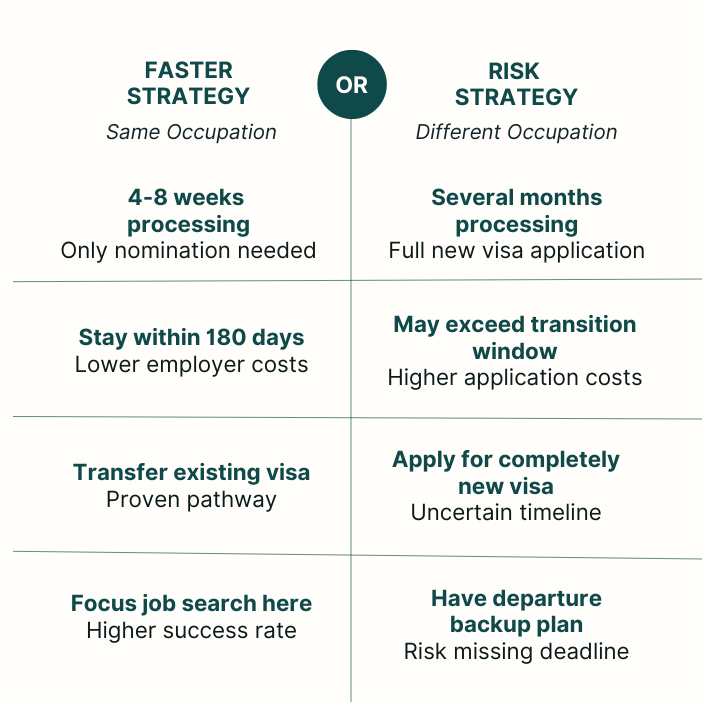
According to visa condition 8607, you must work only in the occupation nominated in your most recent Skills in Demand visa application. This creates two very different pathways when finding a new sponsor:
Option 1: Same Occupation (Faster Process 🐇)
- New sponsor nominates you for the same occupation as your current visa
- They transfer your existing visa through nomination approval
- Processing time: 4-8 weeks for nomination
- You can stay within your 180-day window
- Lower costs for new sponsoring employer (nomination fees only)
Option 2: Different Occupation (Much Longer Process 🐢)
- New sponsor wants to hire you in a different occupation than your current nomination
- You must apply for a completely new Skills in Demand visa
- Processing time: Several months (full visa application process)
- May exceed your 180-day window – significant risk
- Higher costs (full visa application fees plus nomination)
🎯 Strategy Check: If you're considering jobs in different occupations, understand this likely means applying for a new visa rather than transferring your existing one. The problem is this could extend well beyond your 180-day period and may require departure from Australia during processing.
Job Search Implications
- Focus primarily on your nominated occupation for faster transitions
- If considering different occupations: Start those applications immediately and have backup departure plans
- Discuss timing with potential employers so they understand the process requirements
Backup Sponsor Strategy: Managing Multiple Opportunities
Many visa holders wonder: Can I pursue multiple sponsors simultaneously?
The short answer is yes – there's no rule preventing multiple employers from nominating you during your transition period.
Since you only have 180 days to find a new sponsor, and processing takes up to 8 weeks, backup options isn't a bad idea. But only if done right.
How This Works
- Multiple employers can submit nominations for you at the same time
- Each nomination goes through processing independently
- You'd accept the first approved nomination that meets your needs
- Other employers would withdraw their pending nominations
Considerations
- Be transparent with potential employers – let them know you're exploring multiple options due to timeline constraints
- Understand employer costs – each nomination involves fees (typically $330 plus potential Standard Business Sponsorship costs)9
- Ethical obligations – don't encourage employers to invest in nominations unless you're interested
- Quick decision-making – be prepared to make immediate decisions when approvals come through
When This Strategy Makes Sense
- You're early in your transition period (first 60-90 days)
- You have multiple legitimate opportunities in your field
- The timeline pressure justifies the backup approach
- You can be genuinely committed to any of the potential employers
💬 Sample script: “Given the 180-day timeline and processing delays, I'm exploring a few opportunities to make sure I can secure sponsorship within my visa period. I'm very interested in this role and would prioritize your offer if approved.”
Being honest about your situation.

Why Processing Times Could Kill Your Timeline
Currently, 75% of nominations are processed within 39-68 days depending on the SID visa stream.10 This means if you find a sponsor by day 90, you should receive approval before your transition period expires.
180-Day Timeline for 482 Visa Job Loss
- Day 0: Employment ends, 180-day countdown begins
- Days 1-7: Complete emergency checklist, document end date, verify visa status
- Day 30: Financial assessment complete, serious sponsor search underway
- Day 90: Should have solid sponsor prospects or consider other options
- Day 120: Latest point to submit nomination applications given processing times
- Day 150: Final decision point for alternative visa pathways
- Day 180: Transition period expires – must have new sponsor or depart
Here's what this means in real terms.
If you hit day 120 without a submitted nomination, even the fastest processing (39 days) puts your approval at day 159. That's 21 days before your visa transition expires – not a comfortable margin when you're dealing with government processing.
And that's assuming everything goes perfectly. I don't know about you, but nothing has ever gone perfectly for me. Or at least that I can remember.
Processing delays happen, the Department of Home Affairs sends applications back for more information, and sometimes nominations just sit longer than expected. You don't want to be gambling with your family's future in Australia on government processing speeds.
Processing delays can push approvals beyond your 180-day window.
Can I Work During My 180-Day Transition Period?
Yes, you CAN work during your 180-day transition period.
Not just for potential new sponsors, but for anyone.
The only restriction is you cannot work for a new sponsor until their nomination is approved.
Emergency Income Options: Legal Work During 180-Day Visa Transition
Immediate Income Strategies
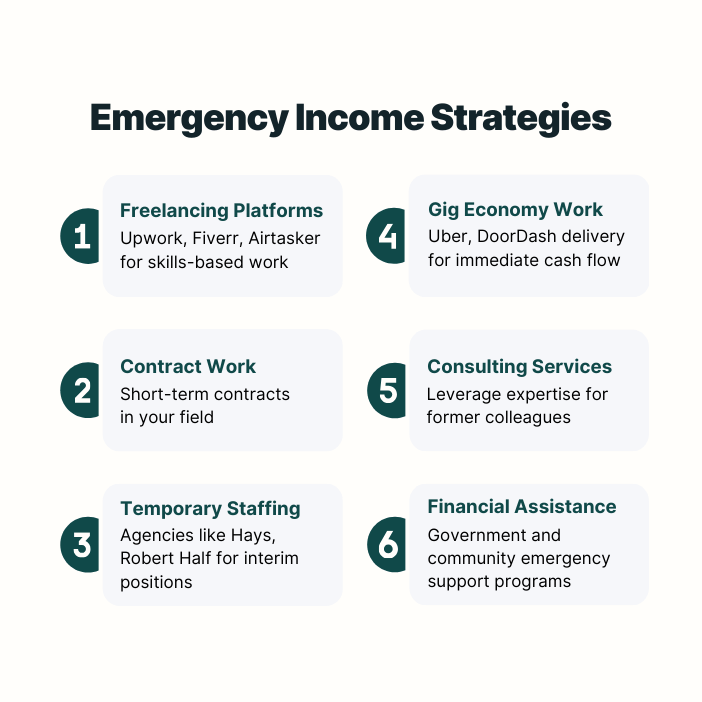
- Freelancing platforms – Upwork, Fiverr, Airtasker for skills-based work
- Gig economy – Uber, DoorDash, Menulog delivery for immediate cash flow
- Contract work – Short-term contracts in your field while seeking sponsorship
- Consulting – Leveraging your expertise for former colleagues or networks
- Temporary staffing – Agencies like Hays, Robert Half for interim positions
What's NOT allowed
- Working for a potential sponsor before the Department of Home Affairs approves their nomination
- Breaching any other visa conditions (like health insurance requirements)
- Working in occupations that require specific Australian licensing you don't have
Keep detailed records of all work and income during your transition period. You'll need this documentation for tax purposes when you file your tax return with the Australian Taxation Office.
Emergency Income After 482 Visa Job Loss
💰 Financial Disclaimer: Emergency financial strategies discussed are general options only and not personalized financial advice. Consult with qualified financial advisors for advice specific to your circumstances.
Losing your job creates immediate financial stress, especially since the cost of living in Sydney is so high. I'm sure this is not news to you.
What might be news to you are all the resources and financial strategies available to help bridge the gap between paychecks.
These are your “break glass in case of emergency” options.
Immediate Financial Relief Options
- Banking assistance – Contact your bank about mortgage or loan deferrals, hardship provisions through ASIC's financial hardship information
- Rent assistance – Speak with your landlord or rental management agency about payment plans and available programs
- Superannuation early access – Temporary residents may qualify for early access in cases of severe financial hardship through Services Australia
- Emergency assistance services – Community support organizations (see Resources section)
- Government support – Some local councils offer emergency assistance programs through Australia.gov.au services directory
I have several resources listed at the bottom to get you started or to start exploring what your options are.
Unlock Your Super: Early Access for Financial Hardship
The criteria for early access are strict, but if you meet them, this could provide financial breathing room. You'll need to demonstrate genuine hardship and show you've exhausted other options.
Start this process without delay. It can take several weeks.
What Happens to My Family During the Transition Period?
Losing your job when you're the primary visa holder hits differently when you have a family.
On a positive note, your family's rights continue during your transition.
What doesn't change for your family
- Your spouse can keep working for their current employer
- Your spouse can change jobs or seek new employment freely
- Kids continue school without interruption
- Everyone maintains healthcare coverage during the 180 days
- No one needs to leave Australia during your transition
↩️ Sponsorship Pivot: Your spouse could become the primary visa holder through their employer, if their employer offers sponsorship. Or maybe they find sponsorship before you do? This “role reversal” could work, saving you from having to find a new sponsor. Or perhaps taking pressure off so you can explore permanent residency options.
What Happens If You Can't Find a New Sponsor Before Day 180
🛂 Visa Pathway Disclaimer: Alternative visa options have specific eligibility requirements and processing times. No pathway guarantees success. I strongly recommend getting professional migration advice before applying for any of the alternative visas listed below.
If you're reading this at day 150 with no sponsor prospects, I won't sugarcoat it, this is exactly the situation you wanted to avoid.
Don't panic.
You're not out of options yet, but you need to act before day 180. Once your transition period expires, you cannot submit new visa applications from within Australia.
Alternative Visa Pathways
If sponsorship isn't happening, these alternatives might buy you time or provide different pathways.
Alternative visa options
- Skilled Independent visa (189) – If you have 65+ points and under age 45
- Regional visa pathways – Different requirements outside major cities
- Student visa – Maintains legal status while regrouping
The catch is that most of these alternatives require months of processing and significant upfront costs. They're not magic solutions, but they might work depending on your specific situation.
It's worth noting that in 2023-24, 26,892 people successfully transitioned from Skills in Demand visas to permanent residency. This represents nearly 1 in 4 of all temporary-to-permanent visa transitions in Australia, according to Australia's Migration Trends 2023-24 report from the Department of Home Affairs.
When switching from one visa to another, you can apply for a bridging visa.
For guidance on which bridging visa and which alternative visa listed above works best for you, I highly recommend talking with a migration agent.
This is something you want to get right the first time. And if you do this right, you may never have to search for a sponsorship again.
Strategic Departure: Leaving on Your Terms
Returning home isn't failure. Yes, it absolutely sucks, and the logistics can feel overwhelming when you're already stressed.
But leaving on your terms with proper planning beats scrambling after your visa expires.
How Does the 365-Day Total Limit Work?
I had no idea that the 365-day limit applies to the total transition time across the entire visa period, not per transition. So, if you've already used 100 days in a previous 180-day transition, you only have 265 days remaining for future transitions. But each one is still 180 days between new sponsors. Does that make sense?
Day Calculation Must-Knows
- Count every day from employment cessation to new employment start
- Include weekends and public holidays in your count
- Previous transition periods count against your total allowance
- The clock doesn't reset when you get new sponsorship
🗄️ Record-Keeping Requirements: Document every employment change, transition period, and return to work. The Department of Home Affairs can ask for this information at any time, and you need accurate records to prove compliance.
Staying Compliant and Informed
You have more options during your 180-day transition between sponsorships than you might think. You can work, your family's rights continue, and there are pathways forward even if new sponsorship doesn't work out.
You do need to act quickly, maintain your health insurance, and keep detailed records of EVERYTHING.
Please, get professional migration advice if your situation is complicated! Do this before you need to. Yes, you might have to pay for their time, but it will be worth it.
Official Government Resources
- Department of Home Affairs – Crisis contact information and official visa policies including transition period rules
- ImmiAccount Portal – Visa status checking and emergency access guidance for monitoring your transition period
- Fair Work Ombudsman – Employment termination rights and workplace protections during visa transitions
- Services Australia – Emergency financial assistance eligibility and Centrelink support for temporary residents
- Australian Taxation Office – Emergency tax advice for multiple income sources during transition periods
- NSW Fair Trading – Tenant rights and rental dispute resolution services during financial hardship
- NSW Government Housing Support – Rental assistance programs including Rent Choice and bond loans for eligible temporary residents
Professional Services
- Migration Institute of Australia – Emergency consultation finder and registered migration agent directory for crisis visa situations
Emergency Financial Support
- Salvation Army Emergency Relief – Immediate financial assistance for families in crisis during visa transitions
- St Vincent de Paul Society – Family support during visa and employment transitions including emergency accommodation assistance
- Department of Communities and Justice (DCJ) Rental Assistance – Help with rent arrears (up to 4 weeks), bond loans, and tenancy support
- Energy Accounts Payment Assistance (EAPA) – Utility bill assistance for people in financial crisis
- National Debt Helpline – 1800 007 007 for free financial counseling (9:30am-4:30pm, Mon-Fri)
- Financial Rights Legal Centre – Free financial advice and counseling services for temporary residents
Crisis-Specific Community Support
Tenants' Advice Line – 1800 251 101 (Mondays 10am-1pm, Thursdays 2-5pm) for immediate tenant advice during crisis situations
Lifeline Australia – 13 11 14 (24/7 crisis support) for mental health support during visa and employment crises
Beyond Blue – 1300 22 4636 (mental health support line) with resources specifically for people facing major life transitions
Tenants' Union of NSW – Free tenant advocacy, advice, and rental negotiation support during financial hardship
- Kris Ahn Lawyers. (June 20, 2024). Important Changes to Visa Conditions 8107, 8607, and 8608: What You Need to Know. https://krisahn.com.au/changes-to-visa-conditions-8107-8607-and-8608/ ↩︎
- Work Visa Lawyers. (December 7, 2020). TSS 482 Visa and Changing Employers. https://www.workvisalawyers.com.au/services/employer-sponsored-visas/tss-482-visa/tss-482-visa-and-changing-employers.html ↩︎
- My Access Australia. (July 27, 2024). TSS 482 visa update – Condition 8607. https://www.myaccessaustralia.com/482-visa-condition-8607/ ↩︎
- Comandini Migration Services. (October 29, 2024). From 1 July 2024, significant changes will be implemented to visa conditions 8107, 8607, and 8608 as part of the Australian Government's Migration Strategy. https://www.comandinimigration.com.au/migrate-to-australia/from-1-july-2024-significant-changes-will-be-implemented-to-visa-conditions-8107-8607-and-8608-as-part-of-the-australian-governments-migration-strategy/ ↩︎
- Kris Ahn Lawyers. (June 20, 2024). Important Changes to Visa Conditions 8107, 8607, and 8608: What You Need to Know. https://krisahn.com.au/changes-to-visa-conditions-8107-8607-and-8608/ ↩︎
- Work Visa Lawyers. (December 7, 2020). TSS 482 Visa Condition 8607. https://www.workvisalawyers.com.au/services/employer-sponsored-visas/tss-482-visa/tss-482-visa-condition-8607.html ↩︎
- My Access Australia. (July 27, 2024). TSS 482 visa update – Condition 8607. https://www.myaccessaustralia.com/482-visa-condition-8607/ ↩︎
- Australian Consulate-General Noumea. Home Affairs – Immigration (visas) Citizenship and Border Protection. https://noumea.consulate.gov.au/nmea/Visas_and_Immigration.html ↩︎
- MinterEllison. On Saturday, 7 December 2024, the Government released the new Skills in Demand (subclass 482) visa, replacing the Temporary Skill Shortage (subclass 482) (TSS) visa. https://www.minterellison.com/articles/delays-to-governments-new-skills-in-demand-visa ↩︎
- BAL Immigration News. (March 12, 2025). Australia | Updated visa processing times. https://www.bal.com/immigration-news/australia-updated-visa-processing-times/ ↩︎