
Yes, 482 visa holders can bring spouses, partners, and dependent children under 23 to Australia.
Bringing your family to Australia on a Skills in Demand Visa involves unique challenges beyond the general visa requirements. While you're focused on employment documentation as the primary applicant, your family members face additional hurdles with relationship evidence, custody documents, and age thresholds that could make or break your move to Sydney.
For general visa documentation requirements, check my Skills in Demand Visa Documentation Made Simple and Clear guide. This article focuses on family-specific considerations that could save you months of stress and heartache.
⏱️ Article Summary
482 visa holders can bring family members including spouse/partner and children under 23 to Australia. Processing time: 9 months Core Skills, 45 days Specialist Skills, for 90% of applications. Key requirements: relationship proof, Form 1229 custody consent (if applicable), and financial capacity. Choose combined application (everyone arrives together) or subsequent entrant (family joins later).
⚠️ Important: Immigration policies change regularly. Always check the Department of Home Affairs SkillSelect portal for current information and consult with a registered migration agent for personalized advice about your specific circumstances.
Who Can You Bring on a 482 Visa?
Here are the family members eligible as dependents on your Skills in Demand visa (subclass 482):
| Family Member | Eligibility Requirements | Key Documentation |
| Spouse/Partner | Legal marriage OR de facto relationship (12+ months) | Marriage certificate OR evidence of shared life |
| Biological children | Under 23 years old AND financially dependent | Birth certificates, passport |
| Step-children | Under 23, financially dependent, AND other parent consent | Birth certificate, custody documents, Form 1229 |
| Adopted children | Under 23 years old AND legally adopted | Adoption papers, court orders |
| Other dependents | Financially dependent AND part of household | Proof of dependency, legal guardianship |
The Department of Home Affairs assesses your financial capacity to support all dependents. This isn't usually an issue if you've secured employment with a salary above the Core Skills Income Threshold (CSIT), which is AUD $79,423 for nominations lodged between 1 July 2026 and 30 June 20271.
Family Migration Decision Framework
One of the first crucial decisions is whether to apply together with your family or have them join you later. This choice affects timing, costs, and documentation requirements.
Combined vs. Subsequent Application Approaches
| Consideration | Combined Application | Subsequent Entrant Application |
| Timeline | Everyone arrives together | Primary applicant first, family follows |
| Processing time | Core Skills: 9 months (90% of applications) Specialist Skills: 45 days (90% of applications)2 | Initial: same as a combined application Subsequent: no separate figure published3 |
| Cost | One-time higher fee | Initial fee + later dependent fees |
| Documentation | All documents needed at once | Can gather dependent docs over time |
| Housing setup | Need immediate family accommodation | Can secure suitable housing before family arrives |
| School enrollment | Children start together with move | Can research schools before children arrive |
| Employment | Both adults search simultaneously | Partner can job search from afar or after arrival |
| Rights & obligations | Same for all family members | Same as primary visa holder's rights and obligations |
Processing times from the Department of Home Affairs processing times guide, read September 2026.
Recommended Approach for Common Scenarios:
- Complex custody situations: → Subsequent application gives more time to gather documentation
- School-age children mid-year: → Subsequent application allows for school-year planning
- Partner with career considerations: → Subsequent application allows job hunting from US
- Tight timeline for primary job start: → Subsequent application prevents delays from family documentation
- Pregnant or planning pregnancy: → Combined application avoids complications with adding newborns later
While many families prefer a combined application to avoid separation, a subsequent application might be smarter when you need extra time to gather custody documentation or align with school calendars.
Strategic Planning for Staggered Applications
When planning a staggered visa approach:
- Document establishment timeline: Create a calendar tracking when each family member should begin preparing documentation
- Set up document collection systems: Use shared cloud storage to gather documents while separated
- Plan communication protocols: Establish how you'll collaborate on application requirements across time zones
- Budget for higher overall costs: Factor in potential duplicate costs and exchange rate fluctuations
- Consider school enrollment timing: Align children's arrival with Australian school terms
- Prepare for potential policy changes: Stay informed about visa requirement updates between applications
482 Visa Subsequent Entrant: Adding Family Later
If you decide on a subsequent entrant application, you'll use Form 1436 (Adding an Additional Applicant after Lodgment) to bring family members to Australia after your visa approval.
Subsequent Entrant Process Overview
- Primary applicant obtains Skills in Demand visa (subclass 482)
- Submit Form 1436 for family members
- Pay visa application charges for dependents
- Provide relationship and identity documentation
- Complete health and character assessments
- Await visa decision. Sorry, but Home Affairs doesn't publish a separate processing time for subsequent entrant applications. Use the main application times as your guide: 9 months for 90% of Core Skills cases, 45 days for 90% of Specialist Skills cases4.
Dependent applications are assessed against your original visa criteria. Your family members receive the same visa with the same conditions and expiry date as yours.
The cost for subsequent applications varies by family composition. According to the Department of Home Affairs, the budget is approximately AUD $4,015 (USD $2,800) per adult and AUD $1,005 (USD $705) per child, plus health examination costs.
USD amounts are approximate and for budgeting, not today's rate.
Documentation for Subsequent Applications
Key differences for subsequent applications include:
- Form 1436 (Adding an Additional Applicant)
- Primary visa holder's current visa grant notice
- More extensive relationship evidence if relationship is new
- Evidence of relationship existence at the time of primary visa grant
- For children born after primary visa grant, full birth certificates
🚨 Critical point: Subsequent applications face higher scrutiny of relationships. Be prepared to provide robust evidence that the relationship existed at the time of your original application.
How to Add a Baby Born on 482 Visa
For babies born in Australia:
- Notify Department of Home Affairs within 28 days using Form 1022 (Notification of changes in circumstances)
- Provide birth certificate and passport when available
- Obtain letter of support from your sponsoring employer5
- No visa application fee for babies born in Australia
The letter of support from your employer is a simple letter stating that they know you're adding a new family member to your 482 visa and they agree to their obligations to you and your family, as sponsors of your visa.
It is not a letter supporting you having a baby because that would be weird. I know you probably figured that out on your own but I wanted to be clear.
For babies born outside Australia:
- Submit Form 1436 for the newborn
- Provide birth certificate and passport
- Pay applicable visa fee
- Complete health checks as required
Start the process immediately after birth to avoid complications.
482 Visa Family Documentation Requirements
Partner/Spouse Documentation
Australian immigration expects financial intermingling between partners. This single difference trips up countless couples who still have separate financial accounts.
When my husband and I moved to Sydney with separate bank accounts, it raised red flags with Australian immigration officials who interpret financial separation as a sign of an uncommitted relationship.
Documentation Requirements by Relationship Type
| Relationship | Primary Requirements | Supporting Evidence |
| Married | • Marriage certificate • Joint financial account • Shared address proof | • Joint asset ownership • Travel history together • Wills naming each other |
| De facto | • 12+ months cohabitation evidence • Joint financial account • Statutory declarations | • Shared household expenses • Social evidence (photos) • Joint travel bookings |
Without financial interdependence evidence, even a legal marriage may face scrutiny. If you maintain separate finances, take these steps at least 3 months before applying:
- Open a joint bank account
- Add each other to insurance policies
- Create documentation showing how you share expenses
The Australian system prioritizes evidence of intertwined lives over legal status alone.
482 Visa Dependent Child Documentation
⚠️ CRITICAL TIMELINE ALERT: Child custody documentation is the #1 cause of family separation during migration. Begin the consent process (Form 1229) at least 6 months before application, especially with shared custody arrangements.
Documentation Requirements by Custody Situation
| Custody Situation | Required Documentation | Timeline Consideration |
| Shared custody | • Form 1229 from non-applicant parent • Parent's government ID • Notarized consent letter • Custody agreement | Start 6 months before application |
| Sole custody | • Court orders granting sole custody • Legal documentation of custody rights | Include with initial application |
| Absent parent | • Evidence of attempts to contact • Police/court documents regarding absence • Statutory declarations | Allow extra time for processing |
Form 1229 Consent Process

The consent process follows this recommended timeline:
- 6 months before: Gather custody documents, prepare explanation
- 5 months before: Contact other parent in writing
- 4 months before: Send Form 1229 with instructions
- 3 months before: Follow up if needed
- 2 months before: Consider alternatives if consent not provided
Negotiation Strategies for Difficult Co-Parenting
When facing resistance from a co-parent:
- Create a written visitation plan that includes video calls and vacation visits
- Consider professional family mediation to facilitate agreement
- Document all communication attempts thoroughly
- Be transparent about your timeline and the child's opportunities in Australia
💡 Insider tip: For difficult situations, have your initial conversation in person with a neutral third party, then follow up with written documentation.
Consent Letter Template
This template supplements (but doesn't replace) the official Form 1229. Please note this is a suggested template based on the information in Form 1229.
Read the form carefully. And please consult a migration lawyer sooner rather than later for sticky situations.
I am not a migration lawyer or migration agent and I do not play one online. If you need a migration lawyer or migration agent, I have a few listed in my resources page plus I have a few family support organizations listed in the resources section at the bottom.
I am only adding this template to help get you started. You may need more information. You may not need this at all or you may need additional information. It is always best to consult a migration agent or migration lawyer.
[Date]
Department of Home Affairs
Australia
RE: Consent for [Child's Full Name] to migrate to Australia
I, [Full Legal Name of Non-Applicant Parent], born on [Date of Birth], as the legal parent of [Child's Full Name], born on [Child's Date of Birth] in [Place of Birth], hereby give my consent for my child to:
1. Be granted an Australian Skills in Demand visa (subclass 482)
2. Travel to Australia with [Applicant Parent's Name]
3. Reside in Australia with [Applicant Parent's Name]
I understand that this consent allows my child to remain on this visa until its expiration, with all rights and privileges granted therein.
My contact details for verification:
Address: [Current Address]
Phone: [Phone Number]
Email: [Email Address]
Sincerely,
[Signature]
[Printed Name]
Witnessed by: [Notary Name and Seal]
Date: [Date]
Notary Registration Number: [Number]
If consent is completely unattainable despite documented efforts, consult an immigration lawyer immediately to explore alternative options, including possible court intervention through the Federal Circuit and Family Court of Australia.
482 Visa Dependent Child Age Limits
Children approaching age thresholds require special planning to maintain their eligibility as dependents.
Critical Age Thresholds for Dependent Children
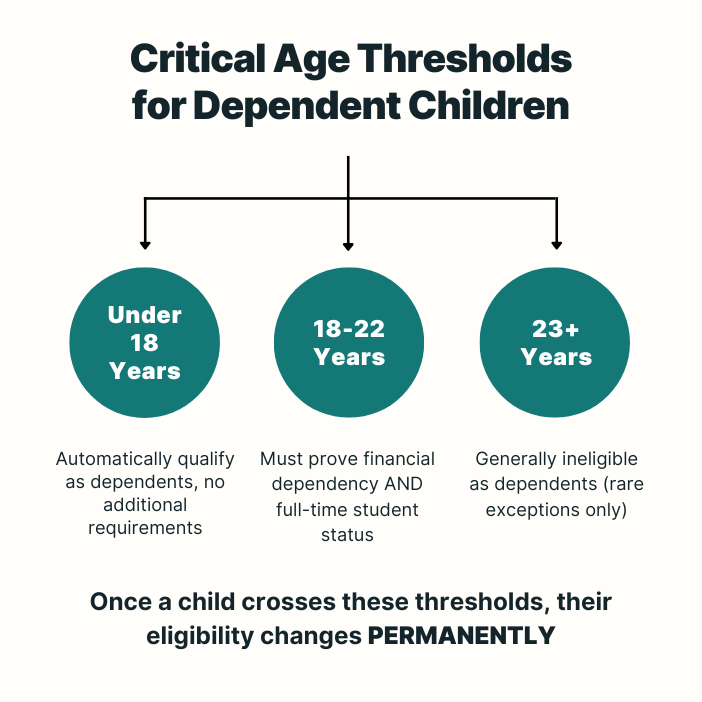
⏰ Time-Sensitive Eligibility Cutoffs
- Under 18: ✅ Automatically considered dependent
- 18-22: ⚠️ Must be financially dependent on you or your partner for at least 12 months before you apply. Study helps prove it but isn't required
- 23 and older: ❌ Eligible only if they can't earn a living due to physical or cognitive limitations
⚠️ DEADLINE ALERT: Once a child crosses these thresholds, their eligibility changes PERMANENTLY. This isn't a deadline you can fix after the fact.
Documentation for Older Dependent Children (18-22)
For children 18-22 years old, you must prove they're:
- Wholly or substantially reliant on you or your partner for financial support, more than on anyone else, to meet basic needs for food, clothing and shelter
- Financially dependent for at least 12 months before you apply
Home Affairs asks for:
- A completed Form 47a (Details of a child or other dependent family member aged 18 years or over)
- Proof of your relationship, such as a birth certificate or adoption papers
- Evidence they live with you
- Their tax records
- Proof they are currently studying, if that applies
Gap Years and Study Breaks
A break from study does not end a child's dependency. The test is financial: are they still wholly or substantially reliant on you for food, clothing and shelter, more than on anyone else?
What a gap year does and doesn't do
- A gap year is not a disqualifier by itself
- Enrolment records are useful evidence of dependency, so a gap makes the case a little harder to show
- If there is a gap, keep the evidence that does the work: proof they live with you, their tax records, and what you pay for
What actually puts eligibility at risk
- ❌ A child who starts earning enough to support themselves, whether they are studying or not
- Moving out and covering their own living costs
- ⚠️ Turning 23 before the application is decided
Home Affairs lists proof of study as one way to show dependency, not as a condition of it. A child taking a year out who is still living at home on your money is still your dependent.
Strategic Planning for Teenage Dependents
Critical Age Timeline Planning
- 16-17 year olds: ⚠️ Apply well before their 18th birthday
- 21-22 year olds: ⚠️⚠️ Apply at least 6-12 months before they turn 23
You can request priority processing age deadline consideration, especially if children are within 3-6 months of a critical birthday.
💡 Insider tip: For children approaching 23, consider applying for a student visa as a backup plan. This won't keep them on your family visa, but it provides an independent pathway to stay in Australia if they age out before your PR application.
After Arrival Considerations
Family Considerations During Job Transitions
When the primary visa holder changes employers, the entire family's status is affected. The 180-day transition period applies to all family members. It started on 1 July 2024, before the Skills in Demand visa replaced the TSS visa.
| Requirement | Timeline | Consequences if Not Met |
| Sponsor notification (separate employer obligation) | Within 28 days via ImmiAccount notification form or email to sponsor.notifications@abf.gov.au6 | Sponsor sanctions |
| New employer nomination | Within 180 days | Family must depart or change visa |
| Update family details | With new nomination | Dependents may face status issues |
Home Affairs allows up to 180 days in a single period and up to 365 days in total across the period your visa is granted for7. These periods start from 1 July 2024 and do not count any earlier time you stopped working under the condition that applied before then. For detailed guidance on managing this process, see my Making the Most of the 180-Day Transition Period article.
📝 Note: If your sponsorship ends, your sponsor has to pay reasonable and necessary return travel costs for you and your sponsored family members. You request it in writing and they have 30 days to pay. Home Affairs can make the request for you. See the sponsorship obligations for what's covered.
Future Planning
Family Considerations for Permanent Residency
Your family composition directly impacts your PR strategy, with three critical factors to balance:
| Factor | Consideration | Strategic Approach |
| Children's age | Children over 23 cannot be included in PR applications | Prioritize faster PR pathways if children approaching age limits |
| PR timeline | Most pathways require 2-3 years on temporary visa | Balance waiting periods against children's age thresholds |
| Relationship changes | Marriage, divorce, or new children affect eligibility | Add new children to visa before PR application |
⚠️ Important: Once PR is granted, there's no guaranteed way to bring over children who have aged out of dependent status. This makes timing critical when children are approaching age thresholds.
482 Visa Family Questions Answered
What documentation do children from previous relationships need?
Birth certificate, custody documents, and Form 1229 consent from the non-applicant parent (unless you have sole custody).
Can I include children if I don't have full custody?
Yes, but you'll need documented consent from the other parent. Shared custody arrangements require careful documentation and often benefit from legal advice.
What if the other parent refuses consent?
Document all attempts to obtain consent, consult an immigration lawyer, and in extreme cases, apply for court permission.
Can my child over 18 be included on my visa?
Yes, if they're under 23 and financially dependent on you or your partner for at least 12 months before you apply. Enrolment helps prove dependency but isn't required. You'll need substantial documentation, including Form 47a.
What happens to my family if I change jobs?
All family members have the same 180-day transition period to find a new sponsoring employer. The entire family's visa status is tied to the primary applicant.
Next Steps: Bringing Your Family to Australia on 482 Visa
- Assess your family's specific situation: Look at ages, custody arrangements, and educational status of all dependents
- Decide between combined or subsequent application: Based on your family's unique circumstances
- Begin document collection: Start with the most time-sensitive documents (especially Form 1229 for step-children)
- Create timeline and backup plans: Especially for children approaching age thresholds
- Consider consulting a migration agent: For complex family situations, professional advice can be invaluable
These resources provide official information, community support, and professional assistance for families migrating to Australia on the Skills in Demand visa (subclass 482):
Sydney Moving Guide Articles:
- Skills in Demand Visa Documentation Made Simple and Clear – Comprehensive guide to general visa documentation
- Rights and Obligations on a Skills in Demand Visa – What your family can and cannot do in Australia
- Making the Most of the 180-Day Transition Period – Job transition guidance
Official Government Resources:
- Department of Home Affairs – Adding Family Members – Official information on subsequent entrants
- Form 1229 – Consent Form – Official consent form for children
- Form 1436 – Adding an Applicant – Form for adding family members after visa grant
- Form 1022 – Notification of Changes – Notification of changes in circumstances
- Visa Entitlement Verification Online (VEVO) – System for checking visa status and conditions
- Skills in Demand Visa – Change in Situation – Official sponsor obligations and notification requirements
- Australian Taxation Office – Foreign Resident Tax Info – Tax considerations for families
- Department of Education – International Students – School enrollment information
- Services Australia – Moving to Australia – New arrivals guide
Family Support Organizations:
Parents Beyond Breakup – Support for separated parents
International Social Service Australia – Support for families facing international custody issues
Family & Relationship Services Australia – Resources for families in transition
- Absolute Immigration. (2024). Important Update – Temporary Skilled Migration Income Threshold (TSMIT) Rises to $73,150. https://absoluteimmigration.com/news/update-tsmit-rises-to-73150; Pathway to Aus. (2025). Australia's TSMIT: Why The 2025 Increase Matters For Skilled Migration. https://pathwaytoaus.com/general/australias-tsmit-why-the-2025-increase-matters-for-skilled-migration/ ↩︎
- Department of Home Affairs. (2026). Global visa processing times, Processing times guide: Skills in Demand visa (subclass 482), Core Skills and Specialist Skills streams. Page last updated 4 September 2026. Read 17 September 2026. https://immi.homeaffairs.gov.au/visas/getting-a-visa/visa-processing-times/global-visa-processing-times ↩︎
- Department of Home Affairs. (2026). Global visa processing times, Processing times guide: Skills in Demand visa (subclass 482), Core Skills and Specialist Skills streams. Page last updated 4 September 2026. Read 17 September 2026. https://immi.homeaffairs.gov.au/visas/getting-a-visa/visa-processing-times/global-visa-processing-times ↩︎
- Department of Home Affairs. (2026). Global visa processing times, Processing times guide: Skills in Demand visa (subclass 482), Core Skills and Specialist Skills streams. Page last updated 4 September 2026. Read 17 September 2026. https://immi.homeaffairs.gov.au/visas/getting-a-visa/visa-processing-times/global-visa-processing-times ↩︎
- My Access Australia. (2025). TSS 482 Visa Newborn Baby. https://www.myaccessaustralia.com/tss-482-visa-newborn-baby/ ↩︎
- Department of Home Affairs. (2025). Skills in Demand visa (subclass 482) – change in situation. https://immi.homeaffairs.gov.au/visas/getting-a-visa/visa-listing/skills-in-demand-visa-subclass-482/change-in-situation ↩︎
- Department of Home Affairs. (2026). Visa conditions, condition 8607 – Must only work in nominated occupation. Read 17 September 2026. https://immi.homeaffairs.gov.au/visas/already-have-a-visa/check-visa-details-and-conditions/conditions-list ↩︎