
The Skills in Demand visa (subclass 482) lets skilled workers live and work in Australia for up to 4 years with employer sponsorship, then transition to permanent residency.
We never planned on moving to Australia. Not even for vacation. But when a recruiter reached out to my husband about a software engineering position in Sydney, everything changed.
Transitioning to Australian life as an American isn't actually that hard. Sometimes it's definitely not fun and can be super frustrating, but it's absolutely doable. You just need the right information. That was the hardest part for us. I spent countless hours searching online, joining forums, and reading government websites trying to understand what a work sponsored visa actually meant for us.
Australia introduced the Skills in Demand visa in December 2024, replacing the old Temporary Skill Shortage visa. I'll do my best to break this new visa down in plain English (no legal mumbo jumbo 🤦♀️), just the practical information I wish someone had given me when we were making our move.
⏱️ Quick Summary
The Skills in Demand visa lets you work in Australia for up to 4 years with employer sponsorship, bring your family, and apply for permanent residency after 2 years. Three streams: Core Skills, Specialist Skills, or Labour Agreement. You need an employer sponsor, relevant experience, English test, and health/character checks.
⚠️ Disclaimer: I am not a registered migration agent or immigration lawyer. This article provides general information based on personal experience and research. Immigration laws change frequently. Always verify details with the Department of Home Affairs or consult with a registered migration professional before making visa decisions.
What You Get With a Skills in Demand Visa
Australia created this visa to address critical workforce gaps across many industries. It replaced the Temporary Skills Shortage (TSS) visa in December 2024, creating a clearer path for skilled workers and their families.1
Think of it as Australia saying: “We need accountants, nurses, and IT specialists… but not so much underwater basket weavers.” The government targets specific skills Australia needs right now through a streamlined, more focused approach.2
With this visa, you can:
- Work in Australia for up to 4 years
- Bring your family with you
- Apply for permanent residency after meeting requirements
- Change employers with more flexibility than ever before
Important Note for US Citizens
Unlike citizens from countries with Reciprocal Health Care Agreements (which does NOT include the USA)3, you'll need to maintain private health insurance while in Australia. This is actually a visa requirement. When we moved to Australia, we had to purchase private health insurance because Americans aren't eligible for Medicare coverage.
Which Skills in Demand Visa Stream Is Right for You?
The SID visa has three distinct streams, each designed for different types of skilled workers (which SID visa stream is right for your situation?).4
| Feature | Core Skills Stream | Specialist Skills Stream | Labour Agreement Stream |
| Who It's For | Workers with jobs on the Core Skills List | Highly specialized workers with high salaries | Workers needed under specific agreements |
| How Long It Lasts | Up to 4 years | Up to 4 years | Varies |
| Path to PR | After 2 years | After 2 years | Varies |
| Main Requirement | Job on CSOL | Salary of AUD $141,210+ | Terms in the agreement |
| Current Salary Threshold | AUD $76,515 | AUD $141,210 | Varies by agreement |
You can check the official Core Skills Occupation List on the Jobs and Skills Australia website and review skill level requirements on the Department of Home Affairs website.
🔔 Important Update: Salary thresholds increased on July 1, 2025. The Core Skills threshold is now AUD $76,515, while the Specialist Skills threshold is now AUD $141,210.5 These thresholds exclude superannuation (Australian retirement benefits).
Core Skills Stream: Requirements and Salary Threshold
This stream is the most common pathway and targets occupations on the Core Skills Occupation List (CSOL). It's perfect for professionals like teachers, nurses, and IT specialists who are in high demand but don't command the highest salaries.
SID Visa Core Skills Stream:
- Must have a job on the Core Skills Occupation List
- Annual salary must be at least AUD $76,515
- Processing times typically range from 2-4 months
- Includes trades workers and various technical professionals
- Apply directly through the Department of Home Affairs
Specialist Skills Stream: High Salary Pathway
This premium stream is for high-earning specialists and offers the fastest processing. No occupation list restricts you, just meet the salary threshold.
SID Visa Specialist Skills Stream:
- No occupation list restriction (except for trades, machinery operators and laborers)
- Annual salary must be at least AUD $141,210
- Priority processing (currently averaging 39 days as of May 2025, despite the government's original 7-day target)6
- Designed for senior professionals, executives, and specialists
- Apply directly through the Department of Home Affairs
Labour Agreement Stream: Pre-Approved Industry Roles
This stream is for specific industries with negotiated agreements with the Australian government. Most applicants won't use this stream unless their employer has a pre-existing agreement.
SID Visa Labour Agreement Stream:
- Requirements vary based on the specific agreement
- Typically used for industries with unique needs
- Agreement-specific salary thresholds and conditions
- Often used for regional or industry-specific shortages
Skills in Demand Visa Requirements
Basic Requirements for All Applicants
To qualify for a Skills in Demand visa, you need to:
- Have relevant skills and qualifications for your nominated occupation
- Find an approved Australian sponsor (often harder than finding a parking spot in Sydney, but definitely possible)
- Have at least one year of relevant work experience within the past five years7
- Pass English language requirements (usually IELTS 5.0 or equivalent)8
- Meet health and character requirements
- Be under 45 years old (for most applicants)
That age requirement is no joke. I learned this the hard way. When we considered applying for permanent residency after three years in Australia, we discovered I was over the cutoff age. If permanent residency is your goal, don't wait too long to start the process!
Age is actually one of the most critical factors in the points system for Australian PR.
For the Skilled Independent visa (subclass 189), applicants between 25-32 years old receive the maximum 30 points. After that, the points decrease gradually: 33-39 years get 25 points, 40-44 years get 15 points, and those 45 and over receive zero points for the age category.
Since the minimum threshold is 65 points overall, losing those age points can make qualifying for PR much more difficult without exceptional qualifications or experience.
How to Check If Your Job Qualifies
The Core Skills Occupation List (CSOL) determines which jobs qualify for the Core Skills Stream. Jobs and Skills Australia regularly updates this list to reflect current workforce needs.9
The CSOL includes 456 occupations across various sectors, including:10
- Healthcare professionals (nurses, doctors, specialists)
- IT specialists (developers, cybersecurity experts, data analysts)
- Engineers (civil, mechanical, electrical)
- Teachers (primary, secondary, vocational)
- Skilled trades (electricians, plumbers, carpenters)
- Business professionals (accountants, marketing specialists, HR managers)
For the Specialist Skills Stream, there's no occupation list. Just meet the salary threshold (with the exception of trades, machinery operators and laborers).
Unlike our situation, where a recruiter unexpectedly approached my husband with a software engineering position in Sydney, most people actively research their visa options first. Take time to verify your eligibility under either pathway.
Skills Assessment Requirements
Depending on your occupation, you may need to have your skills assessed by an Australian authority (guide to professional skills assessment for Australian visas). This process verifies that your qualifications and experience meet Australian standards. Each profession has a different assessment authority – for example:
- Engineers are assessed by Engineers Australia
- IT professionals are assessed by the Australian Computer Society
- Healthcare workers are assessed by bodies like the Nursing and Midwifery Board
- Tradespeople are assessed by Trades Recognition Australia
The assessment process typically involves submitting evidence of your qualifications, work experience, and sometimes completing examinations or practical assessments. Processing times range from 4 weeks to 4 months depending on the authority and assessment type.
This was a real sticking point for us. My husband got his job from working in healthcare for years, learning on the job rather than having a formal computer science degree. When we considered applying for permanent residency, the skills assessment looked like an uphill battle because he didn't have all the traditional boxes ticked. If you're in a similar situation, start preparing your documentation early and be thorough!
You'll need to gather extensive documentation including proof of identity, qualifications, and work experience.
Language and Character Requirements
English Language Requirements
Most applicants need an IELTS score of 5.0 overall with at least 5.0 in each component (Listening, Reading, Writing, Speaking) or equivalent in other approved tests: PTE Academic (36 in each component), TOEFL iBT (4 in each component), or Cambridge English (162 in each component).11 Native English speakers from countries like the UK, US, Canada, and Ireland may be exempt from testing.
Health Requirements
You'll need to undergo a medical examination with a doctor approved by the Australian government. Review the Department of Home Affairs health requirements for detailed information. The exam includes a physical check-up, chest X-ray, and blood tests to ensure you don't have conditions that might:
- Be a significant healthcare cost to Australia
- Require care that would limit Australian citizens' access to services
- Pose a public health risk
Character Requirements
You must provide police clearances from all countries where you've lived for 12 months or more in the past 10 years. Australia screens for serious criminal records, associations with criminal organizations, and security risks. Having a minor offense doesn't automatically disqualify you, but you should disclose everything.
After understanding these eligibility requirements, your next step is navigating the actual application process from start to finish.
How to Apply for the Skills in Demand Visa
Getting a Skills in Demand visa involves several phases.
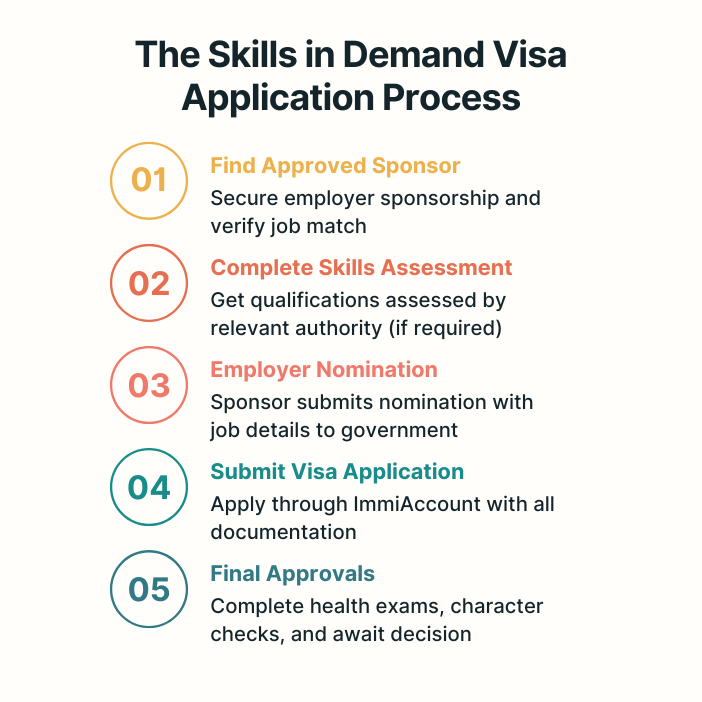
Before You Apply: Sponsorship and Documents
- Find an employer to sponsor you
- They must be approved to sponsor workers
- Your job must match your skills and experience
- Networking and LinkedIn are essential tools for connecting with potential employers
- Making your sponsorship application stand out is crucial in a competitive market
- Check if you qualify
- Is your job on the right list?
- Do you meet the age and English requirements?
- Research the specific requirements for your occupation to avoid surprises
Required Documents for Your Application
- Get your skills assessed (if needed)
- Some occupations require formal assessment
- Assessment authorities vary by profession
- Prepare comprehensive evidence of your qualifications and experience
- Get nominated by your sponsor
- Your employer submits your job details
- This is their formal commitment to sponsor you
- The nomination must be approved before you can apply
💡 A critical piece of advice: Start collecting documents early, especially police clearances, which can take months in some countries. Having everything ready will make your application process much smoother.
Submitting Your Application Through ImmiAccount
- Apply for your visa
- Submit everything through ImmiAccount
- Upload all required documents and pay fees
- Ensure all forms are complete and accurate to avoid delays
- Use the official document checklist to make sure you have everything
- Complete health and character checks
- Medical examinations with approved doctors
- Police clearances from all countries where you've lived
- Be thorough and honest in all disclosures
After You Apply: Processing Times and Next Steps
- Wait for a decision
- Processing times vary by stream and circumstances
- Core Skills Stream: typically 2-4 months
- Specialist Skills Stream: target 7-day processing
📝 Note: As of May 2025, Department of Home Affairs data shows processing times averaging 39 days for Specialist Skills Stream and 47 days for Core Skills Stream applications. Escalation requests are only considered for applications exceeding these timeframes.12
The application process may seem overwhelming, but breaking it down into these phases makes it manageable. Focus on one step at a time, prepare documentation thoroughly, and stay organized throughout the process.
🎯 Bottom Line: The application process may seem overwhelming, but breaking it down into these phases makes it manageable. Focus on one step at a time, prepare documentation thoroughly, and stay organized throughout the process.
Negotiating Your Relocation Package
When my husband first started negotiating with his company, they didn't offer any relocation support. None. Zero. He simply had to decline because we couldn't afford to move to Australia without financial help. Eventually, they agreed to reimburse shipping costs, flights, and two weeks of accommodations.
What to Ask For in Your Relocation Package
Getting the reimbursement when we arrived in Sydney was crucial. It gave us immediate Australian funds for our first apartment's rent and deposit. Without that support, we would have been hurting financially. The company also covered all visa application costs (AUD $3,115 for primary applicants as of May 2025), though initially they were only going to pay for my husband's fees, not mine as the second applicant. He turned down that offer too.
One oversight on our part was that we didn't get reimbursed for medical exams or police checks. These expenses add up quickly – especially if you have family members. Don't make our mistake. Include these costs in your negotiation from the start, along with all application fees and relocation expenses.
Health Insurance Coverage
Be strategic about what you ask for in your relocation package. I know many expats who have successfully negotiated for private healthcare coverage, particularly important since Americans aren't eligible for Australia's Medicare system. This can save you thousands of dollars annually.
Education Costs for Families
If you're moving with children, consider negotiating for school tuition coverage. This is especially important in New South Wales, where temporary work visa holders must pay to attend public schools. These fees can be substantial, so having your employer cover them can make a huge difference for your family's budget.
Each expense you can get covered means less financial stress during your transition. The worst they can say is no, but you might be surprised by what employers will agree to when they really want your skills.
How Location Affects Your Visa Options in Australia
Australia's visa system has important regional dimensions that can significantly impact your application, lifestyle, and future opportunities. Where you live in Australia isn't just about beaches versus outback. It can affect your visa pathways, processing times, and permanent residency options.
State-Specific Visa Programs
Some states offer nomination for skilled migrants through programs like:
- New South Wales – Strong demand for healthcare, IT, and finance professionals
- Victoria – Focus on technology, healthcare, and education sectors
- Queensland – Opportunities in tourism, agriculture, and healthcare
- Western Australia – Mining, engineering, and healthcare professionals in demand
- South Australia – Manufacturing, healthcare, and science roles often prioritized
Regional areas often have more flexible requirements and may offer faster pathways to permanent residency for certain occupations.
Visa Benefits by Location
Where you settle in Australia can affect your visa journey.
- Regional areas offer access to additional visa categories like the Skilled Work Regional (Provisional) visa (subclass 491)
- Major cities (Sydney, Melbourne, Brisbane) have more jobs but higher competition
- Specific occupation shortages vary by state – an occupation in demand in Western Australia might not be needed in Victoria
The definition of “regional Australia” was revised in November 201913, and now includes all of Australia except for Sydney, Melbourne, and Brisbane. This means that cities like Perth, Adelaide, Gold Coast, and Canberra are now classified as regional areas for visa purposes, opening up more opportunities for migrants willing to live outside the three major population centers. Check the official regional area postcodes on the Department of Home Affairs website or visit state migration portals for state-specific information.
Below is a breakdown of regional versus non-regional areas across Australia.
| State/Territory | Major Cities/Areas | Regional Status | Key Benefits |
| New South Wales | Sydney metropolitan area | Non-regional | Higher job availability |
| Newcastle, Wollongong, Central Coast, etc. | Regional | Faster PR pathways, additional visa options | |
| Victoria | Melbourne metropolitan area | Non-regional | Higher job availability |
| Geelong, Ballarat, Bendigo, etc. | Regional | Faster PR pathways, additional visa options | |
| Queensland | Brisbane metropolitan area | Non-regional | Higher job availability |
| Gold Coast, Sunshine Coast, Cairns, etc. | Regional | Faster PR pathways, additional visa options | |
| Western Australia | Entire state including Perth | Regional | Faster PR pathways, additional visa options |
| South Australia | Entire state including Adelaide | Regional | Faster PR pathways, additional visa options |
| Tasmania | Entire state including Hobart | Regional | Faster PR pathways, additional visa options |
| Northern Territory | Entire territory including Darwin | Regional | Fastest PR pathways, additional visa options, enhanced incentives |
| Australian Capital Territory | Entire territory including Canberra | Regional | Faster PR pathways, additional visa options |
We lived in Sydney the entire time we were in Australia, but sometimes I wonder if we should have considered regional areas. The cost of living in Sydney was so much higher than Seattle, but if we were able to move to a regional area, I'm not sure we would have made the move.
Faster Processing Times in Regional Areas
Some states receive priority processing for specific industries or skills:
- Critical sectors like healthcare and education often get faster processing regardless of location
- States with severe skills shortages may receive expedited nomination approvals
- Regional migration visas often receive higher priority processing
🎯 Bottom Line: Research state-specific migration websites when planning your application to identify where your skills are most in demand and where you might enjoy the most visa benefits.
Your Work Rights and Visa Conditions

Understanding what employers must do to sponsor you helps you better approach potential sponsors. Finding an employer willing to sponsor you is often challenging.
Understanding your rights and responsibilities helps you maximize the benefits of your visa while avoiding potential pitfalls that could affect your status.
Your Work Rights and Travel Permissions
With the Skills in Demand visa, you can:
- Work for your sponsoring employer in your nominated occupation
- Travel in and out of Australia freely without additional permits
- Study at Australian institutions (with international student fees)
- Apply for permanent residency after meeting eligibility requirements
- Change employers when needed with much more flexibility than before
- Work for anyone for up to 180 days if you leave your sponsored job
Changing Employers: The 180-Day Transition Period
One of the most significant improvements implemented in July 2024 is the 180-day transition period. This change gives visa holders much more flexibility and security.
The new rules let you:
- Take up to 180 days to find a new sponsor if you leave your job (or if your employer restructures)
- Work for any employer during this transition period
- Work in any role for any employer during this transition period – not just in your nominated occupation14
- Use up to 365 days total throughout your visa for transitions15
This safety net gives you considerably more freedom and protection than the old 60-day rule, removing much of the stress of changing jobs.
Oh my gosh, I wish we'd had this when we lived in Australia! My husband felt trapped in a job he didn't love because the position listed on his work-sponsored visa was the position he would be stuck at.
If he got a promotion or changed titles, it would require a whole new visa application, a hassle his company didn't want to deal with. This new flexibility would have made a huge difference for us.
Your Responsibilities as a Visa Holder
As a visa holder, you must:
- Work for your sponsor while you have an active arrangement
- Maintain adequate health insurance to cover what Medicare doesn't
- Notify the Department of Home Affairs of significant changes in your circumstances
- Follow Australian laws and visa conditions at all times
Understanding your full rights and obligations on a Skills in Demand visa helps you maximize your Australian experience.
Health Insurance Requirements for Americans
Since the United States does not have a Reciprocal Health Care Agreement with Australia, USA citizens need comprehensive private health insurance to cover all medical costs. Unlike visitors from countries with agreements (like the UK or New Zealand), you won't have access to any Medicare benefits, so your private insurance will need to cover everything from doctor visits to hospital stays.
🎯 Bottom Line: The Skills in Demand visa offers significant flexibility while still requiring you to fulfill certain obligations. Understanding both your rights and responsibilities will help you make the most of your time in Australia while maintaining your visa status.
How to Get Permanent Residency From Skills in Demand Visa
For many visa holders, the ultimate goal is permanent residency in Australia. The Skills in Demand visa can be your stepping stone to achieving this goal through several pathways. Our complete guide to permanent residency pathways from SID visa covers these options in detail, but here's a brief overview.16
| Visa Type | What You Need | Benefits | Typical Timeline |
| Employer Nomination (186) | • 2+ years with sponsor • Under age 45 • Continued employment in same role | • Immediate permanent residency • No visa conditions after grant • Full access to all social services | 6-12 months processing time after eligibility |
| Permanent Residence (191) | • 3+ years with sponsor • Meeting regional residence requirements | • Designed specifically for SID holders • Simpler process than other PR pathways • Regional Australia benefits | 8-14 months processing time after eligibility |
| Skilled Independent (189) | • 65+ points on points test • Positive skills assessment • Not tied to employer | • Complete freedom to work anywhere • No sponsorship needed • Select your own career path | 9-18 months application to grant (when eligible) |
The good news is that under the new system, all full-time sponsored employment counts toward permanent residence eligibility, even when changing employers. This means your work history with multiple employers is cumulative for the two-year requirement under the Employer Nomination Scheme (186 visa).17
Not applying for permanent residency when I had the chance is one of my biggest regrets.
After living in Sydney for three years, we started having serious talks about applying for PR, but we kept hitting roadblocks. Since my husband's company didn't sponsor permanent residency visas, and his skills assessment looked challenging without a formal computer science degree, we faced significant barriers.
By the time we sorted through these issues, we were close to the end of our four-year visa, and I was over the age cutoff.
So take it from me. Start planning your PR pathway early!
If permanent residency is your goal, start researching and planning your pathway from day one of your arrival in Australia. The sooner you begin preparing, the better positioned you'll be when you become eligible to apply.
Including Family Members on Your Skills in Demand Visa
One of the great benefits of the Skills in Demand visa is the ability to bring your immediate family to Australia.
Your family members can:
- Work without restrictions for partners and dependent children 18+ (this is a significant benefit – your spouse and eligible children have completely unrestricted work rights, with no limitations on hours or employer)18
- Study at Australian schools and universities (primary and secondary education is often free in public schools)
- Access Medicare for basic healthcare needs
- Apply for permanent residency together with the primary applicant
Who qualifies as a family member:
- Your spouse or de facto partner (including same-sex partners)
- Your dependent children under 18 years
- Dependent children 18-23 who are full-time students
- Children with disabilities of any age who are financially dependent on you
See the Department of Home Affairs family member definitions for complete details.
Family members must meet their own health and character requirements, but they don't need to satisfy the skills, experience, or English language requirements that apply to the primary applicant. All family members must maintain adequate health insurance as required by the Department of Home Affairs.
For many families, the partner's ability to work freely is a significant advantage, making the transition to life in Australia much more manageable financially.
I was the second applicant on my husband's work-sponsored visa, and finding work quickly was essential. The cost of living in Sydney is very high, so we needed a double income to live the way we wanted and have money for travel. I got lucky and secured a position at Garvan Medical Institute before we even left Seattle. If you're the partner, start your job search early—it'll make the transition much smoother.
Frequently Asked Questions
Taking the Next Step: Your Action Plan
✅ Ready to get started? Here's a checklist to help you begin.
- Verify your occupation on the Core Skills List or check if you'll qualify for the salary threshold
- Research state-specific opportunities to identify where your skills are most in demand
- Update your resume to Australian standards (they call it a CV, and they want it to be 3-5 pages with detailed achievements)
- Begin English test preparation if needed (IELTS, PTE, TOEFL, or Cambridge)
- Investigate skills assessment requirements for your profession
- Start networking with Australian employers through LinkedIn and industry platforms
- Gather documentation for health and character checks
- Calculate total costs including application fees, health checks, and relocation expenses
- Consult with a registered migration agent for personalized advice. Migration professionals can identify opportunities and challenges specific to your situation. Most offer initial consultations where they review your circumstances and suggest the best pathway forward.
⚠️ Important Note: Immigration requirements can change. Always check the latest information on the Department of Home Affairs website or consult with a registered migration agent before making decisions.
Related Articles on Sydney Moving Guide
- Understanding Australian Employer Sponsorship Requirements
- Core Skills vs Specialist Skills Streams
- Making the Most of the 180-Day Transition Period
- Family Migration Under Skills in Demand Visa
- Strategies for Finding Potential Australian Sponsors
Official Government Resources
- Department of Home Affairs – Visas – The official source of visa information with current requirements and application forms. Essential for verifying the latest policy changes and fee schedules.
- Skills Recognition Information – Find out who will assess your professional skills and what the process involves. Includes detailed requirements for different occupations.
- Tax Office – For Foreign Residents – Essential tax information for visa holders including tax rates and obligations. Critical for understanding your tax situation before arriving.
- Fair Work – For Visa Holders – Understand your workplace rights and protections in Australia. Particularly helpful if you encounter issues with your employer.
- Services Australia – Reciprocal Health Care Agreements – Information about which countries have healthcare agreements with Australia. Americans should note the US has no agreement.
- Medicare for Visa Holders – Complete healthcare information including coverage details and registration process. Explains what services might be available based on your visa.
Skills Assessment Authorities
- Engineers Australia – For all engineering disciplines including civil, mechanical, electrical and others. Offers detailed assessment guidelines and sample documentation.
- Australian Computer Society – For IT professionals, software developers, and digital specialists. Provides clear pathways for those with formal qualifications and those with experience-based skills.
- Trades Recognition Australia – For skilled trades including electricians, plumbers, carpenters and others. Includes assessment options for those with international qualifications.
- Nursing and Midwifery Board – For nurses, midwives and related healthcare professionals. Details registration requirements and bridging programs if needed.
- Australian Department of Home Affairs. (2024, November 30). “Skills in Demand visa program addressing workforce needs.” Retrieved from https://immi.homeaffairs.gov.au/visas/getting-a-visa/visa-listing/skills-in-demand-visa-subclass-482 ↩︎
- This Is Australia. (2024, December 13). “Skills in Demand (SID) Visa (Subclass 482).” Retrieved from https://www.thisisaustralia.com/work-visas/skills-in-demand-visa-subclass-482/ ↩︎
- Services Australia. (2024, July 11). “Reciprocal Health Care Agreements.” Retrieved from https://www.servicesaustralia.gov.au/reciprocal-health-care-agreements ↩︎
- Australian Department of Home Affairs. (2024, December 7). “Skills in Demand visa (subclass 482).” Retrieved from https://immi.homeaffairs.gov.au/visas/getting-a-visa/visa-listing/skills-in-demand-visa-subclass-482 ↩︎
- One Planet Migration Law. (2025, March 27). “New Skills in Demand Visa Salary Thresholds from 1 July 2025: What Employers Need to Know.” Retrieved from https://www.oneplanetmigrationlaw.com.au/immigration-blog/new-skills-in-demand-visa-salary-thresholds-from-1-july-2025-what-employers-need-to-know ↩︎
- Agape Henry Crux. (2025, February 28). “Updated Processing Times for Skills in Demand (SID) Visas (Subclass 482) – Feb 2025.” Retrieved from https://www.ahclawyers.com/news-articles/25/02/28/updated-processing-times-for-skills-in-demand-sid-visas-subclass-482 ↩︎
- MJ Legal. (2024, December 15). “482 visa changes (2024/2025) – TSS to SID.” Retrieved from https://mjlegal.com.au/blog/482-visa-changes-2024-tss ↩︎
- IELTS Australia. (2024, December 17). “Skills in Demand visa (subclass 482) and IELTS requirements.” Retrieved from https://ielts.com.au/australia/about/news-and-articles/article-skills-in-demand-visa ↩︎
- Jobs and Skills Australia. (2025, January 10). “2025 Core Skills Occupations List (CSOL) Update.” Retrieved from https://www.jobsandskills.gov.au/topics/migration-strategy/draft-core-skills-occupations-list-csol-consultation ↩︎
- travelobiz. (2025, January 25). “Australia 2025: Top In-Demand Jobs and Work Visa Options for Skilled Workers.” Retrieved from https://travelobiz.com/australia-2025-top-in-demand-jobs-and-work-visa-options-for-skilled-workers/ ↩︎
- MinterEllison. (2024, December). “New Skills in Demand visa and Core Skills Occupation List.” Retrieved from https://www.minterellison.com/articles/delays-to-governments-new-skills-in-demand-visa ↩︎
- Agape Henry Crux. (2025, February 28). “Updated Processing Times for Skills in Demand (SID) Visas (Subclass 482) – Feb 2025.” Retrieved from https://www.ahclawyers.com/news-articles/25/02/28/updated-processing-times-for-skills-in-demand-sid-visas-subclass-482 ↩︎
- Visa Envoy. (2025, February 8). “Designated regional areas for Australian immigration purposes.” Retrieved from https://visaenvoy.com/regional-areas/ ↩︎
- KPMG. (2024, December 9). “Australia – Further Information on Introduction of Skills in Demand Visa.” Retrieved from https://kpmg.com/xx/en/our-insights/gms-flash-alert/flash-alert-2024-243.html ↩︎
- KPMG. (2025, January 15). “Australia – Further Information on Introduction of Skills in Demand Visa.” Retrieved from https://kpmg.com/xx/en/our-insights/gms-flash-alert/flash-alert-2025-046.html ↩︎
- Grace International Group. (2024, December 30). “Skills in Demand Visa Australia 2025: Pathway to Permanent Residency.” Retrieved from https://au.graceintlgroup.com/skills-in-demand-visa/ ↩︎
- This is Australia. (2024, December 13). “Skills in Demand (SID) Visa (Subclass 482).” Retrieved from https://www.thisisaustralia.com/work-visas/skills-in-demand-visa-subclass-482/ ↩︎
- SOL Migration. (2025, January 16). “Skills in Demand Visa (Subclass 482).” Retrieved from https://www.solmigration.com/visas-services/skills-in-demand-visa/ ↩︎