

Australian states want skilled workers they need, and they're willing to give them 5 precious points towards permanent residency. The catch? You need to convince them you're worth betting on.
State nomination for the 190 visa isn't just about meeting requirements. It's about winning a competitive selection process. Think of it as professional matchmaking. States are looking for their ideal professional partner, and you need to prove you're exactly what they're searching for.
The nomination process adds 5 important points to your migration score, often making the difference between visa success and disappointment. In 2024-25, 33,000 people received their permanent residency through this pathway with a 98.7% success rate once nominated, according to the Migration Program Report 2024-25 published by the Department of Home Affairs. While the official requirement states you need 65 points minimum, most successful applicants score 65-75 points to remain competitive1.
If you're considering the 190 visa pathway, understanding how to secure state nomination is your first and most critical step.
👀 At a Glance
State nomination requires meeting basic eligibility (under 45, skills assessment, English proficiency), scoring competitively (aim for 65-75+ points), creating targeted EOI, and understanding state-specific requirements. Success Rate: 98.7% grant rate once nominated, from the 2024-25 Migration Program Report. Processing Time: 9-15 months average2. Investment: AUD $6,140 (USD $4,300) application fee3 plus state fees.
⚠️ Important: Immigration policies and visa requirements change regularly. Always check the Department of Home Affairs website for the most current information and consult with a registered migration agent for advice specific to your situation.
Understanding the 190 Visa Nomination Process
The 190 visa provides permanent residency through state sponsorship rather than independent qualification. States adopt the skilled workers they need. You get 5 points toward your migration score. They get your professional expertise where they need it most. Everyone wins (if you can survive the process).
This matchmaking works because states don't nominate people they don't believe will succeed. They're not taking chances on risky candidates. The 33,000 places granted in 2024–25 represent smart workforce planning, not random acts of kindness.
You receive 5 points. States receive your professional expertise.
Complete Eligibility Requirements for State Nomination
Before we talk about how to stand out, let's cover the non-negotiable requirements. These eliminate applicants faster than a bouncer at an exclusive club.
Required eligibility criteria include:
- Age under 45 at time of invitation (this is a hard cutoff – no “but I look young for my age” exceptions)
- Skills assessment for an occupation on the relevant skilled occupation list through the proper skills assessment process
- English language competency meeting minimum requirements (usually IELTS 6.0 in each component – yes, you need to prove you can speak the language you're reading this in)
- Work experience requirements vary by state but most require 2-3 years in your nominated occupation
- Health and character clearances from all countries you've lived in
These requirements, while challenging, are achievable with proper preparation.
📑 Documentation Suggestion
Start gathering documentation early, especially police clearances from countries where you lived years ago. These can take months to obtain. Having everything ready shows the preparedness states value in their selection process.
What Points Do I Really Need for State Nomination?
The official minimum is 65 points (including the 5 from state nomination).
What actually gets you nominated?
Most competitive applicants score 65–75 points.
You're competing against skilled professionals worldwide for limited state nomination places. While 65 points makes you eligible, states favor higher-scoring candidates, especially in popular occupations like IT, engineering, and healthcare (because everyone wants to move to Australia).
Minimum Points Requirements vs What You Actually Need
| Requirement Type | Points Needed | What This Means |
| Official Minimum | 65 points (including 5 from state nomination) | Eligible but highly competitive (good luck with that) |
| Competitive Range | 65–75 points total | Most successful applicants score in this range |
| State Nomination Boost | +5 points | Can push you from “maybe” to “yes please” |
🗣️ Points tip
Improving English scores provides one of the fastest point boosts. Moving from IELTS 7 to IELTS 8 can add 10 valuable points, often making the difference between receiving invitations and waiting indefinitely. Check current English language requirements for specific score thresholds.
⚠️ Competition Warning: While 65 points is the official minimum, most successful applicants score 65-75 points to remain competitive. States prioritize higher-scoring candidates, especially in popular occupations. Plan to exceed minimum requirements (because 65 is more like a cover charge than a guarantee).
State nomination provides those 5 important points, often transforming your competitive position from “hopeful” to “viable.”
Creating Your Successful Expression of Interest (EOI)
Your EOI functions as your professional dating profile for Australian states. It needs to showcase your skills while demonstrating genuine interest in their specific needs. Creating a targeted EOI involves more than just filling out forms (though accurate Australian spelling, not US spelling, will help your case).
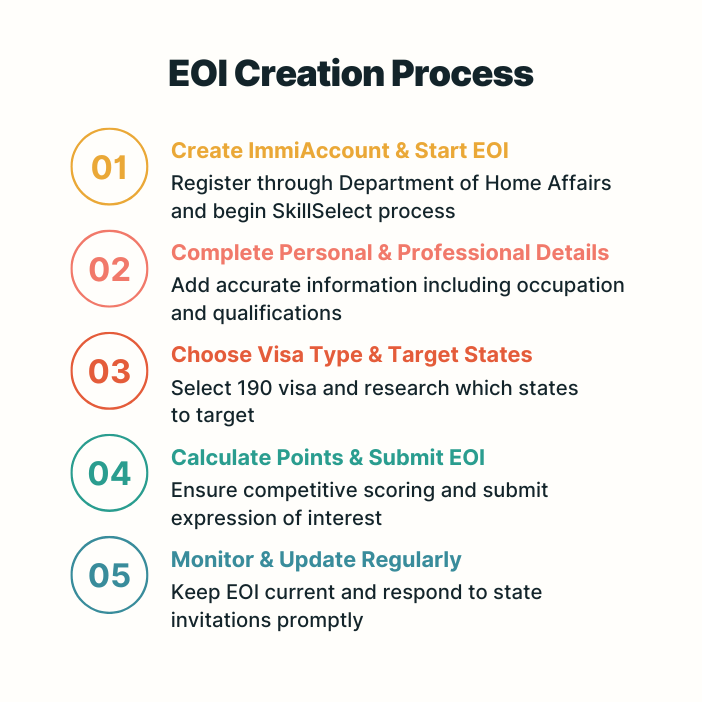
The 7-step EOI creation process
- Create your ImmiAccount through the Department of Home Affairs website
- Start your EOI in the SkillSelect system
- Complete personal information with absolute accuracy (states fact-check everything)
- Select your nominated occupation from the relevant skilled occupation list
- Choose visa subclasses (select 190 for state nomination)
- Select target states based on your research and occupation availability
- Submit and maintain your EOI with regular updates
Step 6 is where things get interesting.
Which states should you target?
Some applicants select “any state” to maximize opportunities (the shotgun approach). Others focus on specific states where they have genuine connections or career advantages (the sniper approach).
EOI Setup for State Attention
Getting your information right matters when states receive hundreds of EOIs for limited nomination places. Any gaps between your EOI and supporting documentation can eliminate you from consideration faster than typos on a resume.
Staying On Top of Your SkillSelect and EOI
- Update immediately when circumstances change (new job, improved English score, additional qualifications)
- Research state requirements before selecting which states to include in your EOI
- Show genuine interest in specific states through research and connections
- Maintain realistic expectations about processing timeframes and competition levels
🎯 State Selection
Some states prefer applicants who select only their state rather than “any state” because it shows commitment to their specific region. Research each state's selection criteria before making this decision (because playing hard to get sometimes works).
Winning State-by-State Nomination Approaches
Each Australian state operates its own nomination program with unique criteria, processing times, and selection priorities. Knowing these differences means you can focus your efforts where they'll actually work rather than applying blindly (like throwing spaghetti at the wall and hoping something sticks).
State selection involves multiple factors.
- Occupation availability on each state's specific skilled occupation list
- Processing timeframes varying by jurisdiction
- Selection criteria beyond basic points scores
- Regional commitment expectations and enforcement approaches
- Economic priorities driving current nomination plans
Current processing times average 9–15 months for the complete visa process, but individual states may nominate faster or slower depending on their current needs and application volumes according to current DHA processing timeframes.
State requirements vary dramatically.
Queensland requires offshore applicants to have 5 years experience in their nominated occupation and current employment, while onshore applicants need 6 months of Queensland residence and work.
Western Australia requires employment contracts for nomination eligibility.
What works for Queensland might disqualify you in Western Australia. Be sure you do your research.
Important Differences in State Nomination Requirements4
| State/Territory | Processing Time | Main Requirements | Special Considerations |
| NSW | 6 weeks average | Ranking system based on points | Highly competitive, large allocation (prepare for battle) |
| Victoria | 20 business days | Direct application required | Strong settlement support programs (they care) |
| Queensland | Varies by occupation | 5 years offshore / 6 months onshore | Clear experience requirements (no fudging) |
| Western Australia | 4–8 weeks | Employment contract required | Job offer needed for nomination (bring proof) |
| South Australia | 6–10 weeks | Points-based ranking | Regional opportunities available (consider the countryside) |
| Tasmania | 8–12 weeks | Genuine commitment required | Strong regional focus (island life calling) |
What actually works in practice.
- NSW loves tech workers who can show they're not just looking for any job – they want to build their career in Sydney's innovation scene
- Victoria wants families who'll actually stay – healthcare workers get bonus points for researching schools and showing they've thought through the family move
- WA basically requires a job offer – engineers with mining contracts in hand get fast-tracked because WA knows they're serious about contributing to the economy
- Tasmania offers the best odds – fewer people want to live on an island, so if you're genuinely willing to commit to 2+ years there, you'll likely get nominated faster
State Nomination Preparation Checklist
3–6 Months Before Application
- Research target state occupation lists and requirements using official state immigration websites
- Begin skills assessment process (3–6 months lead time – plan ahead)
- Improve English scores if needed for competitive edge
- Gather employment references and documentation
1–3 Months Before Application
- Create targeted EOI selecting appropriate states
- Obtain police clearances from all countries lived in
- Research state-specific settlement requirements
- Prepare financial capacity evidence
After Nomination (60-day deadline)
- Complete health examinations promptly
- Finalize character documentation
- Submit complete visa application
- Begin settlement planning for nominated state
The nationality patterns from 2024-25 show India represented 34.4% of successful 190 applicants, China 9.6%, and Nepal 7.6%5. These numbers give you an idea of the global competition you're facing.
Which Australian States Offer the Best Nomination Opportunities?
“Best” depends on your occupation, experience level, and personal circumstances. Popular states like New South Wales and Victoria receive more applications but also have larger nomination allocations. Smaller states might offer faster processing but fewer available occupations (it's like choosing between a crowded beach and a secluded cove).

Consider these factors
- Occupation demand in your target state's current labor market
- Family considerations if you're relocating with children or elderly parents
- Professional networks and existing connections supporting your settlement
- Lifestyle preferences aligning with long-term satisfaction in your chosen state
State Processing Differences
NSW typically processes EOIs within 6 weeks but high-demand occupations like software engineers may wait 3-6 months for invitation rounds. Tasmania often nominates within 8-12 weeks due to lower application volumes, while Victoria's 20-business-day timeframe applies mainly to straightforward applications with complete documentation.
Even high-scoring applicants can face extended waiting periods in competitive states like NSW. Some applicants with 90+ points report waiting over a year for invitations, highlighting that points alone don't guarantee quick nomination success. Sometimes the “best” opportunity isn't the most obvious choice.
Nomination Budget Planning
State nomination involves multiple cost layers that catch many applicants unprepared. Planning your investment prevents financial surprises during the application process (because nobody likes unexpected bills).
Complete 190 Visa Nomination Investment Breakdown
| Cost Category | Amount | Notes |
| Government Fees | ||
| Visa application fee | AUD $6,140 (USD $4,300) | Primary applicant |
| Adult dependent fee | AUD $3,070 (USD $2,150) | Per additional adult |
| Child dependent fee | AUD $1,535 (USD $1,075) | Per child (kids get a discount) |
| State nomination fee | AUD $0–300 (USD $0–210) | Varies by state (some generous, others need coffee money) |
| Required Assessments | ||
| Skills assessment | AUD $500–1,200 (USD $350–840) | Varies by assessing authority (paying experts to confirm you know your job)6 |
| English language test | AUD $300–400 (USD $210–280) | Per attempt (some become professional test-takers) |
| Medical examinations | AUD $300–500 (USD $210–350) | Per person |
| Police clearances | AUD $50–200 (USD $35–140) | Per country lived in |
| Documentation Costs | ||
| Document translation | AUD $100–400 (USD $70–280) | For non-English documents (Latin diplomas won't translate themselves) |
| Certification/notarization | AUD $50–150 (USD $35–105) | Official stamps and signatures |
| Courier fees | AUD $50–200 (USD $35–140) | International submissions |
| Potential Hidden Costs | ||
| Multiple test attempts | AUD $300–1,200 (USD $210–840) | If English scores need improvement (practice makes expensive) |
| Additional assessments | AUD $500–1,200 (USD $350–840) | If initial application rejected |
| Time off work | Variable | Appointments and document collection |
| Exchange rate buffer | 10-20% | Currency fluctuation protection |
⚠️ Important: Costs and fees change regularly. Check current visa application charges on the Department of Home Affairs website for the most up-to-date pricing information.
USD amounts are approximate and for budgeting, not today's rate. Double check them when the time comes to pay so you are not caught off guard.
I highly recommend setting up your currency exchange account or accounts early and signing up notifications. Timing is everything when it comes to transferring money overseas. (Yes, I recommend OFX for transferring money to Australia and yes they have a special offer for SMG readers.)
Your budget planning should account for the 9-15 months processing time, during which exchange rates might fluctuate and additional documentation requests might arise. Having 5-10% more than your calculated budget provides a cushion for unexpected requirements (because bureaucracy loves surprises).
From Nomination to Visa: What Happens Next
Getting a state nomination kicks off a specific sequence of actions with firm deadlines. Understanding this timeline helps you prepare documentation in advance and respond quickly when opportunities arise.
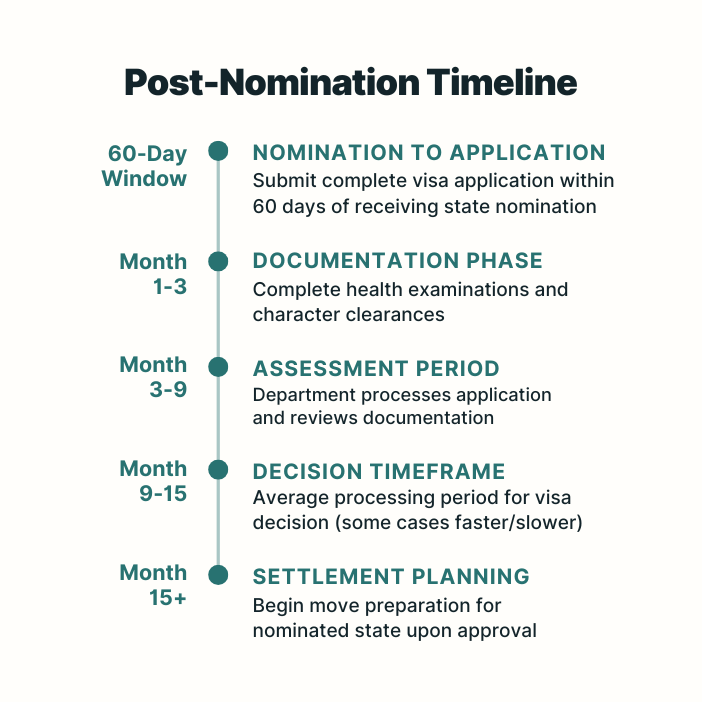
Immediate post-nomination steps
- 60-day invitation window to submit your visa application after receiving nomination7
- Complete documentation submission including all health and character requirements
- Processing period averaging 9–15 months for visa decision
- Settlement planning for your move to the nominating state
States nominate people they believe will succeed.
Yes, they make you jump through a lot of hoops but once you’re done jumping, things start looking much better and visa approval might be in your very near future. So do some stretches, warm up properly and get ready to start jumping.
Processing Timeline Expectations
The complete 190 visa process averages 9-15 months from application to approval. Plan finances and timeline accordingly. This includes state nomination wait time plus visa processing after nomination approval.
One way to make things easier on yourself is to use the time between EOI submission and potential nomination to gather all your required documents together, especially police clearances and health examinations. Be ready to submit right after nomination.
What This Means for You
State nomination isn't about being perfect on paper. It's about being the right match for what states actually need. The 33,000 people who got their permanent residency through this pathway in 2024-25 figured out that 65 points might be the official minimum, but 70+ points is where real invitations happen.
Get your skills assessment done early (because it takes forever). Score those English points. Pick your states based on genuine research. The 9-15 months processing time rewards those who plan ahead, not those who scramble at the last minute.
Official Government Resources
- Department of Home Affairs – Skilled Nominated Visa (Subclass 190)
- SkillSelect System
- Migration Program Planning Levels
- Australia's Migration Trends, 2024–25 Report
- Migration Program Report 2024-25
- Visa Processing Times
- Current Visa Application Charges
State Nomination Resources
- NSW Government – Skilled Migration
- Victoria Government – Live in Melbourne
- Queensland Government – Migration Queensland
- South Australia – Immigration SA
- Western Australia – Migration Services
- Tasmania – Skilled Migration
Professional Assessment Resources
- Skills Assessment Authorities Directory
- English Language Testing Organizations
- Skilled Occupation Lists
Community Support Resources
- Department of Home Affairs, “Skilled Nominated visa (subclass 190).” Minimum 65 points to be invited. https://immi.homeaffairs.gov.au/visas/getting-a-visa/visa-listing/skilled-nominated-190 ↩︎
- Department of Home Affairs, “Migration Program Report 2024-25,” section 2.16, p.53. State/Territory Nominated grant rate 98.7% in 2024-25. https://www.homeaffairs.gov.au/research-and-stats/files/report-migration-program-2024-25.pdf. Processing times from Department of Home Affairs, “Global visa processing times.” https://immi.homeaffairs.gov.au/visas/getting-a-visa/visa-processing-times/global-visa-processing-times ↩︎
- Department of Home Affairs, “Subclass 190 Skilled Nominated visa,” https://immi.homeaffairs.gov.au/visas/getting-a-visa/visa-listing/skilled-nominated-190 ↩︎
- Processing times and requirements as reported by individual states, subject to change. Check current state government websites for latest information. ↩︎
- Department of Home Affairs, “Australia's Migration Trends, 2024-25,” printed p.7, with counts in Table 7, printed p.8. State/Territory Nominated places by country of citizenship. https://www.homeaffairs.gov.au/research-and-stats/files/migration-trends-2024-25.pdf ↩︎
- Department of Home Affairs, “Current visa pricing.” https://immi.homeaffairs.gov.au/visas/getting-a-visa/fees-and-charges/current-visa-pricing. State nomination fees are set by each state or territory. Skills assessment fees are set by the assessing authority: https://immi.homeaffairs.gov.au/visas/working-in-australia/skills-assessment-and-assessing-authorities ↩︎
- Department of Home Affairs, “After You Submit Your Expression of Interest,” https://immi.homeaffairs.gov.au/visas/working-in-australia/skillselect/expression-of-interest/after-you-submit-your-expression-of-interest ↩︎