

So you got the email. State nomination approved. Cue the celebration dance in your kitchen (or wherever you do your happy dancing).
Want to turn that happy dance into a full blown party? 98.7% of people who reach this stage get their permanent residency.1 🎉
The hard part (convincing a state to pick you) is done. Now you're following steps that almost everyone completes successfully.
The Skilled Nominated Visa (subclass 190) gives you permanent residency plus full work freedom within your nominated state from day one. No employer controlling your visa status, no wondering if you'll need to pack up and leave. Just the straightforward trade of 2 years in your chosen state for permanent Australian residency.
So what happens next. Application processing takes 9–15 months, fees start at AUD $6,140 (USD $4,300), and you've got exactly 60 days to submit everything once your invitation arrives.
I'm covering everything you need to know about the practical implementation details after receiving nomination. If you're still working on getting nominated, check my state nomination guide first.
👀 At a Glance
You're pre-qualified for success with a 98.7% approval rate based on the 2024-25 Migration Program Report. Expect 9–15 months processing, AUD $6,140+ (USD $4,300+) in fees, plus that crucial 60-day application deadline. You get work rights from day one, immediate Medicare access, and citizenship pathway after 4 years residency, all in exchange for 2 years in your nominating state.
⚠️ Important: Immigration policies and requirements change frequently. Always check the Department of Home Affairs website for current information and consult with a registered migration agent for personalized advice about your specific situation. Processing times and fees are subject to change without notice.
Your 190 Visa Application Timeline: From Nomination to Grant
Once you've received state nomination, your pathway to permanent residency follows specific phases with clear deadlines. Understanding each phase helps you prepare and respond effectively.
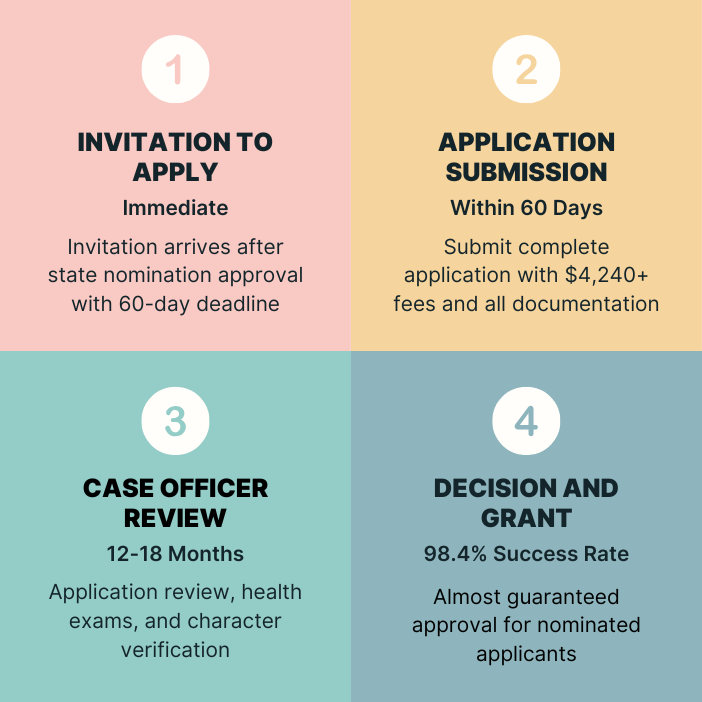
Invitation to Apply (Immediate)
Your invitation arrives immediately after state nomination approval. The Department of Home Affairs sends you an email with specific instructions and starts your 60-day countdown timer.
That is a hard deadline. You have 60 days to submit everything.2
This isn't negotiable. Miss it, and you're explaining to your family why you need to start the whole nomination process over again.
The 60-day countdown includes weekends, holidays, and that week you planned to go camping. Start gathering documents before nomination if possible.
Application Submission (Within 60 Days)
What you need to submit.
- Complete application form covering all family members
- Application fee: AUD $6,140 (USD $4,300) for the main applicant3
- All supporting documentation (see document checklist below)
- Health examination bookings (you can complete these after submission)
- Police clearances from every country you've lived in
Payment happens at submission. The Department of Home Affairs doesn't do payment plans or “I'll pay you Tuesday for a visa today.”
Case Officer Review
Official timeline: 9–15 months for 90% of applications.4
What happens during the waiting.
- A case officer reviews your application (they're real people, not robots)
- Health examination requests come around 2–3 months after lodging
- Character verification checks happen when they get around to it
⏰ Processing Time Notice
Current processing times reflect Department of Home Affairs capacity constraints rather than policy changes. Check current global processing times for the most up-to-date estimates.
Decision and Grant (The Finish Line)
Approval is almost guaranteed. 98.7% of applications reaching this stage get approved.5 Decision notification comes via email with your visa grant details and conditions.
| Phase | Timeline | Your Job |
| Invitation | Immediate | Panic briefly, then get organized |
| Submission | Within 60 days | Submit everything + pay fees |
| Processing | 9-15 months but could be less | Wait patiently, respond quickly |
| Decision | Final stage | Start planning your Australian life |
📆 Processing Delays: Delays usually mean incomplete applications, not rejections. Get it right the first time, and your wait is just about processing capacity, not your approval chances.
Your Complete Document Checklist: Get It Right the First Time
Document preparation makes or breaks your timeline. The Department of Home Affairs expects thorough documentation proving every claim (they're basically doing a background check on your entire adult life).
Why getting it right matters. Most processing delays come from incomplete submissions or missing documents. Submit everything properly the first time, and you're in the 98.7% who sail through to approval.

Core Identity Documents (Everyone Needs These)
Essential Personal Documents
- Current passport (needs at least 2 years left on it)
- Birth certificate (certified copy)
- Name change documents (if your current name differs from birth certificate)
Education & Professional Documents
- Educational qualifications (degrees, diplomas, transcripts)
- Skills assessment from relevant authority (you already did this for nomination)
- Professional registration certificates (if your job requires them)
Character Requirements (All Adults)
Background Verification Documents
- Police clearances from every country you lived in 12+ months since age 166
- Form 80 (Personal particulars) – 18 pages of “tell us your life story”7
- Military service records (if applicable)
- Court records (if you have any criminal history)
👮 Police Clearance Heads-Up
Some countries take 3–6 months to send you a piece of paper saying you're not a criminal. Start early, especially if you lived somewhere with particularly creative bureaucracy.
Health Requirements (Everyone in Your Application)
Medical Assessment Documents
- Health examinations at approved facilities (they'll tell you when and where)
- Vaccination records (if they ask for them)
- Medical specialist reports (for specific conditions)
- Chest x-rays and other tests (part of the standard health check)
Family Documentation (If You're Bringing People)
Relationship Proof Documents
- Marriage certificate (spouse/de facto partner)
- Relationship evidence (joint bank accounts, shared lease, photos)
Children's Documents
- Kids' birth certificates (dependent children)
- Custody documents (if children from previous relationships)
- School enrollment proof (for dependent children)
American-Specific Headaches
Additional verification may be needed for US qualifications. Add AUD $100–250 (USD $70–175) and 2–4 weeks because some assessing authorities want extra proof that your American degree is real.
Document tips for Americans
- Apostille stamps from your state's Secretary of State often required
- FBI background checks take 12–14 weeks (plan accordingly)
- Academic transcripts need direct verification from your school
What Rights Do You Get with Permanent Residency?
Permanent resident status begins upon visa grant, providing strong confidence that you'll receive these benefits once you reach the decision stage.8
This isn't a training wheels visa with gradual benefit unlocking. You receive full permanent residency rights from day one. Think of it as getting the master key to Australia rather than a guest pass with restricted access.
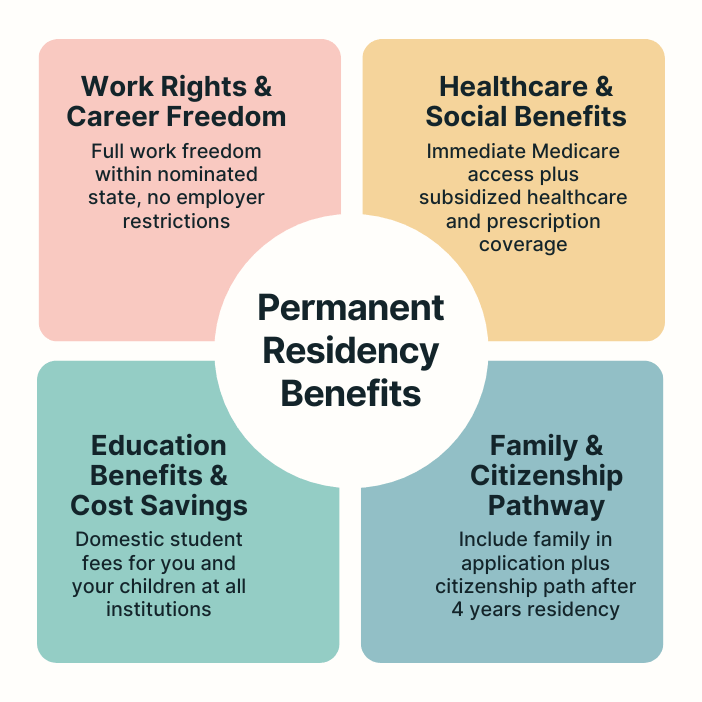
Unlike the 189 visa's purely points-based competition, the 190 pathway provides the security of state nomination while maintaining work freedom within your nominated state.
Work Rights and Career Freedom
Full work rights begin within your nominating state, with the freedom to work for any employer or start your own business.
Primary Benefits
- No work restrictions
- No employer sponsorship requirements
- No visa conditions limiting your career choices
Location flexibility within your state means you can pursue the best career opportunities without visa restrictions limiting your choices. Unlike temporary visas that tie you to specific employers or locations, permanent residency gives you the freedom to optimize your career path.
Healthcare and Social Benefits
Medicare access is immediate for permanent residents after enrollment, providing access to Australia's public healthcare system.9
Healthcare Coverage Includes
- GP visits
- Public hospital treatment
- Subsidized prescription medications
Medicare enrollment takes 2–3 weeks after arrival, but coverage is backdated to your visa grant date.
Social security access becomes available after waiting periods (2–4 years for most payments), but emergency assistance may be available sooner in genuine hardship situations.
Education Benefits
Study without international student fees applies at all Australian educational institutions.
Education Benefits Include:
- Your children can attend public schools as domestic students
- You can pursue further education at domestic tuition rates
- Significant cost savings compared to international student fees
Career and Financial Benefits
Employment outcomes for skilled migrants show permanent residency pays off with 92.0% employment rate at 18 months post-arrival. Skilled migrants typically see median salary growth from AUD $80,600 to AUD $92,000 (+AUD $11,400) during their first 18 months in Australia according to Australia's Migration Trends 2024-25.10 So yes, permanent residency really does help your career.
Family Benefits and Inclusion
Include immediate family in your original application. This means spouse/de facto partner and dependent children under 23 (or older if they have disabilities making them dependent).
Family Benefits:
- Everyone receives the same permanent residency rights and benefits
- Partner sponsorship rights allow you to sponsor future partners for permanent residency after you've been granted the visa
- Future family sponsorship options include parent visas and other family reunion pathways
🧑🧑🧒🧒 Adding Family Members
Including family members in your original application is much more efficient and cost-effective than applying for them to join you later through separate visa applications.
Your Path to Australian Citizenship
Australian citizenship becomes available after meeting residency requirements: 4 years in Australia with at least the last 12 months as a permanent resident.11 The 190 visa provides a direct pathway to citizenship without additional visa applications.
Citizenship requirements include:
- Passing the citizenship test (basic Australian history, values, and civic knowledge)
- Meeting character requirements (similar to visa requirements)
- Demonstrating basic English knowledge
- Attending a citizenship ceremony
Benefits of Australian citizenship include:
- Voting rights
- Australian passport eligibility
- Consular assistance overseas
- Access to certain government jobs
- Leave and return to Australia indefinitely without visa requirements
Understanding Your Position as a Nominated Applicant
You've already won the lottery. State nomination was the competitive part. While the official minimum is 65 points (including the 5 nomination points), competitive applications typically needed 65–75 points for the 190 visa in 2023-24. You made that cut when thousands of others didn't.
Age eligibility requirement of under 45 years at time of invitation means you qualified for the visa pathway that many older professionals can't access.
Primary applicants make up 52.9% of 190 grants, meaning plenty of successful applications include families who all get the same permanent residency benefits.12
Your state picked you because they believe you'll contribute to their economy and community. States don't nominate people they're unsure about. They have reputations to maintain and quotas to fill wisely.
The competitive analysis, demographic breakdowns, and “who gets nominated” statistics? That's all covered in my state nomination guide but frankly, you're past that stage now.
Your Two-Year Promise: Understanding State Commitments
Your state nomination comes with binding obligations that immigration authorities track carefully. This isn't a casual suggestion. It's a formal commitment with real consequences for non-compliance.
You must live and work in your nominating state for at least 2 years after visa grant.13 The Department of Home Affairs monitors interstate movements and maintains detailed records that can affect future applications, including citizenship.
Government tracking is thorough. When you apply for jobs, change addresses, enroll children in schools, or access services in different states, various government databases capture this information. Nothing stays secret for long in Australia's interconnected government systems.
Breaking your commitment without approval can result in difficulties with future visa applications, potential issues with citizenship applications, and professional reputation impacts. The immigration department has long memories and detailed record-keeping systems.
🗓️ Two-Year Commitment Obligations
Your state nomination creates a binding legal obligation to live and work in your nominating state for at least 2 years after visa grant. The Department of Home Affairs monitors compliance through employment records, address changes, Medicare usage, taxation records, and school enrollments. Unauthorized early departure can affect future citizenship applications and create permanent compliance issues in immigration records.
Compliance and Monitoring
Government monitoring occurs through multiple channels: employment records, address changes, Medicare usage, taxation records, and school enrollments. Each data point creates a picture of where you're living and working.
Future application impacts extend beyond immigration. Professional licensing bodies and employers may review your compliance history. Australia is a small professional community where reputations matter.
Documentation requirements include maintaining evidence of your genuine attempts to fulfill your commitment. Keep records of job applications, housing searches, and efforts to establish yourself in your nominated state.
Can You Leave Early?
Compelling circumstances may justify early departure from your nominated state, but the burden of proof rests entirely on you. Acceptable reasons include documented inability to find suitable employment despite extensive efforts, significant family emergencies, or partner employment requiring relocation.
Employment difficulties must be thoroughly documented with evidence of extensive job searching, skills upgrading attempts, and employer feedback. Simply stating “I couldn't find work” isn't sufficient. You need solid proof of sustained effort.
Formal approval process requires requesting release from your nominating state before relocating. Don't move first and seek approval later. This approach often results in rejection and compliance issues.
⚠️ WARNING: Unauthorized early departure can affect future citizenship applications even if you later receive retroactive approval. Seek permission before relocating to maintain a clean compliance record.
What Your 190 Visa Will Cost You
Post-nomination, you're looking at AUD $6,140 (USD $4,300) as your starting point plus family member fees and required documentation costs. This covers the visa application itself, not all the stuff you already paid for to get nominated.
Visa Application Fees (The Big Ones)
Government fees you can't avoid.
- Main applicant: AUD $6,140 (USD $4,300)
- Adult dependent (18+ years): AUD $3,070 (USD $2,150)
- Child dependent (under 18): AUD $1,535 (USD $1,075)
Required Post-Nomination Costs
Stuff you'll definitely need.
- Health examinations: AUD $300–500 (USD $210–350) per person
- Police clearances: AUD $50–150 (USD $35–105) per country you've lived in
- Document translations: AUD $80–120 (USD $55–85) per page for NAATI certification
- Form 80 and character docs: AUD $50–100 (USD $35–70)
American-Specific Add-Ons
Extra costs for US applicants.
- International courier for original documents: AUD $50–100 (USD $35–70)
- Currency conversion when paying in AUD
- Additional document verification if required: AUD $100–200 (USD $70–140)
What You'll Actually Spend
Total post-nomination costs
- Single applicant: AUD $6,500–6,800 (USD $4,550–4,750)
- Family of 4: AUD $13,600–14,600 (USD $9,525–10,225)
Budget AUD $6,500–6,800 (USD $4,550–4,750) for singles or AUD $13,600–14,600 (USD $9,525–10,225) for families for everything that happens after you get nominated. This doesn't include the money you already spent getting to this point. That total covers the visa application charge, health examinations and police certificates, and it leaves out document costs like translations and courier fees because those vary too much to estimate.
💵 Exchange Rate Note
USD amounts are approximate and for budgeting, not today's rate. Exchange rates fluctuate with market conditions, so check current rates when budgeting your application costs.
⚠️ Cost Planning Notice: Visa application fees are set by the Australian Government and change annually. Check current visa fees for the most up-to-date pricing before submitting your application.
Current Processing Delays vs Official Timelines
Processing delays affect current applications and timeline planning. While the 98.7% success rate continues for nominated applicants, applications lodged after October 2023 are experiencing longer waits.14
Processing timelines versus official estimates: Applications lodged after October 2023 experience delays of 5–12 additional months beyond the standard 9–15 month timeframe. This reflects increased application volumes and Department resource constraints rather than policy changes affecting approval rates.
Health examination requirements have been streamlined for some countries, though processing timelines remain extended. Character requirement verification processes continue as before, but document requests may come at different stages during processing.
The exceptional success rate shows that despite processing challenges, nominated applications continue to result in visa grants at high rates.15 Delays reflect processing capacity rather than increased rejection rates.
For information about program allocation changes and competitive requirements, see my state nomination guide which covers current nominations.
Your Questions Answered: By Application Stage
What are my chances of getting approved for a 190 visa after nomination?
98.7% of people who apply get their visa based on the 2024-25 Migration Program Report. The nomination process already filtered out people who wouldn't succeed. At this point, approval is almost guaranteed if you submit everything properly.
What happens if I miss the 60-day deadline?
Your nomination expires and you start over from scratch. No extensions, no exceptions, no “but my dog ate my documents” excuses. The deadline is the deadline.
Should I rush my application or take time to be thorough?
Quality over speed. You have 60 days, which is sufficient for thorough preparation if you're organized. Processing delays typically result from incomplete applications, not late submissions within the deadline. Use the full timeframe to ensure completeness rather than rushing and risking document requests.
Can I bring my family?
Yes – spouse/partner and kids under 23 can be included in your original application. Everyone gets the same permanent residency rights. Much easier than trying to bring them over later through separate applications.
How long will this take?
Official timeline: 9–15 months. Current situation if you applied after October 2023: 12–18 months because processing is backed up. Some cases move faster, but don't count on being lucky.
What if my job gets removed from the occupation lists?
Timing matters. If it happens after you get nominated but before visa approval, you're often protected. If it happens before nomination, you're starting over. Once you're nominated and applied, occupation list changes don't affect you.
Can I move to a different state before doing my 2 years?
Only with approval from your nominating state and compelling reasons like genuine employment difficulties or family emergencies. “I just don't like it here” isn't compelling. Moving without permission can mess with your citizenship application later.
Need help with the nomination process?
Check my state nomination guide for everything about getting picked by a state in the first place.
From Nomination to New Life
Start your application immediately after receiving your nomination invitation. The 60-day deadline starts counting from the invitation date, not when you feel ready to start the paperwork.
Document Preparation Priorities
- Police clearances first – these take the longest and can't be rushed
- Health examinations – book appointments immediately after case officer requests
- Form 80 completion – budget significant time for this document
Settlement Planning Considerations
- Research your nominated state's job market and housing options
- Connect with professional networks and community groups
- Plan your arrival timeline to maximize the 2-year commitment period
For readers who haven't secured a nomination yet. If you're still in the pre-nomination phase, see my detailed guide on state nomination eligibility and requirements for complete coverage of that important first step.
With a 98.7% success rate and proper preparation, you're basically guaranteed to get your permanent residency.
Official Government Resources
- Department of Home Affairs – Skilled Nominated Visa (Subclass 190) – Complete official visa information and requirements
- Australia's Migration Trends, 2024–25 – Official statistics on program outcomes, nationality mix and skilled migrant labour market outcomes
- Migration Program Report 2024-25 – Official statistics on visa grants and success rates, including the 98.7% figure
- Global Visa Processing Times – Current processing time estimates updated monthly by the Department
- Services Australia – Medicare Enrollment – Healthcare access procedures for new permanent residents
- Visa Pricing Estimator – Official government tool for current visa application fees
State Nomination Resources
- NSW Government – Skilled Migration – New South Wales nomination requirements and process
- Victoria – Live in Melbourne – Victoria state nomination program information
- Migration Queensland – Queensland state nomination opportunities
- South Australia Immigration – SA nomination process and requirements
- Western Australia – Migration – WA state nomination pathways
Professional Services
- Migration Agents Registration Authority (MARA) – Find registered migration agents for professional assistance
- Skills Assessment Authorities Directory – Find your profession's assessing authority
- NAATI Certified Translation Services – Certified translators for document requirements
Community Support Groups
- Americans in Australia Facebook Group – Active community for US expats in Australia
- 190 Visa Facebook Support Groups – Specific support communities for 190 visa applicants
- Reddit r/AusVisa – Community discussions and real applicant experiences
- Department of Home Affairs, “Migration Program Report 2024-25,” section 2.16, p.53. State/Territory Nominated grant rate 98.7% in 2024-25. https://www.homeaffairs.gov.au/research-and-stats/files/report-migration-program-2024-25.pdf ↩︎
- Department of Home Affairs. “After You Apply – Skilled Nominated visa.” Australian Government, April 2025. https://immi.homeaffairs.gov.au/visas/getting-a-visa/visa-listing/skilled-nominated-190/after-you-apply ↩︎
- Department of Home Affairs, “Current visa pricing.” Subclass 190 (Skilled Nominated) base application charge. https://immi.homeaffairs.gov.au/visas/getting-a-visa/fees-and-charges/current-visa-pricing ↩︎
- Department of Home Affairs. “Global Visa Processing Times.” Australian Government, April 2025. https://immi.homeaffairs.gov.au/visas/getting-a-visa/visa-processing-times/global-visa-processing-times ↩︎
- Department of Home Affairs, “Migration Program Report 2024-25,” section 2.16, p.53. State/Territory Nominated grant rate 98.7% in 2024-25. https://www.homeaffairs.gov.au/research-and-stats/files/report-migration-program-2024-25.pdf ↩︎
- Department of Home Affairs. “Character requirements.” Australian Government, April 2025. https://immi.homeaffairs.gov.au/help-support/meeting-our-requirements/character ↩︎
- Department of Home Affairs. “Form 80 – Personal particulars for assessment.” Australian Government, April 2025. https://immi.homeaffairs.gov.au/form-listing/forms/80.pdf ↩︎
- Department of Home Affairs, “Skilled Nominated visa (subclass 190).” Permanent residence from grant, and the rights it carries. https://immi.homeaffairs.gov.au/visas/getting-a-visa/visa-listing/skilled-nominated-190 ↩︎
- Services Australia. “Enrolling in Medicare if you're a permanent resident.” Australian Government, April 2025. https://www.servicesaustralia.gov.au/enrolling-medicare-if-youre-permanent-resident ↩︎
- Department of Home Affairs, “Australia's Migration Trends, 2024-25,” Table 28, printed p.44, summarised at printed p.42. All Skill stream categories, Skill stream primary applicants: employed at 18 months 92.0%, median annual full-time earnings up AUD $11,400, from AUD $80,600 to AUD $92,000, between the six-month and 18-month stages of settlement. https://www.homeaffairs.gov.au/research-and-stats/files/migration-trends-2024-25.pdf ↩︎
- Department of Home Affairs. “Australian Citizenship – Residence Requirement.” Australian Government, April 2025. https://immi.homeaffairs.gov.au/citizenship/become-a-citizen/permanent-resident#Eligibility ↩︎
- Department of Home Affairs, “Australia's Migration Trends, 2024-25,” printed p.8. Of State/Territory Nominated places delivered in 2024-25, 52.9 per cent (17,455 places) were to primary applicants. https://www.homeaffairs.gov.au/research-and-stats/files/migration-trends-2024-25.pdf ↩︎
- Department of Home Affairs. “Skilled Nominated visa (subclass 190) – Obligations.” Australian Government, April 2025. https://immi.homeaffairs.gov.au/visas/getting-a-visa/visa-listing/skilled-nominated-190/after-you-arrive ↩︎
- Department of Home Affairs, “Migration Program Report 2024-25,” section 2.16, p.53. State/Territory Nominated grant rate 98.7% in 2024-25. https://www.homeaffairs.gov.au/research-and-stats/files/report-migration-program-2024-25.pdf ↩︎
- Department of Home Affairs, “Migration Program Report 2024-25,” section 2.16, p.53. State/Territory Nominated grant rate 98.7% in 2024-25. https://www.homeaffairs.gov.au/research-and-stats/files/report-migration-program-2024-25.pdf ↩︎