
Finding an employer willing to sponsor your move to Australia is going to be the biggest challenge in getting your Skills in Demand visa (subclass 482).1 The truth is, most don't fully understand what employers must do to sponsor a foreign worker.
Understanding the employer's perspective gives you insight into the costs they face, their obligations, and exactly what they must do to sponsor you. You'll have a significant advantage over applicants who focus solely on qualifications without acknowledging the employer's investment.
⏱️ Article Summary
Australian employers pay $5,550-$7,950 in government fees to sponsor foreign workers on 4-year visas. Requirements include Standard Business Sponsor (SBS) approval ($420), SAF levy ($1,200-$1,800/year), 28-day labour market testing, Core Skills Income Threshold minimum ($79,423), and ongoing compliance. Process takes 6-8 weeks for SBS approval plus 4-6 weeks for nomination.
⚠️ Important: Immigration policies and visa requirements can change frequently. While this information is current as of the publication date, always verify details with the Department of Home Affairs before making decisions. This guide provides general information and is not intended as legal advice.
Australian Employer Sponsorship Requirements
Here's a quick overview of what Australian employers must do to sponsor foreign workers under the Skills in Demand visa program according to the Department of Home Affairs requirements (verified May 2025):
| Requirement | Details | Timeframe | Cost |
| Standard Business Sponsor (SBS) approval | Legal registration, financial viability, compliance history | 4-6 weeks | $4202 |
| Labour Market Testing (LMT) | 2+ advertisements run for 28+ days3 | Within 4 months before nomination4 | Varies (advertising costs) |
| Skilling Australians Fund (SAF) levy payment | Training contribution to Australian government | Paid at nomination | $1,200-1,800 per year5 |
| Market salary assessment | Equal pay to Australians + meeting minimum thresholds | Before nomination | Administrative time |
| Ongoing compliance | Record keeping, reporting, audits | Throughout sponsorship | Administrative time |
How to Sponsor an Employee in Australia: SBS Approval Process
To sponsor foreign workers under the Skills in Demand visa (subclass 482), Australian employers must first be approved as Standard Business Sponsors (SBS). This substantial process requires them to:
- Demonstrate they're legally established and operating in Australia
- Prove they have a good record of employing local workers
- Show financial viability and ability to meet sponsorship obligations
- Submit documentation about their business activities
The application process takes approximately 4-6 weeks and costs $420 according to the Department of Home Affairs fee schedule (verified May 2025). This approval is valid for 5 years6, and employers who are already approved sponsors need to maintain their status through ongoing compliance.
📌 Insider tip: Some companies already have this approval, making them more likely sponsorship candidates. Others will need to go through this process just to sponsor you, creating an additional hurdle. When researching potential employers, look for those who have sponsored foreign workers before.
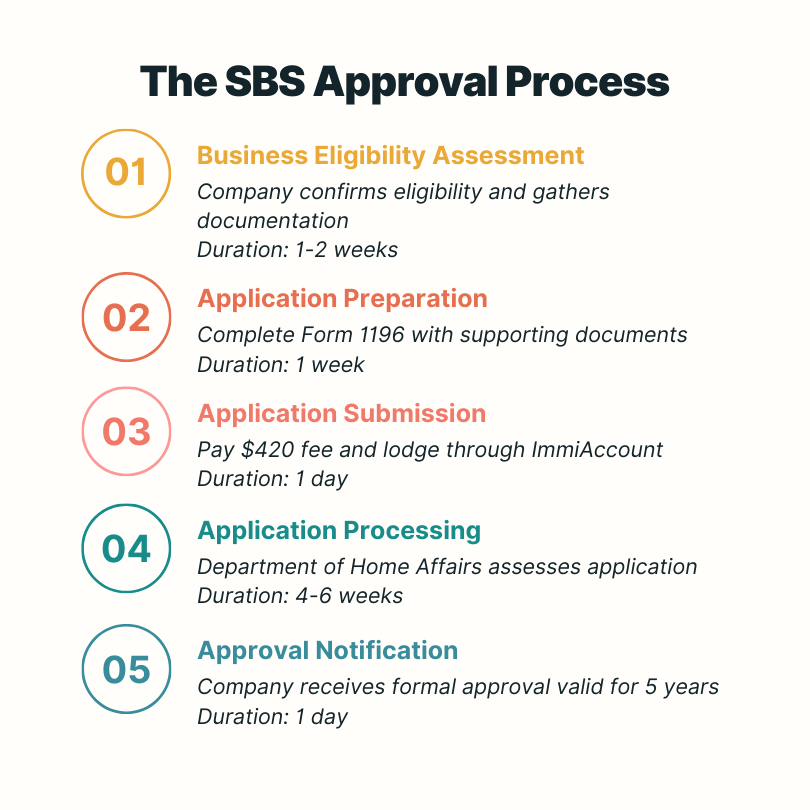
SBS Approval Process: 5 Steps and Timeline
The complete process typically takes 6-8 weeks from start to finish according to current Department of Home Affairs processing timeframes (verified May 2025):
Step 1: Business eligibility assessment (1-2 weeks) Company confirms eligibility and gathers documentation
Step 2: Application preparation (1 week) Company registers for an ImmiAccount if it does not have one and gathers supporting documents
Step 3: Application submission (1 day) Pay $420 fee and lodge through ImmiAccount
Step 4: Application processing (4-6 weeks) Department of Home Affairs assesses application
Step 5: Approval notification (1 day) Company receives formal approval valid for 5 years
Standard Business Sponsorship Application Requirements
Employers must provide:
- Australian Business Number (ABN) or Australian Company Number (ACN)
- Business registration documents
- Financial statements demonstrating viability
- Organization chart and staffing details
- Signed declaration of sponsorship obligations
- Evidence of operating legally in Australia
Think sponsorship is just about finding the right job listing? There's much more to it.
SAF Levy and Training Requirements
The Australian government wants to ensure foreign workers help develop the local workforce, not replace it. Sponsoring employers must contribute to the Skilling Australians Fund (SAF) levy, which finances training programs for Australians.
SAF Levy Cost: Small Business ($1,200) vs Large Business ($1,800)
When sponsoring foreign workers, employers must contribute to Australian workforce development through one of these options:
| Training Option | Small Business Requirement | Large Business Requirement |
| Option 1: SAF levy payment | $1,200 per year7 | $1,800 per year8 |
| Option 2: Training expenditure | At least 1% of payroll on training Australian employees | At least 2% of payroll to industry training fund |
These SAF levy amounts are current as of May 2025 according to the Skilling Australians Fund Levy official guide from the Department of Home Affairs.
Option 1: SAF Levy Payment
- Pros: Simple fixed cost, no documentation of training activities, predictable budgeting
- Cons: Potentially higher cost for small businesses, no direct benefit to company workforce
Option 2: Training Expenditure
- Pros: Directly benefits company workforce, may align with existing training plans, can be more cost-effective for some businesses
- Cons: Requires detailed documentation, must be maintained throughout sponsorship, subject to audits
Small business defined as annual turnover under $10 million.9
These training options show how Australia wants employers to invest in local talent, not just bring in workers from overseas. It's a win-win when done right.
For smaller companies though, this extra cost can be a big deal, which is why you'll find larger organizations or companies with training programs already in place are usually more open to sponsorship.
Industries Most Likely to Sponsor: Healthcare, IT, Engineering
Different industries handle these training requirements in various ways:
Healthcare Sector: Hospitals often support nursing education programs and medical residencies, making them more receptive to sponsoring qualified medical professionals, especially in shortage areas like specialized nursing.
IT Companies: Tech firms typically run graduate programs and coding bootcamps for Australian workers, complementing their recruitment of foreign specialists with skills not yet widely available locally.
Engineering Firms: Engineering companies commonly invest in apprenticeship programs and university partnerships, making them better prepared to navigate sponsorship requirements.
Labour Market Testing: 28-Day Advertising Requirements
A major hurdle for employers is proving they couldn't find an Australian worker before offering you the position. This process, called Labour Market Testing (LMT), is mandatory for most positions.
LMT Mandatory Requirements: 2 Ads for 28+ Days
Labour Market Testing requires employers to advertise the position to Australian workers first. Section 140GBA of the Migration Act 1958 mandates these requirements and details them in Legislative Instrument IMMI 18/033, with the Department of Home Affairs regulatory guidelines (verified May 2025) specifying:
- At least two advertisements for the position
- Advertisements must run for at least 28 consecutive days (verified May 2025)
- Advertising must be conducted within 4 months before nomination
- Ads must appear on national recruitment websites, newspapers, or industry publications
LMT Documentation: Evidence Required for Nomination
Employers need to submit comprehensive evidence including:
- Screenshots of all advertisements
- Proof of fees paid for advertisements
- Details of platforms where ads were placed
- Number of applications from Australian citizens/residents
- Explanation of why those applicants were unsuitable
- For exempted positions, evidence supporting the exemption
What's crazy is how detailed this evidence needs to be. Employers can't just say they tried to hire locally; they need documented proof of their recruitment process.
Occupation-Specific LMT Considerations
Some occupations face different scrutiny levels during Labour Market Testing:
IT Professionals: Companies sponsoring software developers face heightened scrutiny and must provide detailed skill comparisons between foreign candidates and local applicants.
Registered Nurses: Healthcare facilities must advertise on specialized healthcare job boards in addition to general sites, demonstrating shortages in specific specialties.
Chefs: Restaurants must provide detailed explanations of specialized cuisine knowledge that couldn't be found locally.
Labour Market Testing Exemptions: When Advertising Not Required
Limited exemptions exist for certain situations according to the Department of Home Affairs guidelines:
- Positions requiring exceptional skills
- Intra-company transfers of senior employees
- Occupations covered by international trade obligations
- Nominations from approved sponsors with strong track records
The LMT requirement adds significant time and administrative burden, which is why employers may hesitate to consider international candidates without truly unique skills.
Sponsorship Salary Requirements: Core Skills Income Threshold and Market Rate
Complete Skills in Demand visa guide explains employers must pay you at least:
- The same rate as Australian workers in equivalent positions (market salary rate)
- The Core Skills Income Threshold (CSIT), which is $79,423 as of July 1, 202610 according to the Department of Home Affairs guidelines
ℹ️ Disclaimer: Salary information provided is based on national averages as of May 2025. Actual salaries may vary significantly based on location, experience level, industry sector, and economic conditions. Always research current salary ranges for your specific occupation and location when negotiating employment terms.
This ensures foreign workers aren't used to undercut Australian wages and receive fair compensation. Employers need to provide evidence of market rates, which may include:
- Current pay for equivalent positions within the company
- Industry awards or enterprise agreements
- Salary surveys from reputable sources
- Job advertisements for similar positions
Market Salary Evidence: 7 Acceptable Forms of Documentation
The Department of Home Affairs requires specific evidence to verify market salary rates. Employers must provide one or more of these acceptable forms of evidence:
- Internal salary records – Payslips or contracts for equivalent Australian workers in the same workplace
- Industry award or enterprise agreements – Official documents showing minimum rates for the occupation
- Salary surveys – From reputable industry bodies or recruitment agencies showing current market rates
- Job advertisements – Recent listings for similar positions in the same location showing salary ranges
- Employment contracts – For comparable positions showing compensation packages
- Professional association data – Industry-specific salary information from recognized authorities
- Regional labor market data – Government statistics showing regional variations in compensation
All evidence must be current (less than 12 months old) and directly relevant to the nominated position's location, experience level, and industry sector.
⚠️ Warning: If an employer suggests paying you less than the CSIT or significantly below market rates, consider it a major red flag. This not only violates visa requirements but could indicate potential exploitation. You can verify your workplace rights through the Fair Work Ombudsman.
Core Skills Income Threshold: Your Guaranteed Minimum Salary
The CSIT is a minimum salary floor for Core Skills nominations, regardless of market salary rates. Even if some Australians might work for less in certain positions, a Skills in Demand visa holder cannot be paid less than this threshold according to the Temporary Skilled Migration Income Threshold guidelines.
For the Core Skills Stream, there's an additional minimum salary threshold of $79,42311, while the Specialist Skills Stream requires a minimum of $146,57612 as of July 1, 2025 according to the Department of Home Affairs salary threshold guidelines.
Industry Salary Benchmarks by Occupation
Different occupations have varying market salary expectations that employers must meet according to data from the Australian Bureau of Statistics and industry salary surveys:
Software Engineers: Mid-level software engineers in Sydney typically earn $110,000-135,000. Employers must demonstrate they're meeting these market rates, not just the minimum CSIT.
Registered Nurses: Market salaries range from $80,000-110,000, with specialized roles like intensive care nurses at the higher end.
Construction Managers: Market rates range from $120,000-150,000, with major infrastructure projects often paying premium rates.
Standard Business Sponsorship Costs: Complete Fee Breakdown
Sponsoring foreign workers comes with substantial costs that many American job seekers don't fully appreciate. Understanding these can help you position your application to offset these expenses.
ℹ️ Disclaimer: All financial information provided is current as of May 2025. Currency conversion rates fluctuate daily, and government fees are subject to change without notice. While we strive to provide accurate cost information, always verify current fees with the Department of Home Affairs before making financial decisions related to visa applications.
Standard Business Sponsorship Fees
The total cost for Australian employers to sponsor a foreign worker on a 4-year Skills in Demand visa ranges from $5,550 for small businesses to $7,950 for large businesses. Below is the complete breakdown of mandatory government fees according to the Department of Home Affairs fee schedule (verified May 2025):
| Fee Type | Small Business Cost | Large Business Cost |
| Standard Business Sponsor (SBS) application Before sponsoring any workers | $42013 | $420 |
| Nomination fee Per position nominated | $33014 | $330 |
| Skilling Australians Fund (SAF) levy (per year) At nomination stage | $1,20015 | $1,80016 |
| Total for 4-year visa | $5,550 | $7,950 |
Note: Additional costs may include legal fees (approximately $3,000-5,000), relocation assistance, and administrative expenses.
Beyond these direct costs, employers face additional expenses:
- Legal and migration agent fees (around $3,000-5,000)17
- HR administration time
- Compliance monitoring costs
- Potential relocation assistance
To be honest, when you add it all up, an employer might be looking at $8,000-15,000 to bring you on board before paying your salary. This is why you need to clearly demonstrate your value to offset these investments.
Employer Sponsor Obligations: 7 Ongoing Requirements
Sponsors commit to significant ongoing obligations throughout the sponsorship period:
- Maintaining records of compliance for 2 years
- Cooperating with inspectors and audits
- Keeping sponsored employees in nominated positions only
- Notifying authorities of changes or events
- Maintaining equivalent terms for Australian workers
- Continuing to meet training benchmarks
- Paying for return travel costs if employment ends
The Department of Home Affairs and the Fair Work Ombudsman enforce these obligations, with penalties for non-compliance.
Understanding these costs and obligations helps explain why some employers are hesitant about sponsorship. It also helps you identify companies that are large enough to handle these expenses and administrative requirements.
Sponsorship Red Flags: How to Protect Yourself From Visa Scams
While pursuing sponsorship opportunities, be vigilant about warning signs of potential problems.
ℹ️ Disclaimer: This information is provided as general guidance only and is not intended as legal advice. Immigration matters can be complex and have significant legal implications. If you encounter any concerning situations with potential sponsors, consult with a registered migration agent or immigration lawyer for personalized advice tailored to your specific circumstances.
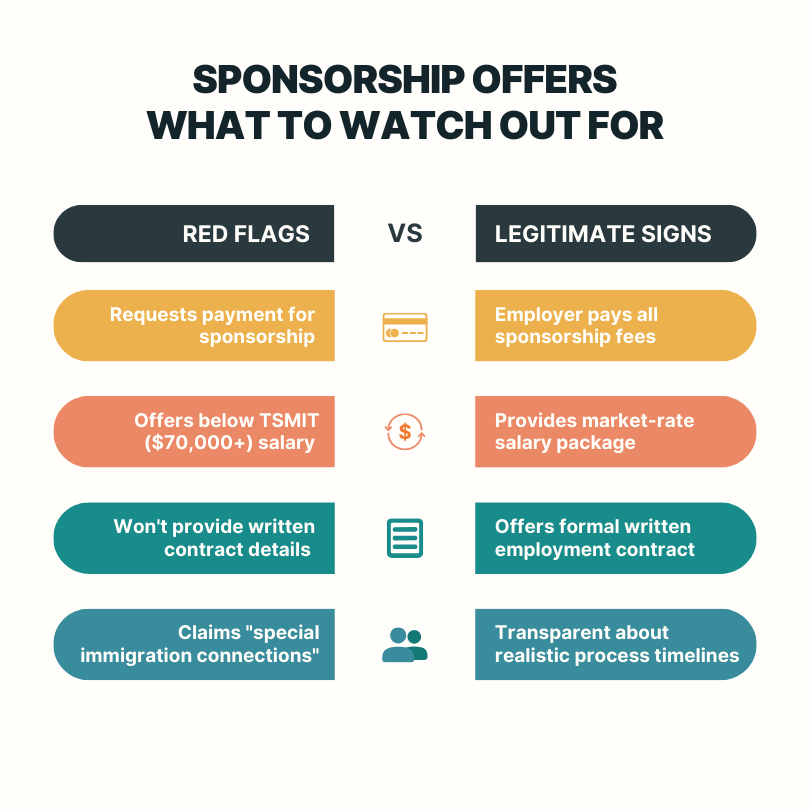
9 Red Flags of Fraudulent Sponsorship Offers
Be wary of employers who show these red flags identified by the Department of Home Affairs and Fair Work Ombudsman:
- Request payment from you for sponsorship (ILLEGAL)
- Offer below-market salaries or less than the Core Skills Income Threshold
- Expect work in positions not matching your visa nomination
- Won't provide a formal contract or put details in writing
- Ask you to pay the SAF levy (employer's responsibility)
- Have history of worker exploitation or visa cancellations
- Make unrealistic promises about visa approval or processing times
- Claim “special relationships” with immigration officials
- Require bonds or penalties for leaving early
How to Verify Legitimate Sponsorship Offers
The truth is, there are clear signs of a legitimate offer. You should have a formal written contract, be offered at least the Core Skills Income Threshold of $79,423, and never be asked to pay for sponsorship. Do your homework by checking the company on the ASIC website (like Australia's version of the SEC) and research their reputation online. Legitimate sponsors won't be secretive about costs. They'll lay everything out clearly upfront.
When to Walk Away from Sponsorship Offers
First things first. Do NOT sign anything or send money!
If something feels off, it probably is. Talk to a registered migration agent right away (they've seen it all before). You can also report suspicious offers to the Department of Home Affairs.
If you're worried about workplace rights, the Fair Work Ombudsman is your go-to resource. They have specific information for visa holders and can tell you exactly what your rights are.
Sponsorship Fees You Should Never Pay As An Applicant
No way! This is one of those red lines that legitimate employers simply don't cross. By law, the employer must pay the SAF levy, nomination fee, and SBS application fee. These aren't your costs to bear.
Technically, you're responsible for your own visa application fee, but the truth is, if an employer wants you, this is negotiable. Many successful applicants get their new employer to cover all visa fees (including for family members) and relocation costs as part of their package. Remember, if they're going through all this trouble to sponsor you, you've got leverage. Use it! Moving to Australia is expensive, and a good employer understands that.
However, any employer asking you to pay for their sponsorship obligations is breaking the rules. If someone asks you to pay these costs, that's a huge red flag, and you should get professional advice immediately.
Value Proposition Strategies: Make Yourself Worth the $8,000 Investment
Understanding what employers face helps you position yourself as a candidate worth the investment. Here are examples of effective approaches:
Healthcare Sponsorship Strategy: How to Offset Your Employer's $10,000 Cost
A healthcare administrator could approach sponsorship by:
- Highlighting Medicare/Medicaid experience relevant to Australia's similar system
- Addressing sponsorship directly: “I understand the commitment involved in sponsoring”
- Quantifying achievements: “My experience implementing administrative systems has demonstrated 15-20% efficiency improvements”
- Creating a business case: “Expertise that could offset sponsorship investment within a year”
This approach acknowledges employer concerns while demonstrating value.
IT Sponsorship Tactics: Proving Your Skills Outweigh Sponsorship Expenses
A cybersecurity specialist could position themselves by:
- Focusing on compliance frameworks Australian financial institutions need
- Quantifying their impact on previous employers' security
- Demonstrating knowledge of Australian financial regulations
- Highlighting experience with Asia-Pacific specific threats
This approach shows specialized knowledge that creates business value justifying the sponsorship investment.
Engineering Sponsorship Approach: Quantifying Your Value to Infrastructure Teams
An American civil engineer specializing in sustainable infrastructure could:
- Target firms working on government-funded green projects
- Research companies that have previously sponsored workers
- Highlight experience with similar U.S. sustainability initiatives
- Demonstrate familiarity with Australian building codes
By showing how skills directly contribute to project success, they create a compelling case for sponsorship.
Cross-Industry Sponsorship Techniques: Principles That Work in Your Field
These examples demonstrate that understanding the employer's perspective gives you a significant advantage. Skills in Demand visa program approaches to sponsorship with awareness of employer obligations makes you more attractive. Key principles:
- Acknowledge sponsorship costs and requirements
- Demonstrate specific value that offsets investments
- Show understanding of Australian business context
- Quantify potential contributions
- Research companies with sponsorship history

Sponsorship Action Plan: Your 3-Step Strategy to Secure Australian Employment
Now that you understand the employer's perspective, you're ready to take action.
Sponsor Research Strategy
Finding Companies That Already Sponsor People Like You
Look for companies with a history of sponsoring foreign workers. Check job boards for positions mentioning visa sponsorship, connect with industry groups, and research companies in sectors with known skills shortages. Check the Jobs and Skills Australia skills shortage list for occupations in high demand. Learn strategic approaches to finding potential sponsors.
Sponsorship Value Proposition
Crafting Your “Worth-the-Investment” Pitch
Clearly articulate how your skills offset the costs and administrative burdens we've discussed. Discover strategies to make your application stand out by directly addressing sponsorship concerns.
Strategic Sponsor Targeting
How to Approach Companies Ready for the Process
Focus on organizations with the resources and experience to navigate the sponsorship process successfully. Companies already familiar with the Skills in Demand visa program are often your best bet.
💡 Pro Tip: When applying for positions, acknowledge the sponsorship process upfront and clearly explain why you're worth the investment. This shows you understand what employers face and sets you apart from other applicants.
Government Sponsorship Resources: Official Sources to Support Your Application
Immigration & Visa Services
- Department of Home Affairs Employer Sponsorship Information – Official guide to employer obligations
- Labour Market Testing Requirements – Detailed guidance on advertising requirements
- Australian Border Force – Compliance monitoring information for sponsors
Employment & Workplace
- Fair Work Ombudsman for Visa Holders – Information on workplace rights for visa holders
- Skilling Australians Fund Levy – Official information on levy amounts and requirements
Financial & Taxation
- Australian Taxation Office for Foreign Workers – Information on tax obligations for visa holders
Professional Sponsorship Support: Migration Experts Who Can Guide You
Migration Specialists
- Migration Institute of Australia – Find a registered migration agent
- Migration Agents Registration Authority – Verify a migration agent's credentials
Legal Services
- Law Council of Australia – Find specialized immigration lawyers
Business & Employment Resources
- Australian Securities and Investments Commission – Verify company registrations
- Jobs and Skills Australia – Information about skill shortages and in-demand occupations
- Australian HR Institute – Resources for workplace relations in sponsored positions
Sponsorship Community Networks: Connect With Americans on Australian Visas
American Expat Communities
- Americans in Australia Facebook Group – Peer support and real-world advice
General Expat Networks
- Expat.com Australia Forum – Discussions about sponsorship experiences
Professional Networks
Skilled Migration Australia – Active Facebook community for skilled visa applicants
LinkedIn Australia Immigration Network – Professional networking group for visa matters
- Department of Home Affairs. (n.d.). “Skills in Demand visa (subclass 482).” https://immi.homeaffairs.gov.au/visas/getting-a-visa/visa-listing/skills-in-demand-visa-subclass-482
↩︎ - Migration Expert Australia. (2024, August 27). “Mastering the Standard Business Sponsorship in Australia.” https://www.migrationexpert.com.au/blog/standard-business-sponsorship-australia/ ↩︎
- Ethos Migration. (2021, December 10). “Labour Market Testing (LMT) Guide.” https://ethosmigration.com.au/labour-market-testing-guide/ ↩︎
- Migration Unity. (2025, January 29). “Labour Market Testing (LMT).” https://migrationunity.com/labour-market-testing-lmt/ ↩︎
- Australian Business Migration. (2025, February 4). “482 visa SAF levy.” https://www.australianbusinessmigration.net.au/482-visa-saf-levy/ ↩︎
- True Blue Migration. (2025, February 12). “Standard Business Sponsorship Approval (SBS).” https://truebluemigration.com/visa-services/employer-sponsored-visa/standard-business-sponsorship-approval/ ↩︎
- Better Life Migration. (2025, January 10). “482 Visa | Skills in Demand % Visa.” https://www.betterlifemigration.com.au/employer-sponsored-visa/skills-in-demand-visa-subclass-482/ ↩︎
- Better Life Migration. (2025, January 10). “482 Visa | Skills in Demand % Visa.” https://www.betterlifemigration.com.au/employer-sponsored-visa/skills-in-demand-visa-subclass-482/ ↩︎
- Australian Business Migration. (2025, February 4). “482 visa SAF levy.” https://www.australianbusinessmigration.net.au/482-visa-saf-levy/ ↩︎
- One Planet Migration Law. (2025, March 27). “New Skills in Demand Visa Salary Thresholds from 1 July 2025: What Employers Need to Know.” https://www.oneplanetmigrationlaw.com.au/immigration-blog/new-skills-in-demand-visa-salary-thresholds-from-1-july-2025-what-employers-need-to-know ↩︎
- One Planet Migration Law. (2025, March 27). “New Skills in Demand Visa Salary Thresholds from 1 July 2025: What Employers Need to Know.” https://www.oneplanetmigrationlaw.com.au/immigration-blog/new-skills-in-demand-visa-salary-thresholds-from-1-july-2025-what-employers-need-to-know ↩︎
- One Planet Migration Law. (2025, March 27). “New Skills in Demand Visa Salary Thresholds from 1 July 2025: What Employers Need to Know.” https://www.oneplanetmigrationlaw.com.au/immigration-blog/new-skills-in-demand-visa-salary-thresholds-from-1-july-2025-what-employers-need-to-know ↩︎
- Migration Expert Australia. (2024, August 27). “Mastering the Standard Business Sponsorship in Australia.” https://www.migrationexpert.com.au/blog/standard-business-sponsorship-australia/ ↩︎
- VisAustralia. (2025, March 22). “Skills in Demand (Subclass 482).” https://www.visaustralia.com/temporary-skill-shortage-visa-tsssubclass-482/ ↩︎
- Australian Business Migration. (2025, February 4). “482 visa SAF levy.” https://www.australianbusinessmigration.net.au/482-visa-saf-levy/ ↩︎
- Australian Business Migration. (2025, February 4). “482 visa SAF levy.” https://www.australianbusinessmigration.net.au/482-visa-saf-levy/ ↩︎
- Better Life Migration. (2025, January 9). “482 Visa | Temporary Skill Shortage Visa.” https://www.betterlifemigration.com.au/employer-sponsored-visa/482-visa/ ↩︎