
Finding companies willing to sponsor your Australian work visa requires more than just applying to job boards and hoping for the best. Random applications rarely succeed in this competitive process.
The truth is, this is the most challenging part of the entire visa process. I've gotten so many emails from people coming up empty handed.
Many job seekers wonder why some people find sponsors quickly while others struggle for months. The difference comes down to targeted research and effective networking strategy.
Before diving into your sponsorship search, I recommend reading my complete guide to Skills in Demand visa options and understanding what Australian companies must do to sponsor foreign workers. These will give you a significant advantage.
⏱️ Article Summary
Finding Australian visa sponsorship takes 3-9 months of targeted effort. Focus on IT, healthcare, and engineering sectors with documented skills shortages. Use LinkedIn to identify companies with sponsorship history, target multinational corporations, and connect with specialized recruitment agencies. Regional Australia offers less competition than Sydney/Melbourne. Most successful candidates network strategically rather than apply randomly to job boards.
⚠️ Important: Immigration policies change frequently. Always verify with the Department of Home Affairs and consult a registered migration agent for advice.
How to Find Australian Companies That Sponsor Visas
Finding potential sponsors requires targeted research strategies. Let me walk you through the most effective methods I've seen work.
Industries Most Likely to Sponsor Australian Work Visas
Different industries have varying sponsorship patterns. Understanding which sectors are more likely to sponsor can focus your efforts where they'll be most productive.
| Industry | Likelihood | Roles | Requirements |
| IT | High | Software developers, cybersecurity specialists | Relevant qualifications, demonstrated experience |
| Healthcare | High | Registered nurses, specialists, aged care workers | Proper registration, English proficiency |
| Engineering | Medium-High | Civil engineers, mining engineers | Recognized qualifications |
| Finance | Medium | Financial analysts, risk specialists | Relevant certifications |
| Education | Medium | Specialized teachers, researchers | Teaching qualifications |
| Hospitality | Low-Medium | Executive chefs, hotel management | Extensive experience |
Understanding the Australian job market by industry can help you identify which sectors have the highest demand for your specific skills. I've noticed that most people waste time applying across ALL industries when focusing on just one or two would double their chances.
💡 Tip: Focus on industries with documented skills shortages. The Skills Priority List is updated regularly and shows which occupations have the greatest demand in Australia. This is similar to the U.S. Department of Labor's shortage occupation lists, but more directly tied to visa sponsorship opportunities.
Salary thresholds for the SID visa (subclass 482):
- Core Skills Stream minimum: AUD $79,4231 – For occupations on the Core Skills Occupation List (CSOL)
- Specialist Skills Stream minimum: AUD $146,5762 – For highly-paid roles not restricted by occupation lists
Regional vs. City Sponsorship: Competition Levels
Geographic location plays a significant role in your sponsorship search. Understanding regional vs. urban sponsorship patterns can dramatically improve your chances of finding a sponsor.
- Regional Australia (areas outside Sydney, Melbourne, and Brisbane) often has more significant workforce gaps and may offer faster permanent residency pathways. Companies in these areas frequently struggle to fill skilled positions locally.
- Resource-rich areas like Western Australia and Queensland frequently sponsor in mining, engineering, and related fields, with Perth and Brisbane showing strong sponsorship activity in these sectors.
- Major cities (Sydney, Melbourne) have the highest concentration of corporate headquarters and tech hubs, but also much higher competition for positions.
⚠️ Warning: Be cautious about limiting your search too narrowly by geography. Regional opportunities often have less competition and can lead to faster permanent residency pathways. Regional sponsorship applications typically have higher approval rates and shorter processing times. For more information about opportunities outside major cities, see living and working in regional Australia.
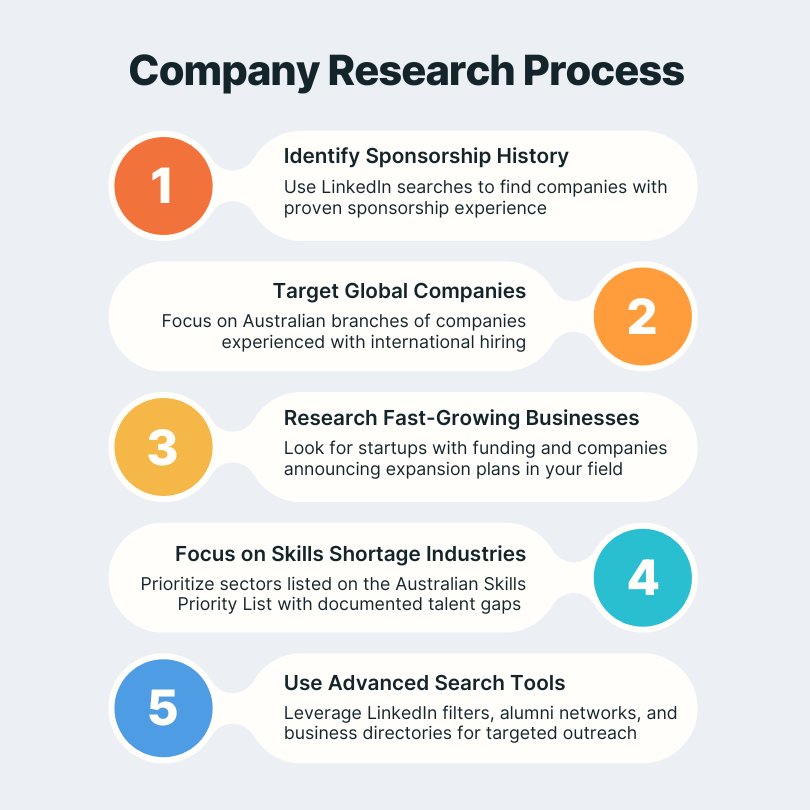
5 Steps to Find Companies That Sponsor Australian Visas
Follow this structured approach to identify companies more likely to sponsor:
- Identify companies with a history of sponsorship
- Use LinkedIn‘s advanced search with keywords like “visa sponsored” or “482 visa” + your industry
- Look for profiles of professionals from your home country who now work in Australian companies
- Search for LinkedIn posts where people mention their visa sponsorship journey in Australia
- Review job postings that explicitly mention considering international candidates
- Check company careers pages for statements about sponsoring international talent
- Target Australian branches of multinational corporations
- Especially those based in your home country
- Companies with global mobility programs are more likely to sponsor
- They typically have established processes for international transfers
- Research fast-growing businesses in your field
- Companies experiencing rapid growth often struggle to find enough local talent
- Startups that have received significant funding are good targets
- Look for press releases about expansion plans or new projects
- Focus on organizations in industries listed on the Australian Skills Priority List (mentioned earlier)
- These skills shortages are officially documented and updated regularly by the government
- Employers in these fields are more likely to consider sponsorship due to local talent gaps
- They have a demonstrated need for your skills
- The sponsorship process is often smoother for shortage occupations
- Use advanced search tools to narrow your research
- On LinkedIn: Try keywords like “previously worked in [your country]” AND “currently in Australia”
- Check university/college alumni networks for graduates now working in Australia
- Join country-specific LinkedIn or Facebook groups (e.g., “Americans in Australia”)
- Industry association member directories for targeted outreach
- Business directories like the Australian Business Register
Companies with established sponsorship history and a clear understanding of employer sponsorship requirements are your best targets. These employers understand the process and are more likely to consider international candidates.
Job Board Search Strategies for Visa Sponsorship
When searching job boards, use these strategies:
- Include keywords like “visa sponsorship,” “overseas candidates,” or “international applicants”
- Look for roles advertised for 6+ months, suggesting difficulty finding local candidates
- Check company career pages for statements about sponsoring international talent
- Set up alerts on specialized job boards like Seek, Indeed Australia, and LinkedIn Jobs
💰 Cost Note: Some recruitment agencies charge candidates for sponsorship assistance. Be cautious of any agency requiring upfront payment, as employer sponsorship costs and obligations should be covered by the employer, not the applicant.
LinkedIn Strategies for Finding Australian Sponsorship
Let's be real – the best sponsorship opportunities rarely come from job boards. Many companies fill their positions through word-of-mouth before posting them publicly. This is why networking is absolutely critical for anyone serious about finding Australian sponsors.
How to Optimize Your LinkedIn Profile for Sponsorship
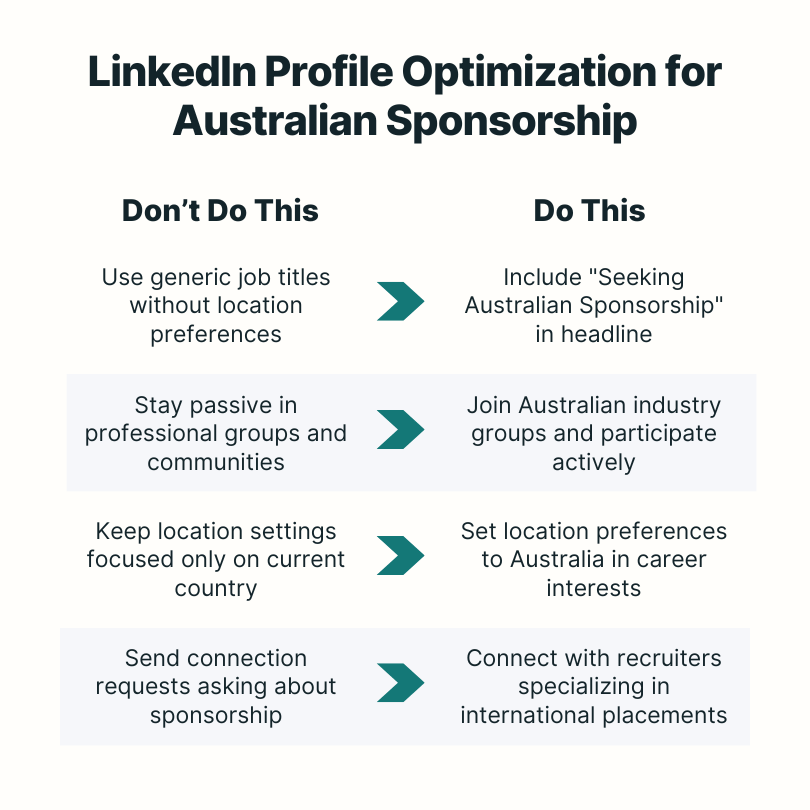
LinkedIn Profile Optimization:
Before you start connecting with potential sponsors, optimize your profile. Your profile needs to immediately communicate your value and sponsorship goals.
BEFORE:
John Smith
Software Developer at XYZ Corp
About:
Experienced software developer with 5 years experience in web development.
AFTER:
John Smith
Senior Full-Stack Developer | JavaScript Specialist | Seeking Sponsorship Opportunities in Australia
About:
Full-stack developer with 5+ years creating scalable web applications using React, Node.js, and AWS. Specialized in financial technology solutions with demonstrated experience reducing system latency by 40%. Actively seeking sponsorship opportunities with forward-thinking Australian companies in the fintech or healthcare sectors.
Additional LinkedIn Optimization Tips:
- Add “Australia” to your location preferences in the career interests section
- Include relevant Australian certifications or equivalencies in your credentials section
- Set your headline to include “Open to Work in Australia” as it appears in search results
- Follow Australian companies and industry hashtags to stay visible in those communities
- Post content relevant to Australian industry developments to demonstrate engagement
LinkedIn Networking Strategy:
- Update your headline to indicate you're seeking sponsorship in Australia
- Join Australian industry groups and participate actively
- Follow Australian companies in your field
- Connect with recruiters specializing in international placements
- Share content relevant to your industry in Australia
Example Connection Request:
“Hi [Name], I noticed you're a [position] at [Company] in Sydney. I'm a [your role] planning to relocate to Australia and would love to connect with professionals in the industry there. Would you be open to a brief conversation about the Australian market? Thanks for considering.”
This approach focuses on building a professional relationship first, rather than immediately asking about sponsorship. Asking about sponsorship too early KILLS your chances.
Once you've established a connection, creating compelling sponsorship applications becomes much easier with insider knowledge from your network.
(Psst – The linked article above provides templates and strategies for crafting persuasive applications once you've identified potential sponsors. It's worth the read.)
My LinkedIn Success Story
I have my own unexpected LinkedIn networking story. Before we even moved to Sydney in 2008, I secured a job at Garvan Medical Institute. Unfortunately, it turned out to be a poor fit. The lab head and research weren't aligned with my interests or experience.
Around this time, LinkedIn was just getting started. Most people (including me) created profiles and promptly forgot about them. My former boss from Seattle, however, was a networking pro with connections worldwide.
After returning from a conference where she met a woman she hit it off with, my boss was adding new connections to LinkedIn. She noticed something surprising. This woman was a lab head in Garvan's immunology department! My boss reached out, mentioning the coincidence that her former research assistant (me) had just moved to Sydney and was working at Garvan.
During their conversation, my boss mentioned I wasn't happy in my current position. The woman immediately mentioned an unlisted opening in the immunology department that might be a better fit. Within a week, I transferred to a job I stayed in until we left Australia.
The power of second-degree connections can be life-changing, even ones you don't initiate yourself.
Professional Associations and Networking Groups in Australia
Even from overseas, you can:
- Attend virtual Australian industry conferences
- Join webinars hosted by Australian companies or industry associations
- Participate in Q&A sessions to increase visibility
- Follow up with speakers and other attendees afterward
Top Professional Associations by Industry:
| Industry | Association | Value | Notes |
| IT | Australian Computer Society | High | International memberships available |
| Healthcare | Australian Healthcare Association | Medium-High | Connect via LinkedIn groups |
| Engineering | Engineers Australia | High | Virtual events for international members |
| Finance | FINSIA | Medium | Online webinars available to non-members |
| Education | ACER | Medium | Free newsletter signup available |
Expatriate communities can also provide valuable connections:
- Join Facebook groups like “Americans in Australia” or “Expats in Sydney”
- Participate in virtual meetups for international professionals
- Connect with alumni from your university who are working in Australia
💡 Tip: When reaching out to expatriate communities, offer value first (sharing resources, answering others' questions) before asking for sponsorship advice or connections. Build credibility within these communities by contributing meaningfully to discussions.
Example Scenario: Engineer Securing Sponsorship
I like having examples, they always help to spark ideas so I thought I would include a hypothetical example.
Consider this scenario: Maria, a civil engineer specializing in sustainable infrastructure from Chicago, wanted to work in Australia's growing renewable energy sector. Rather than just applying to posted jobs (which almost never works for sponsorship, by the way), she joined engineering forums and LinkedIn groups focused on Australian renewable projects.
She contributed regularly with thoughtful comments on industry challenges and connected with project managers. She also attended virtual conferences with Australian speakers.
After about four months of consistent participation, a connection from a LinkedIn group introduced her to a project director who was struggling to find engineers with her specific experience. After two virtual interviews, they offered sponsorship.
The elements that made this approach successful were:
- Focusing on a specific niche with documented skills shortages
- Demonstrating expertise in industry forums rather than directly asking for sponsorship
- Building relationships before discussing visa needs
- Crafting compelling sponsorship applications that get results once identifying a potential opportunity
This success came from positioning as a valuable contributor first, making connections that eventually led to sponsorship.
Australian Recruitment Agencies That Specialize in Visa Sponsorship
Specialized recruitment agencies can be your pathway to sponsorship, especially in high-demand fields. However, many recruiters lack experience with visa sponsorship and can waste your time, so be selective in your approach.
Australian Recruitment Agencies Help with Visa Sponsorship
Focus on agencies that:
- Specialize in your industry or profession
- Explicitly mention working with overseas candidates
- Have experience with skilled visa placements
- Have established relationships with approved sponsors (Standard Business Sponsors)
Reputable Agencies by Industry:
| Industry | Recruitment Agencies | Sponsorship Experience | Contact Approach |
| IT & Technology | Robert Half Technology, Hays IT, Talent International | High | Email with portfolio link + resume |
| Healthcare | Medacs Healthcare, Healthcare Australia | High | Email with qualifications and registration details |
| Engineering | Engineering People, Technical Resources | Medium-High | Email with detailed project experience |
| Finance | Robert Walters, Michael Page Finance | Medium | Email highlighting certifications and regulatory knowledge |
| Education | anzuk Education, Smart Teachers | Medium | Email with teaching credentials and references |
| General/Multiple | Indeed Prime, Adecco, Randstad | Medium | Apply through online portal first |
Questions to Ask Recruitment Agencies About Sponsorship
When working with recruiters:
- Be transparent about your visa status and timeline
- Provide a clear skills profile highlighting Australian shortage areas
- Maintain regular (but not excessive) contact
- Ask specific questions about sponsorship opportunities
Questions to Ask Recruitment Agencies:
- “How many candidates have you successfully placed with sponsorship in the past year?”
- “Which specific companies do you work with that offer sponsorship?”
- “What skills are currently most in demand for sponsored positions?”
- “What is your typical timeline from initial contact to placement for international candidates?”
- “Do you have experience with the Skills in Demand visa process?”
⚠️ Warning Signs: Be wary of recruitment agencies that guarantee sponsorship, require large upfront fees from candidates, are unwilling to name client companies, or have no verifiable track record with visa sponsorship.
When working with reputable recruiters, you'll need to create a compelling case for sponsorship that they can present to potential employers. The linked article offers strategies for creating applications that address employer concerns and highlight your unique value.
Alternative Routes to Australian Visa Sponsorship
If you've been searching for direct sponsorship without success, consider these alternative approaches. Sometimes the indirect route can be faster than the direct one.
❗️Important: When pursuing short-term contracts or temporary work, ensure all arrangements comply with visa conditions. Working without proper authorization can negatively impact future visa applications and may result in visa cancellation.
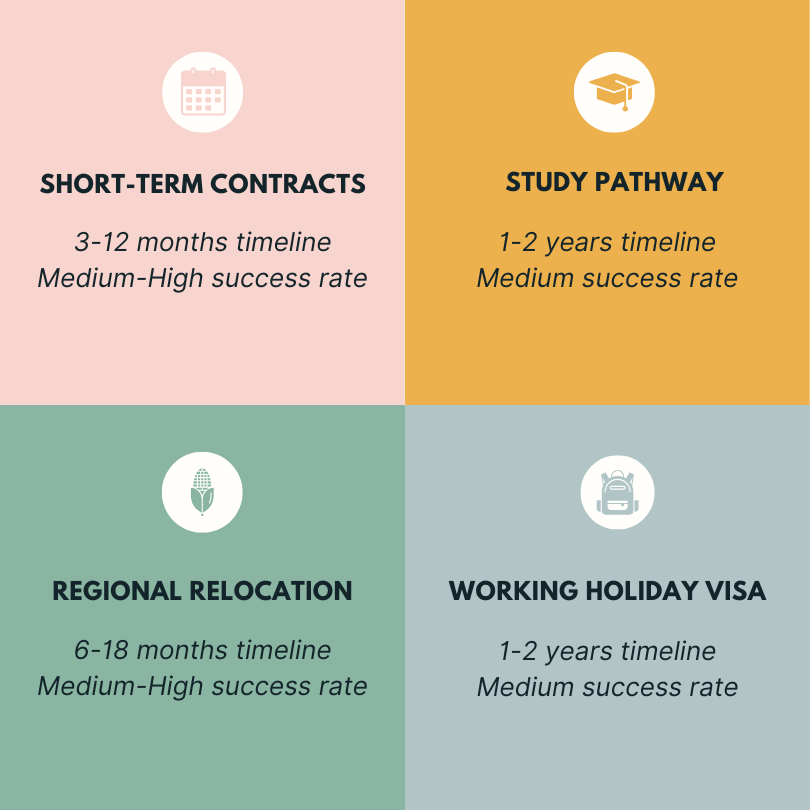
4 Alternative Sponsorship Pathways: Success Rates
| Approach | Timeline | Success Rate | Key Points |
| Short-term contracts | 3-12 months | Medium-High | Shows value to employer directly |
| Australian qualifications | 1-2 years | Medium | Provides local credentials |
| Regional relocation | 6-18 months | Medium-High | Less competition, lifestyle adjustment |
| Working holiday visa | 1-2 years | Medium | Age restrictions apply |
Contract Work as a Path to Australian Sponsorship
- Consider contract or temporary roles with potential sponsors
- Use the opportunity to demonstrate your value firsthand
- Build internal advocates for your sponsorship
- Transition to sponsored positions once you've proven yourself
This approach works particularly well in project-based industries like IT, construction, and consulting. Understanding what employers must do to sponsor foreign workers helps you position temporary work as a low-risk path to eventual sponsorship. Employers can see your skills in action before committing to the sponsorship process.
Study in Australia to Gain Sponsorship Opportunities
Studying in Australia can create sponsorship opportunities:
- Post-study work rights allow you to work while seeking sponsorship
- Build local networks, experience, and references
- Australian qualifications are immediately recognized by employers
- May lead to additional points for how to transition from 482 visa to permanent residency
💰 Note: Educational costs mentioned are estimates as of May 2025. Fees vary by institution and program. This information is provided for general guidance only and is not intended as financial advice.
Most programs are 1-2 years for a master's degree (shorter than many US programs) and tuition ranges from AUD $20,000-$45,000 per year (approximately USD $13,000-$30,000). The key advantage is gaining time on the ground in Australia to build connections and find employer sponsors.
Patience and Persistence in Your Sponsor Search
Finding a sponsor typically takes 3-9 months of consistent effort, so patience and persistence are key. The strategies I've outlined should at least get you started, but remember this isn't just about finding any company willing to sponsor you. It's about finding the right sponsor that aligns with your career goals.
Your chances of success increase dramatically when you focus on industries with documented skills shortages and target companies with a history of sponsorship.
Official Government Resources
- Department of Home Affairs – Skills in Demand Visa: Official immigration and visa information including eligibility requirements, application processes, and updates.
- Skills Priority List: Official information on skills shortages in Australia, regularly updated with demand levels by occupation.
- Fair Work Ombudsman: Information on work rights, employment standards, and legal entitlements for workers in Australia.
- Australian Skilled Occupation Lists: Comprehensive lists of occupations eligible for various skilled visa programs.
- Regional Australia Institute Job Vacancy Map: Tool for identifying regional skills shortages and employment opportunities outside major cities.
Job Search Platforms
- Seek Australia: Australia's largest job board with specific filters for sponsorship-friendly positions.
- Indeed Australia: International job platform with Australian sponsorship opportunities.
- LinkedIn Jobs Australia: Professional networking combined with job listings, allowing for relationship-building.
- Working In Australia: Platform specialized in international placements and sponsorship opportunities.
- Jora Australia: Job aggregator that includes sponsorship-friendly listings from multiple sources.
Recruitment Agencies with Sponsorship Experience
- IT & Technology: Robert Half Technology, Hays IT, Talent International
- Healthcare: Medacs Healthcare, Healthcare Australia
- Engineering: Engineering People, Technical Resources
- Finance: Robert Walters, Michael Page Finance
- Education: anzuk Education, Smart Teachers
- General/Multiple: Indeed Prime, Adecco, Randstad
Community Support Groups
- Americans in Australia Facebook Group: Peer support and networking community for Americans in Australia or planning to relocate.
- Aussie Expat Network: Support organization for those relocating to Australia with regular online events and resources.
- Expat Exchange Australia: Comprehensive forum and information hub for expatriates in Australia.
- InterNations Sydney: Global expat community with active Sydney chapter hosting regular events and networking opportunities.
- Sydney Expat Connection: Local Meetup group providing support and networking for new arrivals in Sydney.
Professional Development Resources
State-specific skilled migration programs: Information on regional and state nomination opportunities for skilled migrants.
Australian Professional Standards by Industry: Official skills standards and qualifications recognition information.
Credential Recognition Information: Resources on how international qualifications transfer to the Australian system.
Professional Year Programs: Information on bridging programs for international graduates in accounting, IT, and engineering.
Skills Assessment Authorities: Guide to organizations that evaluate overseas qualifications for Australian equivalency.
- Department of Home Affairs. (2026, July 1). Salary requirements to nominate a worker. Retrieved from https://immi.homeaffairs.gov.au/visas/employing-and-sponsoring-someone/sponsoring-workers/nominating-a-position/salary-requirements ↩︎
- Department of Home Affairs. (2026, July 1). Salary requirements to nominate a worker. Retrieved from https://immi.homeaffairs.gov.au/visas/employing-and-sponsoring-someone/sponsoring-workers/nominating-a-position/salary-requirements ↩︎