
Finding a Preschool in Sydney
Finding a preschool in Sydney is not going to be easy. The competition is high and the waitlists are long. Some are years long. And yes, there is a waitlist fee, usually between $50 – $75.
For someone just moving to Sydney, you’re going to want to start your search for a preschool now, before you arrive in Sydney.
But how the heck do you do that?
First things first, you need to decide on a location. Do you want a preschool that is close to where you’re going to live or close to where you are going to work?
Some Sydney preschools are located in the same building as a primary school. These preschools give priority to children that will be attending kindergarten the following year. They are part of a larger school system and can be private or public.
Public preschools that are located on the same grounds as the primary school, give priority to children that live in that school’s catchment zone, or school zones as we say in the States.
If you have narrowed down what suburbs in Sydney you’re thinking of living in and are interested in one of these preschools, then start your search in those suburbs.
Private schools don’t follow the same catchment zone system but will be more difficult to get into. If you’re interested in private schools then I would suggest you consider faith-based schools such as Catholic schools. Now Catholic schools don’t follow catchment zones but the parish will insist that you live within their postcodes.
Preschool Search Sites: Care For Kids and MyChild
There are two sites I recommend using to for your search: Care For Kids and StartingBlocks.gov.au. Use both sites as they list different preschool in the city and have different features.
Care For Kids provides links to each preschool website, a contact form to reach the preschool directly from the search results and the average price per day, not just for the individual preschool, but for the suburb or area.
Below is a search I did for preschools in Crows Nest.
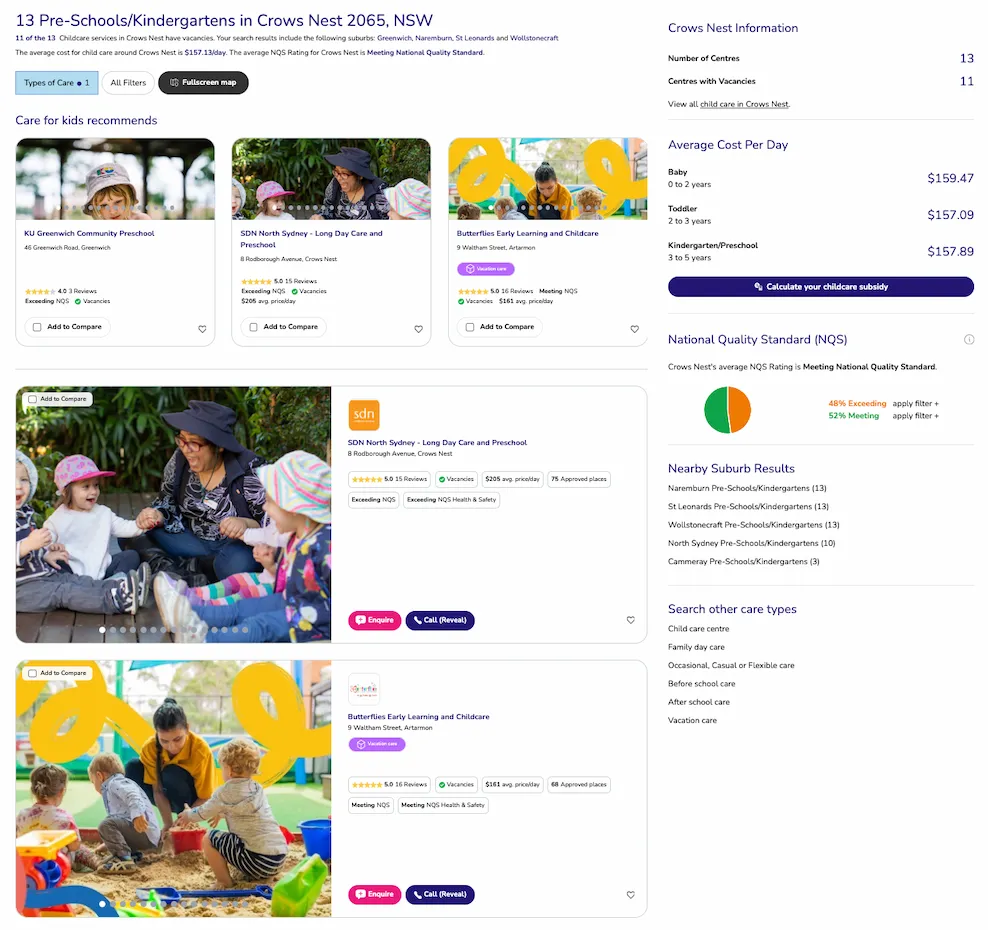
One thing to note when you do a search using Care for Kids is you'll need to know the specific area or suburb. The search results will show you other nearby areas too with links to those suburbs. See the fine print at the top of the page saying the search results include the following suburbs: Greenwich, Naremburn, St Leonard's and Wollstonecraft?
Also note the total number is does not represent preschools with vacancies. To limit the search results to only preschools with vacancies, click on the “All Filters” button at the top of the search results.
The main difference between Care for Kids and StartingBlocks.gov.au is the reviews. The reviews on the Care for Kids listings are mostly imported from Google Reviews, but still nice to have all the information in one place.
StartingBlocks.gov.au doesn't have reviews. This is because it isn't a private company, it's a government run website. This means the search results are not influenced by a preschool paying to be at the top of the page.
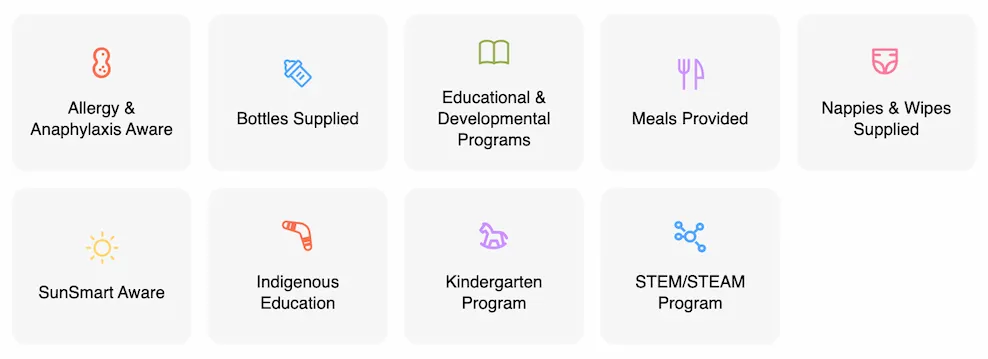
Care for Kids does have more information when the preschool provides it. When you click one of the preschools from the search results, you'll be taken to a page that includes a write up about the preschool plus lists the services provided such as meals, nappies, or kindergarten program.
I did the same search for preschools in Crows Nest on StartingBlocks.gov.au. Those search results are below.
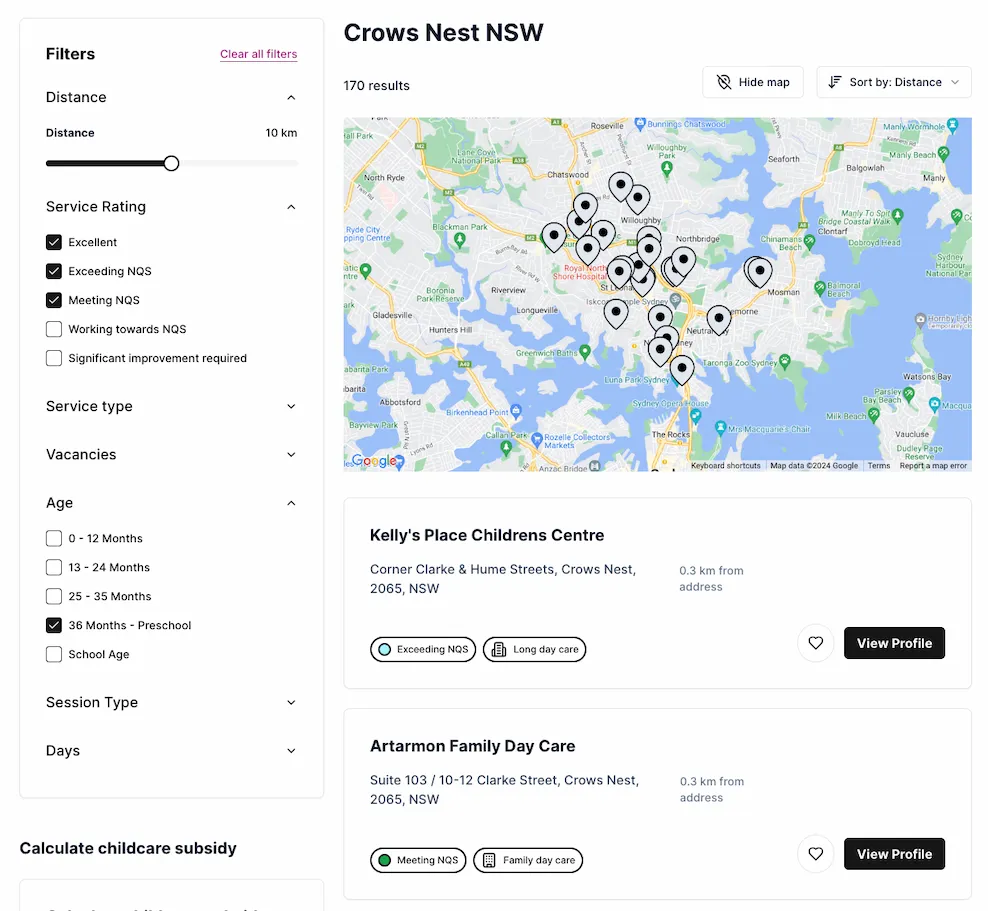
As you can see the search results for StartingBlocks.com.au cover a larger area, in fact you can set the search up to a 100 km area. Why anyone would want to do that, I'm not sure. It is nice to see a broader view especially if you're not sure where you're going to live in yet.
In the search sidebar, you can easily select the preschool quality rating. I'll explain that more below. Ideally, you want “Meeting NQS” or higher.
Below the map view you'll see a list view with a button linking to the preschool's full profile. The StartingBlocks.gov.au profile for each preschool is pretty basic compared to the Care for Kids profile, but it still has all the information you'll need primarily the link to the preschool website and an email address to contact them directly.
Scrolling down past the service quality ratings for the preschool, you'll see the vacancy and fees.
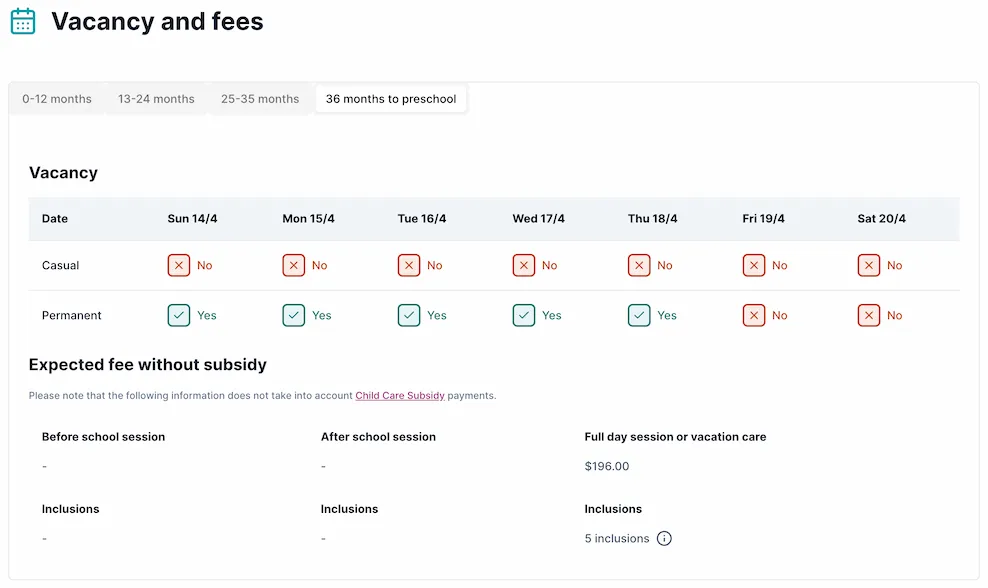
Yes, that is $196 per day. I did notice that both sites list different prices for this specific preschool. I would go straight to the preschool website and look on at the fees they have listed.
Hopefully you still have several months before your arrival in Sydney. If this is the case then go ahead and contact all the preschools that show up in both search sites, with or without vacancies, and ask about space available around the time you’re arriving in Sydney. Then get your name on that precious waitlist asap for the preschool you prefer.
If you’re cutting it closer to your arrival day, then you might want to stick to preschools that currently have space available. Of course, it all depends on your timeframe.
Preschools usually have a few openings when older kids head off to primary school in late January or February.
Quick Note About Waitlists for Sydney Preschools.
Be aware that they might not let you on the waitlist until you are actually present in Sydney. If you get that response then just move on to the next preschool, especially if you’re arriving in Sydney sooner rather than later. Remember, getting on a waitlist is not free so don’t go too crazy (usually the fee is between $50 – $75).
Here's an example of a preschool fee fine print.

Age of Children Going to Preschools in Sydney
Preschool is the year before kindergarten.
Certain preschools exclusively admit children who meet the criteria for starting kindergarten the following year, at the age of 5. Typically, these preschools are situated within the premises of the primary school.
There are a few preschools that accept three-year-olds, but require the children be toilet trained before they will accept them.
Preschool is not a requirement.
In fact, the NSW legislation does not require your child to be in school until they have turned six on or before the cut-off date of July 31st.
From 6 to 15 years old, the NSW legislation requires students to be enrolled in school and to attend school on each day that instruction is provided. It doesn’t matter if it’s public, private or registered homeschooling.
I’m mentioning this in case you are unable to enroll your child in a preschool. In that case, switch to searching for a daycare center, also not easy to do, but you might have better luck.
Benefits to Preschool
There are benefits to having your child in preschool for that year before primary school especially if you are relocating to Sydney.
Preschool will give your children a chance to make friends before going into primary school. The sooner they can make friends the less they will feel like an outsider. They will also have an easier time acclimating to going to school in general. Enrolling your child in a preschool that is located on the same grounds as the primary school they will be going to makes that transition even easier.
The days are action-packed at preschool with activities that your little ones might not be used to, for example, morning tea and afternoon tea. We don’t have either of those in the States but both are part of a full day at preschool. The kids don’t have tea of course but it’s more of a snack break. Both morning tea and afternoon tea are very much part of Australian culture.
For those of you from the States, morning tea is a very real thing. At my work, it is impossible to schedule a meeting at 10:30 am because everyone will be at morning tea for about 30 minutes.
Don’t fight it just join them. Afternoon tea is usually more for things like birthday parties, company announcements, or an early start to Friday drinks.
Preschool isn’t just for socializing. Children start learning the very basics so that they will be more up to speed for kindergarten. For some children, it will mean learning new things and for others, it will be more putting to use what they already know. In this way, preschool helps to ensure that children are close to the same level going into kindergarten.
Preschools in Sydney follow the Early Years Learning Framework where children learn through play. They learn through puzzles, play blocks, reading and listening to stories, and sometimes even computer games. The Early Years Learning Framework has a focus on successful transition to formal schooling.
Hours of Operation
Hours vary from preschool to preschool. Some have normal school hours, 9 – 3 pm, others have long extended hours, 7 – 6 pm.
There are a few others that are morning or afternoon sessions instead of full days. In general, preschools that are only half-day sessions prefer that children attend either five mornings or five afternoons per week.
The preschools that have normal and extended hours usually ask that children attend more than one consecutive day a week. You can of course schedule your child to attend more than two days a week, depending on space available and of course your schedule. Most full-day preschools are two, three, or five days per week.
Majority of preschools in Sydney follow the same school dates as primary and secondary schools. Same school and public holidays too. You’ll need to plan ahead for those holidays and organize alternative childcare.
You might have noticed that the Care For Kids had an option for childcare and holiday care. The Sydney Nannies, Au Pairs, Babysitters & Family Helpers and American Moms in Sydney Facebook Groups are great for babysitting recommendations. And preschool recommendations.
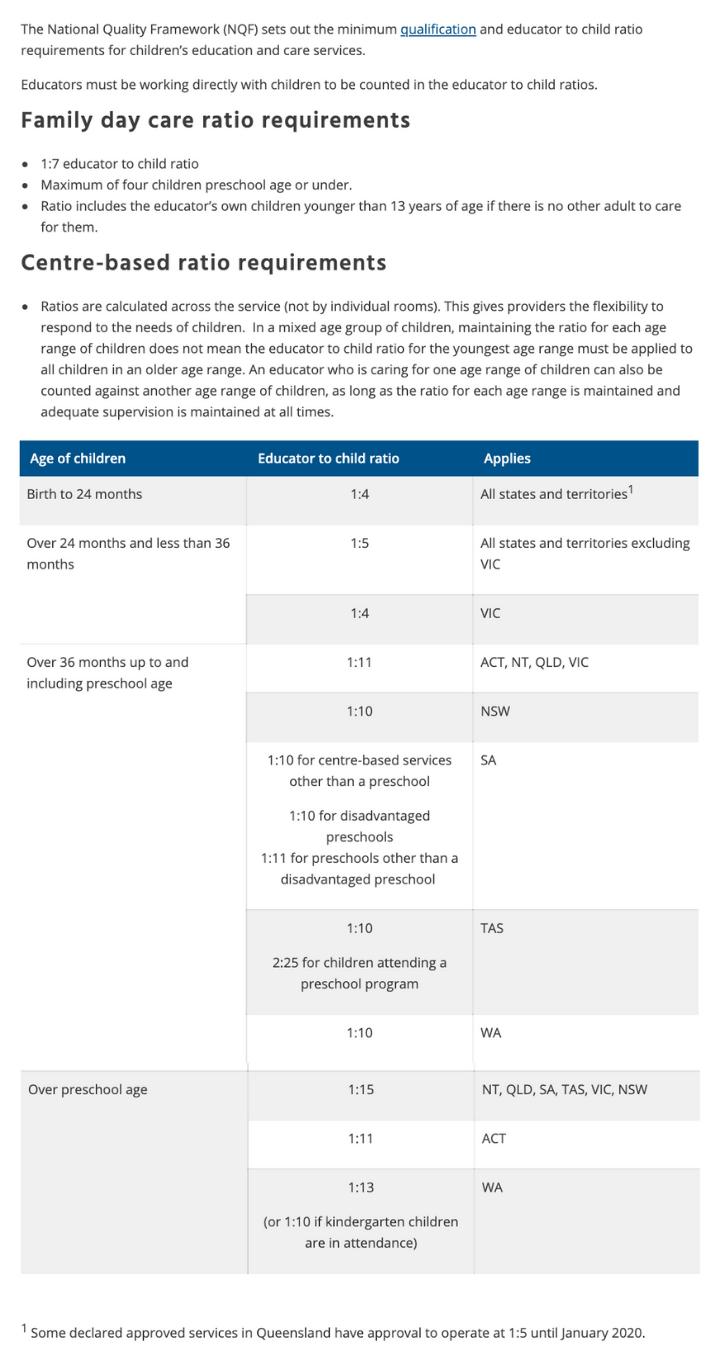
Staffing Levels for Preschools
The minimum staffing levels of preschools and daycare is set by the National Regulation. Of course, there are preschools that have a high ratio of staff per child.
Costs and Fees
Preschools in Sydney cost about the same as regular child care, about $150 – $200 a day depending hours of operation. Yes, really. I know. It's hella expensive. That is the cost before any child care subsidy.
The preschool will ask you to sign a register at the beginning and end of each day or session as a way to keep track of who is attending and who is not. Please ensure you sign this register, which is generally found at the preschool entrance. Not signing out can result in an extra charge. Depends on the preschool, but most are very strict.
Oh, and don't be late. Heaven forbid, you're late to pick up. Late fees start to add up quick.
If you have a permanent residence visa and at a lower family income bracket, you might be eligible for financial assistance. Temporary visa holders, like the TSS Visa (482 subclass), are not eligible for any assistance.
Preschool Enrollment
To enroll in a public preschool you will need the following documents: Birth Certificate, Passport if you have a temporary visa or a permanent residence visa, your current visa and previous visas if applicable, proof of residency this can be a copy of your lease or electric bill, and your child’s immunization history statement.
For private schools you will need pretty much the same documentation plus a few extras. For example, for a Catholic private preschool, they will ask for a Baptism certificate. Does your child have to be Catholic to go to a Catholic preschool? No, but priority will be given to children who are baptized and live within the parish zone.
Preschool Assessment and Rating Process
The assessment and rating process is the same for all early childhood education and care services (long daycare, family daycare, preschool/kindergarten, outside school hours care) throughout Australia.
I'm going to do my best to briefly cover it here. If you need more information go to Australian Children’s Education & Care Quality Authority.
Early childhood education and care services are assessed and rated against the National Quality Standard (NQS). The NQS comprises seven quality areas that are essential for children's learning and developmental outcomes. These areas include educational program and practice, children's health and safety, physical environment, staffing arrangements, relationships with children, collaborative partnerships with families and communities, and governance and leadership.
Each child care center receives one of five ratings based on their performance against the NQS. These ratings range from Exceeding NQS (demonstrating exceptional education and care) to Significant Improvement Required (indicating identified risks to the safety and wellbeing of children).
Getting Your Child Ready for Preschool
After you have settled on a preschool and your application has been accepted, it’s time to get your child ready for attending preschool.
Talk to the preschool teachers.
Ask for any info you need to know such as what foods are acceptable for snacks.
For example, it is very common for preschools to have no nuts policies. Preschools often have a few pamphlets to hand out to parents. This is also a good time to alert the preschool if your child has allergies.
Encourage your preschooler to be excited about attending preschool.
Start talking about how much fun preschool is going to be and all the new friends they are going to make. Tell them stories about when you went to preschool if you can remember any.
If it’s possible, visit the preschool before the first day to have a look and meet the teachers. Preschools often have orientation days for both parents and students. This is a good time for you to network with other parents. Find out if anyone lives close to you and set up a playdate. I know it’s awkward but other parents are a great resource and it will help your kiddo settle into preschool if they already have a friend.
Sidestep any growing pains your child might have.
- Preschools often require the children have a packed lunch. Show your child how to unwrap packaged food that might part of their lunch or snacks for morning and afternoon tea. The same goes for opening up the lunch box or bottled water and other drinks. I know that sounds silly but you’d be surprised how often lunch is not eaten because of not being able to open a lunch box.
- Though uniforms are not mandatory, preschools have a “No Hat, No Play” policy meaning your child will not be allowed outside unless they are wearing a hat. Preschools are very strict about this policy, as are primary and secondary schools. Getting your preschooler use to wearing a hat outdoors is a good idea and will help to sidestep any future drama.
- If your preschool does require a uniform (not completely out of the ordinary as it is normal in Australia for primary and secondary schools regardless if it is a private or public school) you might want to get your child use to the idea of wearing a uniform.
- Also, be sure to clearly label everything your child brings to preschool with them.
- You can also help boost your child’s confidence and feeling of independence by encouraging them to practice personal hygiene on their own like going to the toilette by themselves, washing their hands afterward or wiping their own little runny noses, etc. Several preschools suggest parents dress their children in clothing that is easy to manage with any adult supervision.
- As a new resident of Sydney, practicing your new address and phone numbers for both parents phones with your children is a good idea too.
Resources Mentioned in This Post
Care For Kids
Starting Blocks
Enrolment Form for NSW Government Preschools
Australian Children’s Education & Care Quality Authority