
Your Resume Is the First Impression a Potential Employer Has of You.
This is why it’s so important to make sure your resume is optimized because there are no second impressions given if your resume is not the best fit for the job. This is especially true when it comes to finding a job in Australia that offers visa sponsorship.
Your resume has to leave the hiring manager wanting to talk with you directly to find out more about you and your work experience. It is your job lead magnet.
Even if a company states in the job listing that they are accepting international applicants the truth is they will always go with someone that is located in Australia first.
This means being the “better” candidate isn’t good enough.
Sorry, if that sounds harsh but it’s better you know this before you start your job search for sponsorship for Australia.
Make sure you have done your research and have a strategy for finding job sponsorship.
I highly recommend you read my previous post on tips for finding a job to sponsor your visa. And be sure you have done a visa assessment with a registered migration agent before you even start applying.
You Need to Be a Perfect Match When Applying for Australian Job Sponsorship.
When it comes to applying for Australian job sponsorship, it is crucial to be a perfect match for the position. But how can you convince the hiring manager or recruiter that you are the ideal candidate? It starts with your resume.
Your Resume Needs to Perfectly Match the Specific Job Description.
To increase your chances of getting hired, it’s crucial to make sure that your resume perfectly aligns with the specific job description. This means customizing and refining your resume for each individual job application.
List the Required Skills From the Job Description on Your Resume.
Yes, this means using their exact wording in the job description.
Do NOT copying and pasting the job description to your resume.
For example, if the description says something like “must be a team leader” then on your resume needs to state something such as “Managerial Skills: Team leader for awesome project A”. Then describe Project A and why it was important to the company.
Alright, so not the best example, but you get the idea.
Incorporate the job description wording into your resume either in your Career Summary or Key Skills section.
List All Relevant Studies and Certifications.
I’m including this because it was one that actually throws me for a loop but, after I gave it some thought, it was totally obvious.
First off, list your education in Australian terms.
What do I mean by this?
Ok, here’s an example.
I have a Bachelor of Science (BSc) in Neurobiology from the University of Washington.
When I started applying for Research Assistant positions in Sydney I noticed that they all stated that the position required a BSc in the relevant field of study with honors .
When I read that I thought they meant that only BSc graduates that graduated at the top of their class would be considered. But when I started to notice that all Research Assistant positions from Level 1 to Level 6 had the same requirement, I figured that I was missing something essential.
In Australia, a Bachelor’s Degree is usually a three-year degree. The “with honors” refers to one year in a research program after completing the three-year Bachelor’s Degree.
My four-year degree from UW was the equivalent to a Bachelor of Science with honors in Australia.
That might seem minor, but when the hiring manager or recruiter is going through a stack of resumes, they are only skimming to see if that resume ticks all boxes.
At a glance, I didn’t have my educational requirement box ticked for the positions I was applying for.
Once I changed my resume to state that I had a BSc with honors, I started getting calls for interviews.
Here is a Wikipedia page about what honours means for different countries for those of you not from the US.
Spell out acronyms when listing certifications.
In 2007, I took an intensive course called Introduction to Immunology given by the American Association of Immunologists at the University of Pennsylvania.
On the first resume, I sent out I had listed this course as AAI Introduction to Immunology at the University of Pennsylvania.
Can you see what I did wrong there?
The hiring manager reading my resume probably has no idea what AAI is.
If you have any professional certificates or have taken any type of course for work, don’t assume they are familiar with the institution. Spell it all out to be as clear as possible.
List All Relevant Work Experience.
Be sure to address any gaps in work experience.
If you have taken time away from work to start a family, take care of an ill family member, or travel the world be sure to state it on your resume.
Don’t list every single job you have ever had. There is no need to go that far back in your work history. Keep it to what is relevant to the position you’re interested in.
Pay Attention to the Layout and Format of Your Resume.
Your resume needs to be understood at a glance.
Remember that the hiring manager may have a stack of 100 resumes to get through, if not more since they are recruiting internationally.
Make it as easy as possible for them to get all the necessary information they need to know about you from the first page of your resume. The truth is they may never get to your second page unless they see your qualifications for the job on the first page.
Get right to the point. Don’t get too wordy.
Use bullet points and make sure you pick a font that is easy on the eyes.
No fancy fonts. Not even Times New Roman.
Go with Helvetica or Arial or some equivalent font. Make the font size larger rather than smaller.
Many make the font size too small in order to fit more into that first page. It’s ok to have a resume that is several pages as long as all the information is relevant to the position.
Do Not Use U.S. Letter Document Format.
Australia uses A4 document format.
This will make a difference to your layout when your resume is printed out and it also looks odd online to a recruiter in Australia.
Be Sure to Change MS Word or Apple’s Pages to Australian English.
I have a Macbook and it’s a little tricky changing the settings to Australian English because it’s actually located in the System Preferences. Here’s a screenshot of where you’ll find it under Keyboard and Text.
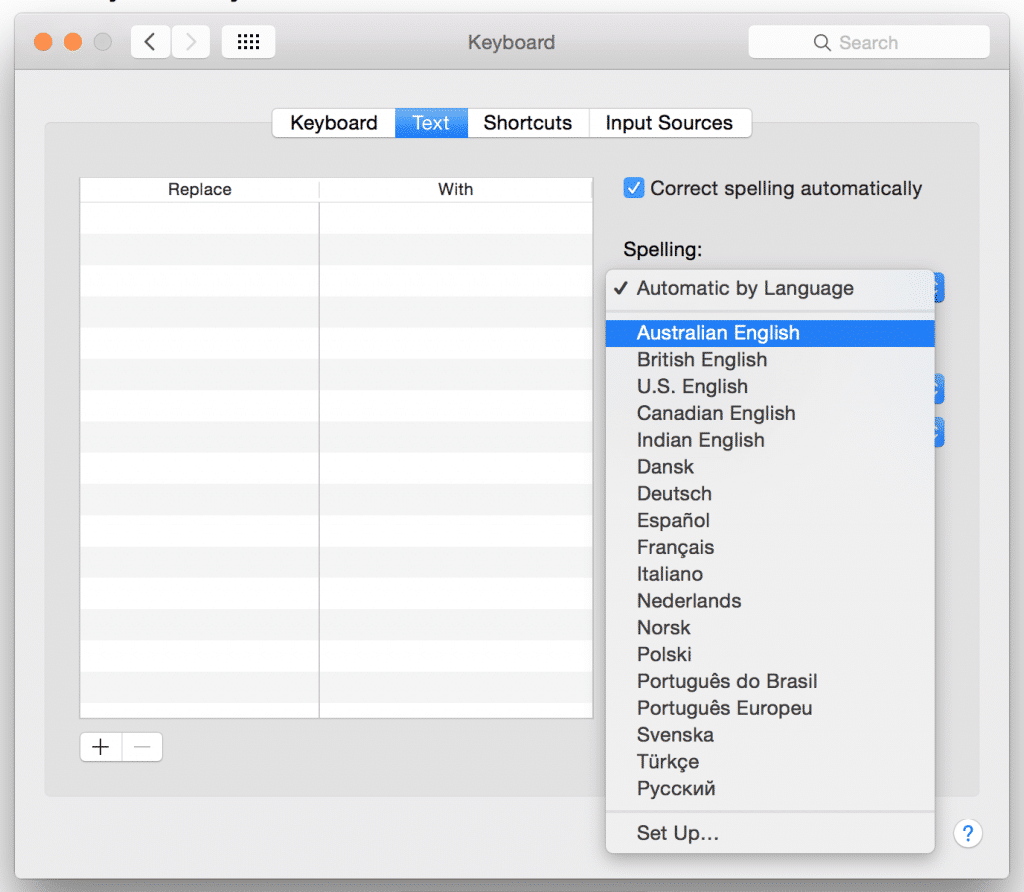
Once you have changed your settings to Australian English, you’ll start to notice just how many differences there are between American English and Australian English.
Be aware that the differences are not limited to just spelling.
There are some significant grammatical differences too. If the auto-correct pops up with a grammar mistake and you’re not sure then Google it.
Remember, the hiring manager is only going to glance at your resume. Misspelled words or mistakes in grammar can make a difference.
Do Not Include Personal Information on Your Resume.
The only personal information that should be included in your resume is your name, phone number, and email.
That’s it. No mailing address.
Keep your email address to your name if possible or first and middle initials with your last name.
No silly email address like coffeelover@gmail.com or even johnsmith1995@gmail.com.
This is hard to do sometimes as email addresses for common names are often all taken. Then try different combinations like smithjohnmicheal@gmail.com or smith.john@gmail.com or maybe johnsmithdeveloper@gmail.com.
Do Not Include Your Photo on Your Resume.
Not sure when or why this fab started, but don’t do it.
Lastly, Do Not Beg for Sponsorship.
In fact, don’t even mention that you are looking for sponsorship on your resume.
Why?
Because you want to show them that you are the one and only candidate for the position and that it is worth their while to sponsor your visa.
Also, do not apply for every single available job listed in Australia in your industry. This gives the hiring managers or recruiter a very bad impression. It makes it seem like you are not sure of your qualifications.
Instead, apply for positions where the employer is willing to consider visa sponsorship for the right applicant.
Optimizing Your Resume for Australian Job Sponsorship Is Just One Piece of the Puzzle.
Yes, it’s an important piece and you definitely need to do it, but it’s only one piece.
What are the other pieces? Well, you still have to interview for the position. You still have to apply for the visa. Even with sponsorship, that takes time. And you still have to pack up and move.
Ask yourself, how quickly could I move to Sydney if I got the job?
To give you an idea. My husband was hired end of November. We arrived in Sydney, end of February.
The hiring company actually wanted us to arrive sooner. Like most companies and recruiters, they want to fill a position asap. How soon you can start will be a factor when deciding between you and another candidate.
I have another post that covers tips for finding an Australian job that offers visa sponsorship that I highly recommend you read.